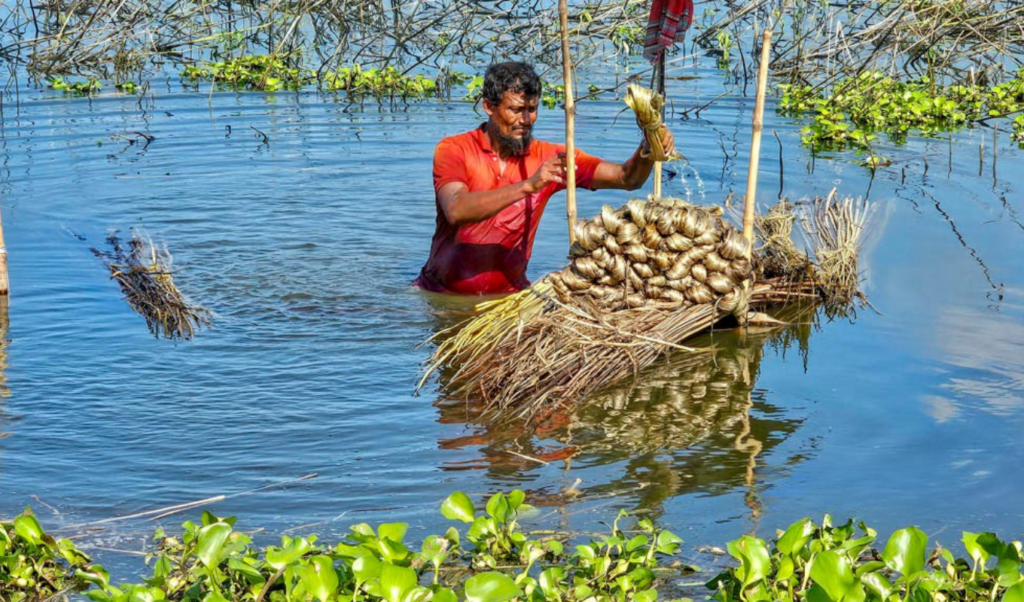
The early morning in the Makrashon area of Tarash upazila, Sirajganj, sees a rush of activity as locals begin collecting snails from Chalan Beel. What has developed here is a bustling snail wholesale market, where daily buying and selling now pose a grave threat to the wetland’s biodiversity.
Throughout the night, traders from Tarash in Sirajganj and Singra and Gurudaspur in Natore use specialised nets to gather snails. By dawn, sacks filled with snails are loaded onto boats and shipped across the country. The demand is particularly high for fish enclosures and duck farms, making snail harvesting a profitable trade.
According to local reports, 20–25 wholesale markets (ārats) are currently active. Each market sees the trade of 1.5–2 tonnes of snails daily. Around 500 boats operate in Tarash upazila and its neighbouring areas — including Kamārshon, Dighi Saguna, Kundal Makrashon, Mannannagar, Ghargram, and Magura Binod — harvesting snails and mussels every day.
Some traders even supply boats and nets to collectors, resulting in a multimillion-taka trade annually.
| Details of Snail Harvesting & Trade | Figures / Estimates |
| Active wholesale markets (ārats) | 20–25 |
| Daily volume traded per market | 1.5–2 tonnes |
| Boats engaged in harvesting | ~500 |
| Snails collected per boat | 25–30 sacks |
| Sale price per boatload | Tk 3,000–3,500 |
| Fuel & operational costs per boat | Tk 900–1,100 |
| Annual turnover | Several crore taka |
Each boat usually involves 4–5 people, jointly collecting 25–30 sacks of snails. These are then sold at around Tk 3,000–3,500 per boatload, leaving net earnings after fuel and other costs. Farmers often participate in this trade during the monsoon season when farming halts, as a way of sustaining their livelihoods.
Trader Kamal explained that snails are bought locally and then supplied to fish farms in Khulna and the southern regions of Bangladesh, with the business thriving mainly during the three to four months of monsoon.
Local residents complain that snail and mussel harvesting has been going on for 7–8 years, with little oversight from the authorities. Environmentalists warn that Chalan Beel’s natural balance is under severe threat, as snails and mussels are essential to maintaining ecological health.
- Professor Abdullah Al Mahmud, Head of Zoology at Sirajganj Government College, stated that small-scale harvesting may not be harmful if natural reproduction is high. However, excessive collection disrupts the natural filtration system of water, leading to ecosystem damage and reduced biodiversity.
- Specialists emphasise that snails not only serve as fish feed but also consume micro-organisms in water, keeping wetlands clean. Moreover, they contribute to soil fertility, a vital element for sustaining agriculture around Chalan Beel.
Without them, water pollution will increase, fish stocks will decline, and soil fertility will deteriorate, threatening the entire wetland system.
Administrative Response
- Nusrat Jahan, Upazila Nirbahi Officer (UNO) of Tarash, noted that authorities are monitoring the sale of harvested snails and will take necessary legal actions where possible. She confirmed that several points of large-scale trading have already been identified.
- Mazharul Islam, UNO of Singra in Natore, said, “We will not allow snail harvesting anymore. Warnings have been issued, and as soon as harvesting begins, we will conduct mobile court drives.”