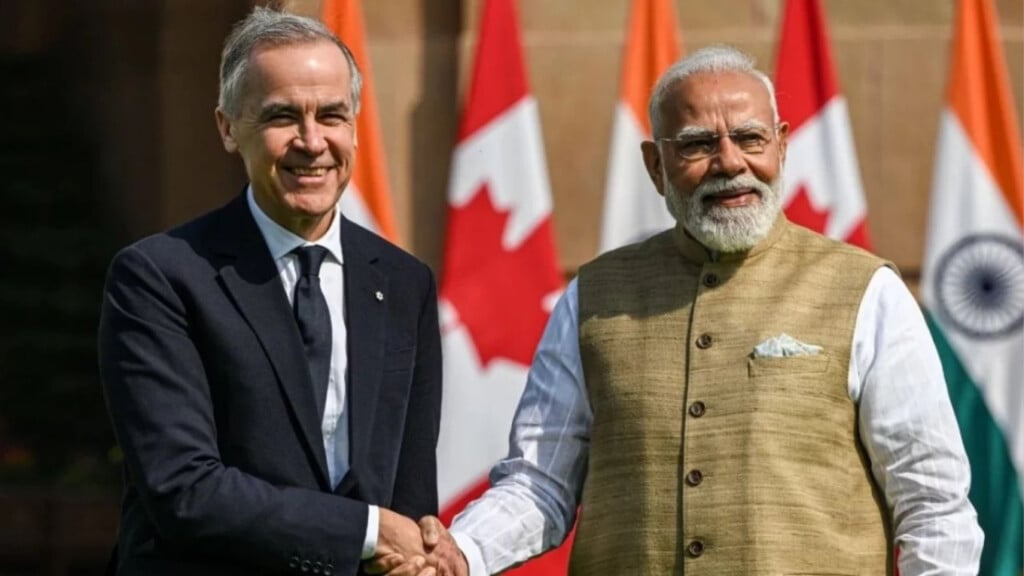
In a transformative shift for Indo-Canadian relations, Prime Minister Narendra Modi and his Canadian counterpart, Mark Carney, have formalised a sweeping ten-year nuclear fuel supply agreement. This diplomatic breakthrough, announced following high-level deliberations in Delhi, signals a strategic “thaw” after years of frostiness, positioning both nations to prioritise energy security and technological synergy over past grievances.
A New Chapter in Energy Cooperation
The centrepiece of the summit is a decade-long commitment for Canada—one of the world’s premier uranium producers—to supply India’s expanding civil nuclear sector. Prime Minister Modi described the deal as a “milestone” that would underpin India’s transition toward a low-carbon economy. Beyond raw materials, the partnership extends into the vanguard of nuclear engineering, with both nations pledging to co-develop Small Modular Reactors (SMRs) and advanced reactor technologies.
The collaboration is not limited to atoms. The leaders outlined a “Future-Ready Partnership” spanning several critical sectors:
Artificial Intelligence & Supercomputing: Joint ventures to enhance processing power and algorithmic research.
Semiconductors: Establishing a resilient supply chain to reduce dependence on single-source manufacturing.
Critical Minerals: Securing the lithium and cobalt necessary for the global electric vehicle (EV) revolution.
Economic Targets and Trade Diversification
A renewed sense of urgency now surrounds the Comprehensive Economic Partnership Agreement (CEPA). Prime Minister Carney indicated that the “ambitious” trade deal, which has been under negotiation for years, is now targeted for completion by the end of 2026. The objective is to elevate bilateral trade to a staggering $50 billion, a goal necessitated by shifting global trade dynamics and the need to hedge against protectionist tariff policies elsewhere.
| Sector | Nature of Agreement | Strategic Goal |
|---|---|---|
| Nuclear Energy | 10-Year Fuel Supply | Long-term Uranium security & SMR development |
| Trade | CEPA Framework | Increase bilateral trade to $50 billion by 2026 |
| Technology | AI & Semiconductors | Digital sovereignty and supply chain resilience |
| Space & Defence | Joint Research | Enhanced satellite tech and maritime security |
| Education | Academic Exchange | Streamlined visa processes for researchers |
Moving Beyond the Nijjar Dispute
The shadow of the 2023 diplomatic crisis—sparked by allegations regarding the death of Hardeep Singh Nijjar—appears to be receding. While the legal cases against four individuals remain sub judice, the Carney administration has adopted a pragmatic tone, stating they currently see no evidence of ongoing Indian involvement in domestic violence or threats on Canadian soil.
This rapprochement is a calculated move for both leaders. For India, Canada represents a vital source of energy and investment; for Canada, India is the lynchpin of a broader Indo-Pacific strategy aimed at diversifying trade away from traditional partners. Following his four-day visit, which included meetings with industrial titans in Mumbai, Mr Carney is scheduled to depart for Australia and Japan, further cementing Canada’s pivot toward Asian markets.