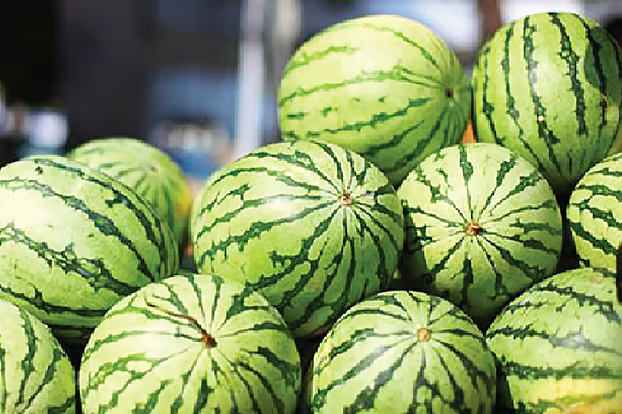
Watermelon remains one of the primary indigenous fruits of the summer season in Bangladesh. Driven by high temperatures and a surging demand for hydrating produce during the warmer months, both consumption and cultivation have seen a steady annual rise. Consequently, national production has nearly doubled within the span of just four years.
Production Trends and Statistical Overview
According to data released by the Department of Agricultural Extension (DAE), watermelon yields have experienced a significant upward trajectory. In the 2020-21 fiscal year, the country produced 1.789 million tonnes. By the 2024-25 fiscal year, this figure escalated to 3.552 million tonnes.
The following table outlines the year-on-year production growth as recorded by the DAE:
| Fiscal Year | Total Production (Million Tonnes) |
| 2020-21 | 1.789 |
| 2021-22 | 2.547 |
| 2022-23 | 3.636 |
| 2024-25 | 3.552 |
Officials from the DAE and industry stakeholders anticipate that production will continue to rise during the current 2025-26 fiscal year. This surplus in supply has contributed to a moderate reduction in retail prices compared to the previous year.
Market Dynamics and Pricing
The peak season for watermelon in Bangladesh spans March and April. Currently, the fruit is widely available, from major wholesale hubs to local neighbourhood vendors. Two weeks prior, prices in various Dhaka markets ranged between 30 and 35 BDT per kilogram, while at the Karwan Bazar wholesale market, rates were as low as 25 to 30 BDT per kilogram. As the season draws to a close, prices have adjusted slightly to between 45 and 50 BDT per kilogram.
Md. Abdullah Al Mahmud, an official from the Horticulture Wing of the DAE, noted that while high temperatures naturally drive demand, the sheer volume of production has ensured widespread availability, keeping prices competitive.
Concerns Regarding Quality and Taste
Despite the visual appeal of the produce, many consumers have expressed dissatisfaction regarding the flavour profile. Reports suggest that while the interiors appear vibrant red, the characteristic sweetness is often lacking. Consumers at Karwan Bazar, such as Md. Jahangir and Iqbal Hossain, noted that several purchases resulted in fruit that was either tasteless or prone to rapid spoilage.
Fruit specialists attribute this decline in quality to several factors:
-
Excessive Chemical Use: The over-application of fertilisers, pesticides, and growth hormones.
-
Premature Harvesting: The drive to bring produce to market quickly often results in fruits being harvested before they reach physiological maturity.
-
Increased Water Content: Md. Abdur Razzaq, Chief Scientific Officer at the Bangladesh Applied Nutrition Research and Training Institute (BARTAN), explained that attempts to artificially increase the size of the fruit can lead to higher water retention, which dilutes the natural sugars.
Regional Production Hubs and Profitability
The coastal regions of Bangladesh remain the heart of watermelon cultivation. The highest yields are recorded in Patuakhali, Bhola, Khulna, Bagerhat, and Barishal. Specifically, Bhola produced approximately 800,000 tonnes in the 2024-25 fiscal year, with cultivation expanding by an additional 4,000 hectares this season.
The financial incentive for farmers is substantial. For instance, in the Dakop Upazila of Khulna, cultivation costs are estimated at 30,000 to 35,000 BDT per bigha (approximately 0.33 acres). With a successful harvest, a farmer can sell the produce for 80,000 to 100,000 BDT per bigha, representing a significant return on investment. Late-season varieties, harvested after April 20th, often command even higher prices as market supply begins to dwindle.