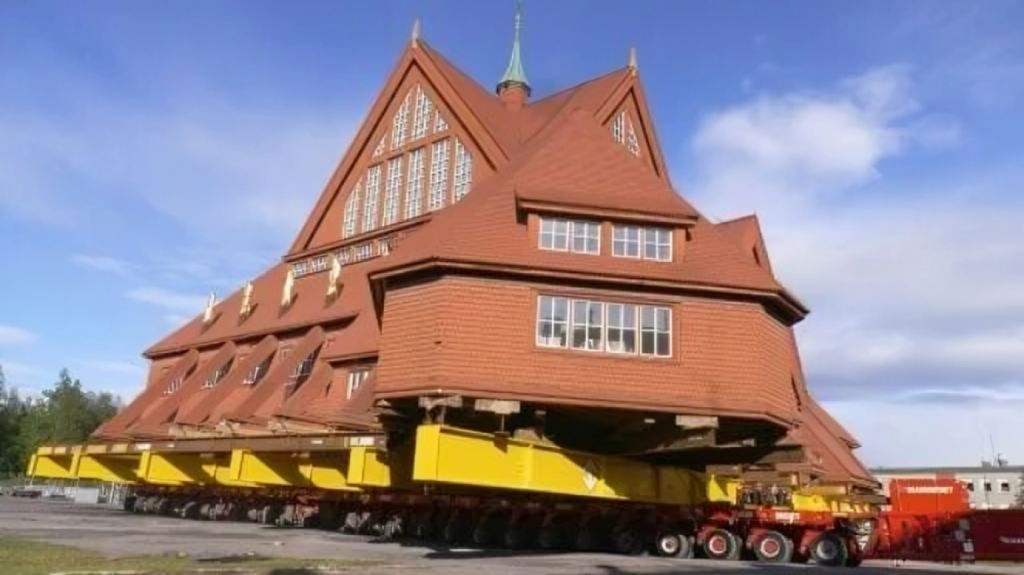
A historic red wooden church, widely regarded as one of Sweden’s most beautiful buildings, resumed its slow journey across the Arctic town of Kiruna on Wednesday, moving incrementally toward its new location to make way for Europe’s largest underground mine.
Kiruna’s entire town centre is being relocated because of the giant LKAB iron ore mine, whose ever-deepening operations have destabilised the ground, creating a risk of collapse in some areas.
Kiruna Kyrka, a Swedish Lutheran church built in 1912, weighs 672 tonnes and is being transported five kilometres (three miles) on remote-controlled flatbed trailers, advancing at a measured pace of half a kilometre per hour toward the new town site.
| Detail | Information |
| Church Name | Kiruna Kyrka |
| Weight | 672 tonnes |
| Height | 40 metres (131 feet) |
| Distance to New Location | 5 km (3 miles) |
| Speed | 0.5 km/hour |
| Architect | Gustaf Wickman |
| Cost of Relocation | 500 million kronor ($52 million) |
| Funding | LKAB |
| Move Completion Scheduled | Wednesday, ~2:00–3:00 pm (1200–1300 GMT) |
The 1,200-tonne convoy, including the church and moving platforms, has so far progressed smoothly. However, officials warned that the journey would slow on Wednesday due to narrow passages and 90-degree turns.
The move has attracted large crowds, with Swedish television broadcasting the entire journey live. King Carl XVI Gustaf was scheduled to join festivities, including an attempt to break the world record for the largest “kyrkkaffe” (church coffee gathering).
Designed by Gustaf Wickman, the church features:
- A neo-Gothic exterior with slanted roofs and windows on each side.
- A dark interior incorporating national romanticism.
- An Art Nouveau altarpiece and an organ with over 2,000 pipes.
- Pews inspired by Indigenous Sami designs.
Prior to the move, the handblown glass windows were removed and replaced with plywood painted to resemble windows. The belltower, which stands separately beside the church, is scheduled to be moved next week.
several more years. The new town centre was officially inaugurated in September 2022.
The church relocation alone is projected to cost 500 million kronor ($52 million), financed entirely by LKAB, reflecting the scale and complexity of the project.
This careful and gradual operation highlights not only Sweden’s engineering capabilities but also the country’s commitment to preserving its cultural and historical heritage even amid industrial expansion