Sunday, 5th April 2026

Khabor Wala Desk
Published: 5th October 2025, 8:46 AM
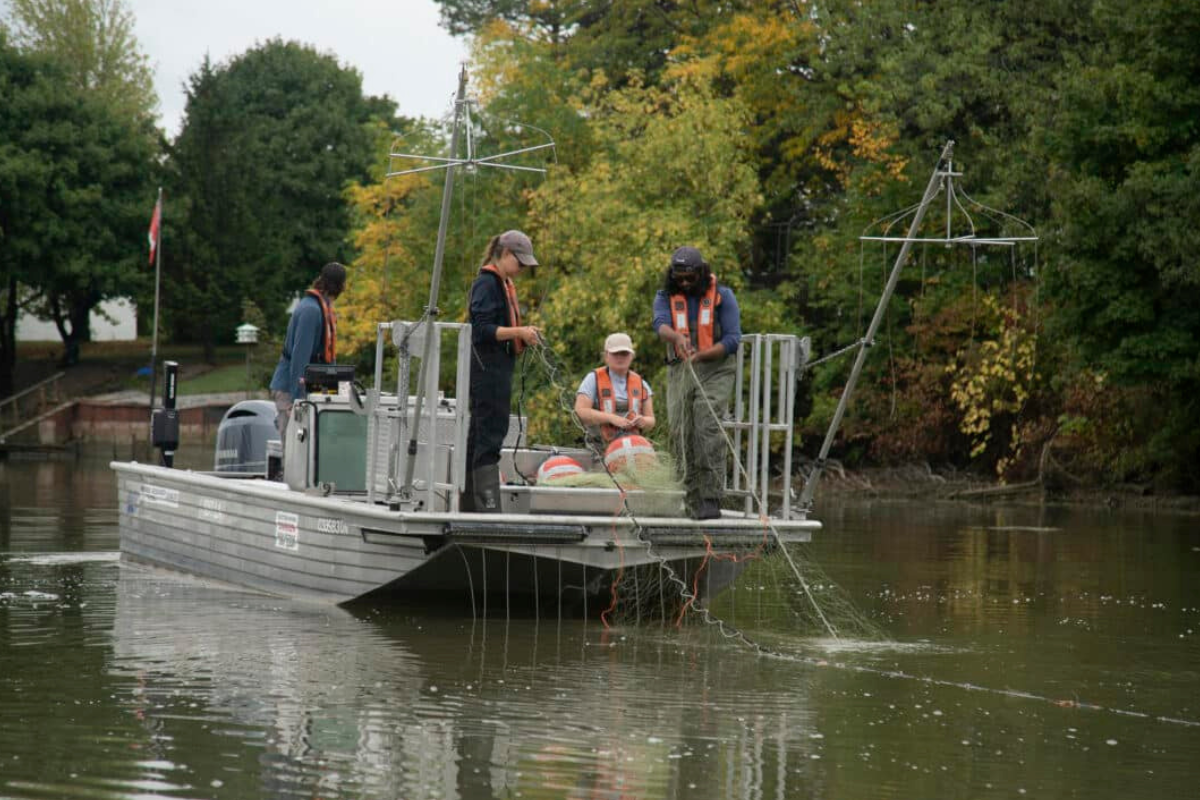
Finally, something that unites President Donald Trump, his Democratic rivals, and the Canadians he has jokingly threatened to annex: a ferociously hungry carp.
The invasive carp, often referred to as Asian carp, were first introduced in the United States during the 1970s. Since then, they have continued to spread relentlessly, consuming almost everything in their path.
“They’re eating machines,” said Trisiah Tugade, an aquatic biologist with Canada’s Invasive Carp Program, as she and her team patrolled the Grand River, a tributary of Lake Erie, in search of the fish that specialists fear could devastate the Great Lakes.
Capable of consuming up to 40 per cent of their bodyweight each day, invasive carp were originally introduced to control nuisance algae in confined environments such as aquaculture ponds. However, floods likely allowed them to escape, enabling their northward migration through rivers such as the Illinois River, raising fears of their establishment in the Great Lakes, the largest freshwater system in the world by surface area.
“There is nothing that I have seen that scares ecologists more than considering the potential impacts if the Asian carp species in the Illinois River establish a breeding population in the Great Lakes,” said Mike Shriberg, a University of Michigan expert in Great Lakes water policy.
This ecological threat has attracted the attention of Trump, who has labelled the fish as “a threat,” and specialists on both sides of the US-Canada border.
Canadian experts conduct annual searches for carp in tributaries of the Great Lakes deemed suitable for spawning and feeding, typically grassy areas with shallow, warmer water.
On the Grand River, Tugade and senior biologist Alex Price supervised an electrofishing mission.
The team submerged two electrodes that released non-lethal pulsating charges, temporarily stunning the fish and allowing them to be netted into a tank onboard.
Fish were then identified, measured, and released back into the river if they were not considered invasive.
Since the programme’s inception in 2012, only a few dozen invasive carp have been captured in Canadian waters.
James Hall, owner of Hall’emin Sport Fishing, recalled being one of the first to catch a carp in Lake Erie:
“I was wondering what it was, but I knew it was something different,” he told AFP, describing the moment he hauled the fish from the water a decade ago. Hall iced the fish and reported it to the government’s carp hotline.
“Invasive carp have been very rare to catch, which is great,” said Price, while stressing the need for vigilance given the magnitude of the threat.
“They can breed multiple times a year and produce hundreds of thousands of eggs in a single event. Within their first year, they can become too large for natural predators to consume,” he added.
Shriberg described the Great Lakes as a unifying force across US political parties and between Canada and the United States.
Defending the lakes against invasive species has historically been a bipartisan priority in the surrounding states, several of which are key US electoral swing states, including Michigan, Ohio, Pennsylvania, and Wisconsin.
Trump’s May White House memo confirming support for measures against “the economic and ecological threat of invasive carp” received praise across party lines.
“We’re in the most politically contentious times I’ve seen in my lifetime,” said Shriberg, describing Trump’s quiet memo as evidence of the rare bipartisan nature of Great Lakes policy.
Despite these efforts, the path forward remains uncertain, as experts continue to monitor and combat the spread of this voracious invasive species.
Key Facts About Invasive Carp
| Feature | Detail |
| Common name | Asian carp |
| Introduced | United States, 1970s |
| Habitat | Rivers and lakes in US and Canada, including Illinois River and Great Lakes tributaries |
| Feeding capacity | Up to 40% of bodyweight daily |
| Reproduction | Multiple breeding cycles per year, hundreds of thousands of eggs per event |
| Threat | Can disrupt ecosystems, outcompete native species, and damage local fisheries |
| Canadian monitoring | Electrofishing, identification, and capture programme since 2012 |
| Captured in Canada | Only a few dozen invasive individuals |
| Political attention | Bipartisan support from US and Canadian authorities, including Trump |

Comments