Sunday, 5th April 2026

Khabor Wala Desk
Published: 27th March 2026, 1:34 PM
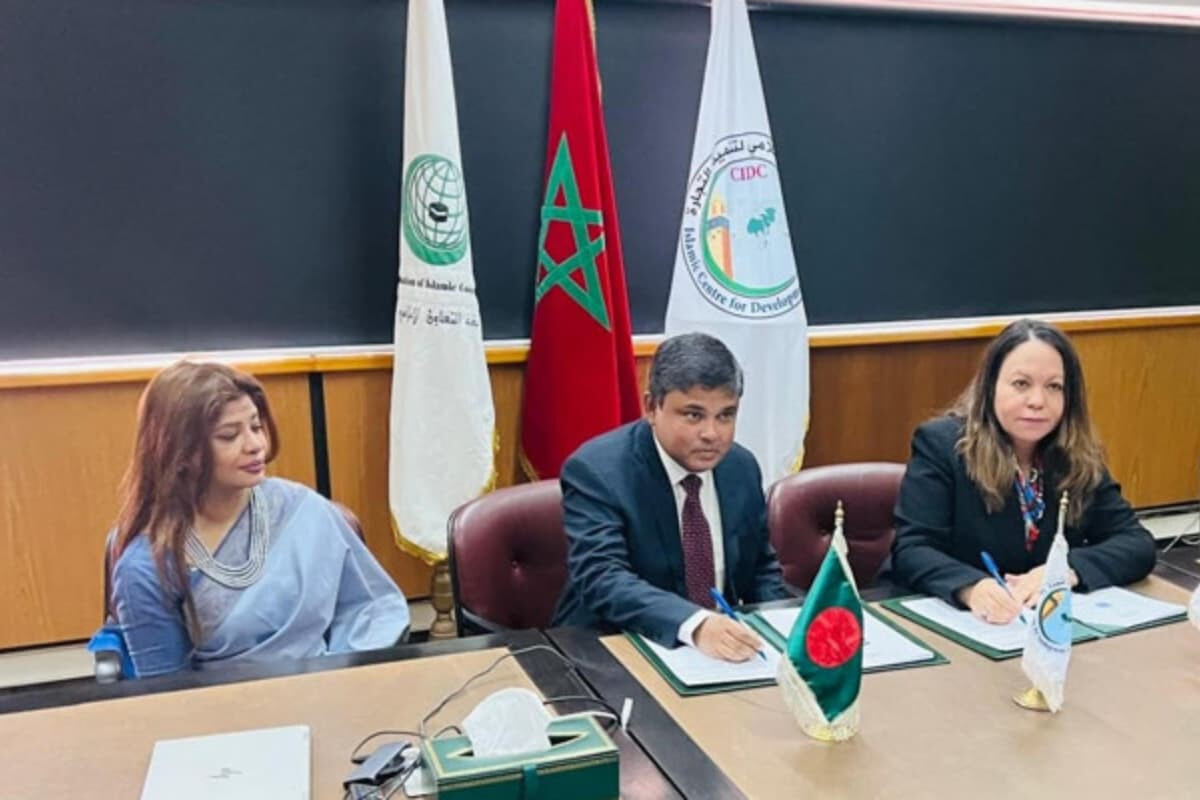
Bangladesh Foreign Trade Institute (BFTI) and the Islamic Centre for Development of Trade (ICDT) have signed a memorandum of understanding (MoU) aimed at strengthening bilateral cooperation in trade and investment development among member states of the Organisation of Islamic Cooperation (OIC).
The agreement was formally signed on Friday at the ICDT headquarters in Casablanca, Morocco, marking a significant step towards enhancing institutional collaboration in economic research, policy development and capacity building within the OIC framework.
On behalf of Bangladesh, the MoU was signed by Ambassador and Permanent Representative to the OIC, M. J. H. Javed. ICDT was represented by its Director General, Latifa Elbouabdellaoui. The signing ceremony was attended by senior officials from both organisations, including Bangladesh Ambassador to Morocco, Sadia Faizunnesa, alongside high-ranking ICDT representatives.
Established in 1984 as a subsidiary body of the Organisation of Islamic Cooperation, ICDT works to promote trade and investment cooperation among OIC member states. The institution focuses on research, policy coordination, trade facilitation and capacity development, with the aim of strengthening economic integration across the Islamic world.
Prior to the signing ceremony, the Bangladeshi delegation highlighted the country’s strategic priorities in expanding international trade and attracting foreign investment. The discussions underscored the government’s commitment to positioning Bangladesh as a strong and competitive trading nation in the global economy under the leadership of the current administration.
The delegation also reaffirmed Bangladesh’s readiness to extend full cooperation to partner countries and international organisations in advancing trade facilitation and investment cooperation initiatives.
Furthermore, Bangladesh urged ICDT to incorporate various national economic sectors and sub-sectors into its research and policy development programmes, thereby ensuring broader representation of emerging economies within its analytical frameworks.
Both parties welcomed the signing of the MoU, describing it as a milestone that would open new avenues for the exchange of knowledge, technical expertise and institutional collaboration. The agreement is expected to enhance opportunities for Bangladeshi professionals to actively participate in ICDT-led initiatives and programmes.
Officials expressed optimism that the partnership would strengthen human resource development and foster greater integration between Bangladesh and OIC member states in trade-related activities.
The Director General of ICDT expressed appreciation for Bangladesh’s continued engagement and active participation in OIC platforms. She noted that Bangladesh has consistently contributed to various OIC bodies and has played a constructive role in advancing collective economic objectives.
She described the MoU as a “historic step” and thanked all stakeholders involved in bringing the agreement to fruition.
ICDT also indicated that, in recognition of Bangladesh’s sustained commitment, it is considering including the country as a pilot nation in selected trade development initiatives. Additionally, the organisation is exploring the possibility of positioning Dhaka as a regional hub for trade and investment-related programmes.
ICDT further announced plans to develop a structured trade and investment programme for the 2026–2027 period. The proposed framework is expected to include a range of activities such as:
The MoU will initially remain in effect for a period of two years. Both parties have expressed confidence that, subject to mutual consent, the agreement will be extended and further strengthened in the future to deepen institutional cooperation and expand the scope of joint initiatives.
The signing of this agreement is widely seen as part of Bangladesh’s broader strategy to enhance its global trade footprint and reinforce partnerships within multilateral economic platforms, particularly across the OIC region.


Comments