Sunday, 5th April 2026

Khabor Wala Desk
Published: 2nd January 2026, 8:22 AM
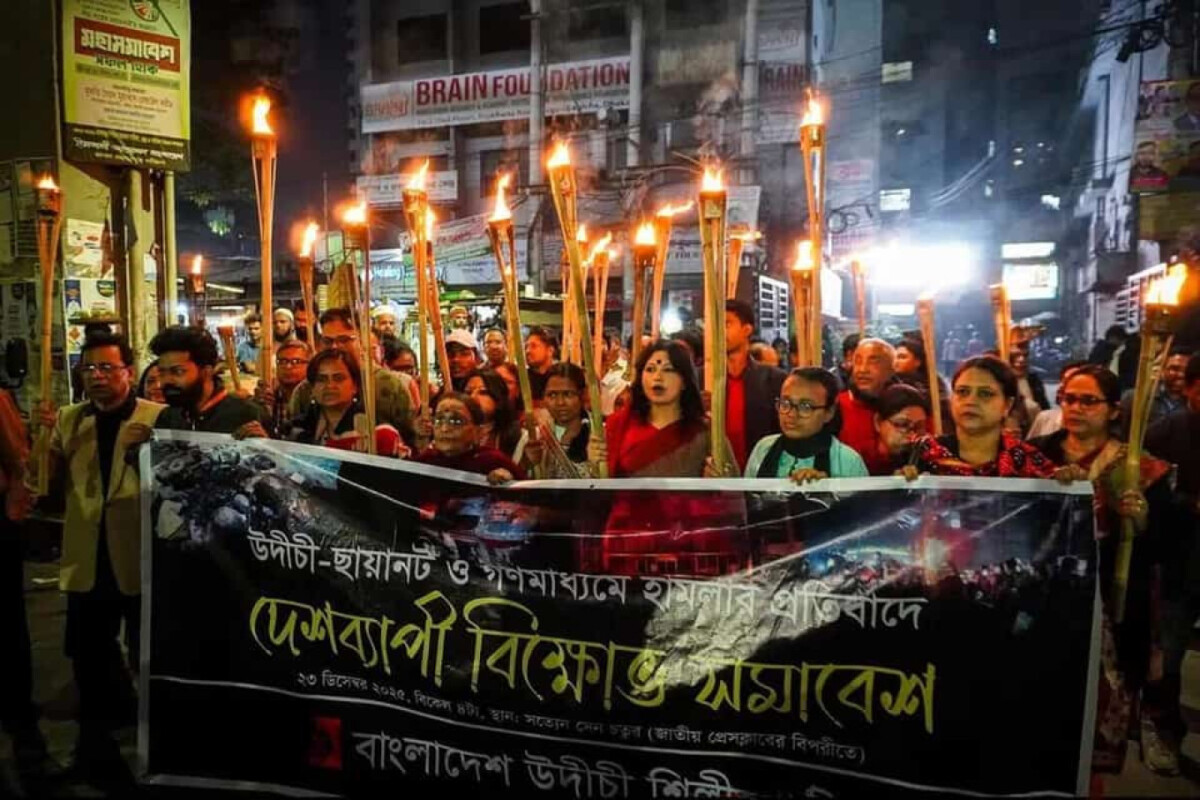
Dhaka – Two of Bangladesh’s most prominent cultural organisations, Chhayanaut and Bangladesh Udichi Shilpigoshthi, were recently subjected to violent attacks, highlighting deep-seated tensions between the country’s Islamic and Bengali identities. The assaults, which included arson and vandalism, targeted offices in Dhaka between 18–19 December, leaving behind a trail of destruction, including damaged musical instruments, burnt books, and defaced images of Bengali luminaries Rabindranath Tagore and Kazi Nazrul Islam.
Founded in the 1960s, both Chhayanaut and Udichi have been instrumental in promoting Bengali culture, particularly during Bangladesh’s liberation struggle. Their work has contributed to the formation of a distinct Bangladeshi national identity. Despite repeated attacks by extremist groups, the organisations remain defiant, resuming activities with public support and renewed calls for a secular, democratic Bangladesh.
The attacks coincided with violent protests across Dhaka and other cities following the killing of Sharif Osman Hadi, a prominent student leader and critic of India, in early December. Offices of major media houses and a member of the Hindu minority were also targeted, raising concerns about rising radicalisation ahead of national elections scheduled for February 2026—the first since former Prime Minister Sheikh Hasina was ousted in a student-led revolt in August 2024.
While the perpetrators have not been definitively identified, many point to radical Islamist factions. Prior to the attacks, Mostafizur Rahman, leader of the student wing of Bangladesh Jamaat-e-Islami, described certain cultural organisations as needing to be “crushed” for true independence. Authorities’ inability to protect these institutions has drawn criticism of the interim government’s law-and-order capabilities.
A summary of the organisations targeted and their historical context is as follows:
| Organisation | Year Founded | Membership / Students | Notable Incidents | Role in Cultural Heritage |
|---|---|---|---|---|
| Chhayanaut | 1961 | 4,000+ students | 2001 bomb attack: 10 killed | Music school; cultural preservation |
| Udichi | 1968 | 15,000+ members | 1999 Jessore bombing: 10 killed; 2005 Netrokona attack: 8 killed | Promotion of music, dance, freedom struggle heritage |
Chhayanaut president Dr Sarwar Ali noted that opposition to Bengali cultural promotion has made his organisation a repeated target. Udichi general secretary Amit Ranjan Dey described the attacks as part of a broader campaign to suppress Bengali language and culture in favour of a radical Islamic identity.
These assaults follow earlier attacks on Baul singers, folk performers representing Bangladesh’s syncretic tradition of Islam blended with Sufism and Hindu influences. Even government plans to recruit music teachers for primary schools were cancelled in November due to pressure from Islamist groups.
Despite the devastation, Chhayanaut and Udichi remain resolute. On 20 December, Udichi members publicly performed outside their vandalised office, sending a clear message of defiance. “When one’s back is to the wall, there is no space to retreat,” said Mr Dey. “We have no choice but to move forward.”
The attacks highlight the fragile balance between Bangladesh’s secular constitutional principles and rising religious extremism, underscoring the ongoing struggle to preserve the nation’s cultural identity.


Comments