Sunday, 5th April 2026

Khabor Wala Desk
Published: 15th October 2025, 9:26 AM
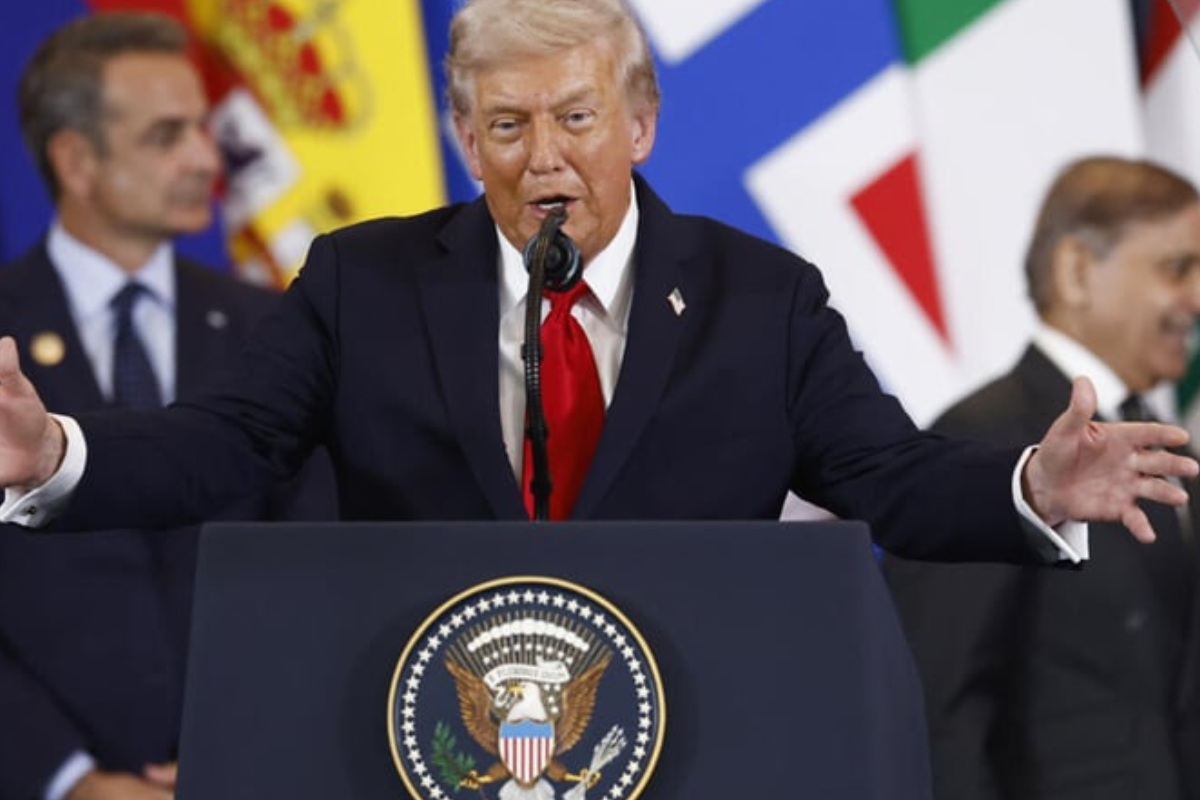
A newly elected United States President, prioritising domestic concerns and initially criticising his predecessor for being too hard on Israel, has swiftly taken up the mantle of peace — achieving an agreement that has been lauded across the globe.
In September 1993, then-President Bill Clinton famously brought together Israeli and Palestinian leaders at the White House for the landmark Oslo Accords, marking the beginning of Palestinian self-governance.
This weekend, it was Donald Trump who announced an agreement to end two years of devastating warfare in Gaza, declaring it “a historic dawn of a new Middle East.”
Yet, despite his characteristically self-congratulatory tone, Trump’s bold approach has raised pressing questions about whether he possesses the ambition or long-term commitment required to secure a comprehensive resolution to one of the world’s most enduring and complex conflicts.
On his return journey from a brief trip to Israel and Egypt, Trump offered only vague remarks about his vision for Palestine’s future, saying he would “decide what I think is right” in “coordination with other states.”
“A lot of people like the one-state solution, some people like the two-state solution. We’ll have to see,” Trump told reporters.
His approach contrasts sharply with the Oslo process, which involved discreet negotiations between Israeli and Palestinian representatives, facilitated by Norway, and laid out a roadmap to resolve contentious issues such as permanent borders and the status of Jerusalem.
Initially, Trump had staunchly supported Israel, even amid global outrage over its Gaza offensive following Hamas’s October 7, 2023 attack. However, he later pressured Prime Minister Benjamin Netanyahu after Israel targeted Hamas leaders in Qatar, a key U.S. ally.
According to Mona Yacoubian, Director of the Middle East Programme at the Centre for Strategic and International Studies, Trump’s 20-point peace plan offers only a broad outline rather than a detailed roadmap.
“In a lot of ways, the easy part is what was just accomplished,” Yacoubian remarked. “But moving this conflict toward resolution will take much more than the vague details presented in the plan.”
| Key Elements of Trump’s 20-Point Gaza Plan | Details / Concerns |
| Pathway to Palestinian Statehood | Described as an “eventual credible pathway”, with no defined timeline or enforcement mechanism. |
| Treatment of the West Bank | The plan makes minimal reference to ongoing settlement expansion and settler violence against Palestinians. |
| Regional Coordination | Suggests collaboration with Arab and Islamic states but lacks a clear framework. |
| Implementation Challenges | Critics warn of inadequate commitment and absence of enforcement tools. |
Yacoubian noted that Trump’s “unconventional” approach might have stemmed from Oslo’s failure, arguing that he “short-circuited the process by using pressure and persuasion rather than patient diplomacy.”
“The problem, of course, is implementation — and that was also Oslo’s undoing,” she added. “Without sustained commitment, the process inevitably falls apart.”
Several Western powers, including France and Britain, have diverged from Oslo’s gradualist model. Both nations formally recognised a Palestinian state last month, signalling a shift towards more direct acknowledgement of Palestinian sovereignty rather than waiting for protracted negotiations.
Former U.S. President Bill Clinton, known for his meticulous negotiations, had often clashed with Benjamin Netanyahu, Israel’s longest-serving prime minister, who has consistently rejected both the Oslo process and the notion of a Palestinian state.
After Netanyahu’s brief loss of power, Clinton sought a final resolution through the Camp David Summit at the end of his presidency — an effort that ultimately failed.
Ghaith al-Omari, a former adviser to Palestinian negotiators during that summit and now a senior fellow at the Washington Institute for Near East Policy, expressed scepticism that today’s leaders could achieve a lasting peace deal.
“Netanyahu is mistrusted, even among Arab leaders who wish for better relations with Israel,” said al-Omari.
Arab and Islamic powers have considered deploying stabilisation forces to Gaza, yet doubts remain about whether they would proceed without guarantees of long-term security. Netanyahu has also rejected any role for the Palestinian Authority (PA) — Hamas’s rival — in post-war governance.
PA leader Mahmud Abbas, who turns 90 next month, faces diminishing credibility after decades marked by stagnation and failed diplomacy.
“He’s simply too discredited,” al-Omari observed. “The last thirty years of his leadership have been synonymous with failure.”
Al-Omari compared the current scenario to Lebanon, where Israeli strikes on Hezbollah have continued intermittently despite a ceasefire nearly a year old — a situation emblematic of unresolved tension rather than peace.
While Trump has demonstrated an instinct for seizing political moments, analysts note he has yet to build a sustained diplomatic infrastructure capable of executing a long-term peace framework.
“I’d be very sceptical if we see the level of engagement we’ve witnessed over the past few weeks continue,” said al-Omari.
Despite the celebratory tone surrounding the Gaza truce, experts caution that the broader Israeli–Palestinian conflict remains far from resolution.
“We’re nowhere near the kind of kumbaya moment that was projected,” al-Omari concluded.



Comments