Sunday, 5th April 2026

Khabor Wala Desk
Published: 8th December 2025, 3:10 AM
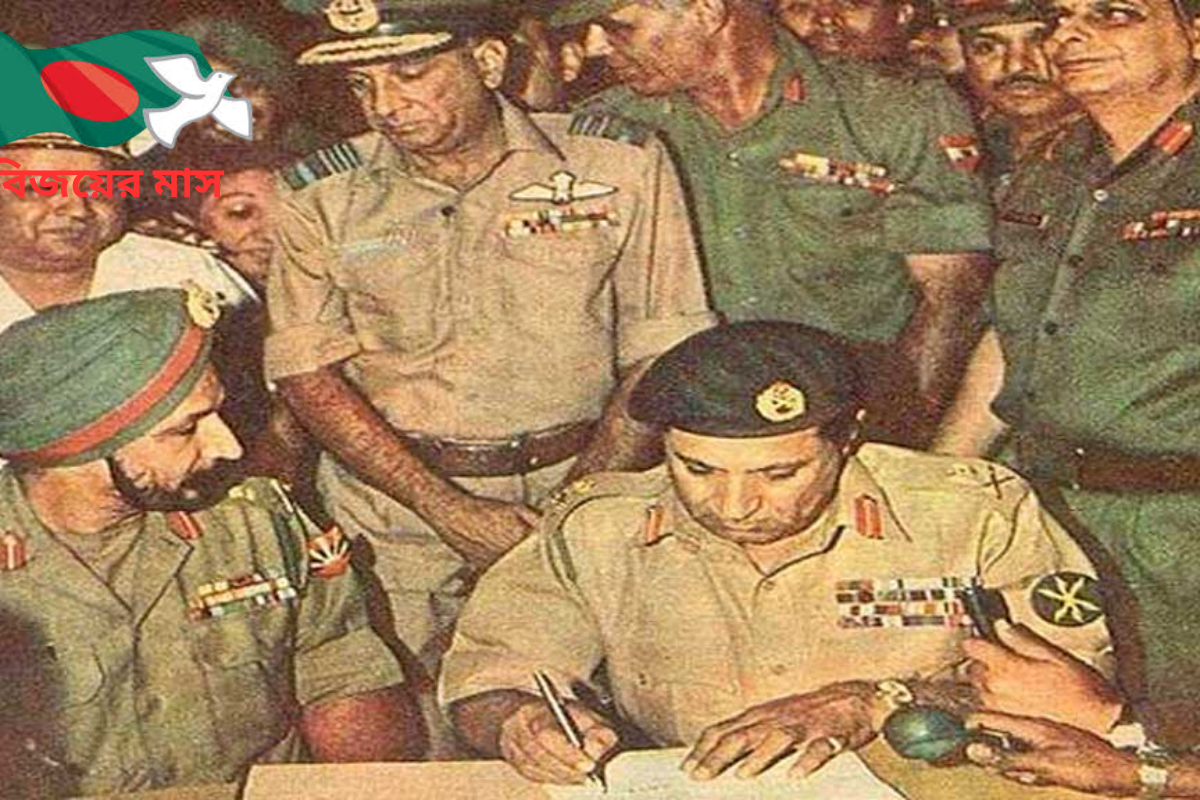
With combined strikes by the Mukti Bahini and allied forces, the enemy has now been completely routed and is on the run. Brothers and sisters of Bangladesh, the time has come. Strike the enemy forcefully together. Deliver the final blow and consign them to their grave.
Assist the freedom fighters by all possible means. Maintain peace and discipline. To all enemy soldiers and Razakars, I call upon you to lay down your arms and surrender. In this way, you may still save yourselves.
Exiled Bangladesh government Prime Minister Tajuddin Ahmad made this appeal in a radio address on 8 December 1971. The speech made it largely clear that Bangladesh’s victory and Pakistan’s defeat were only a matter of time.
Writer Rabindranath Tribedi, in his book 71 Er Dosh Mash, writes that once again that morning Akashvani broadcast a surrender message from Indian Army chief General Manekshaw. Leaflets carrying surrender messages in different languages were dropped from the sky.
The message said that the combined forces had surrounded them from all sides and urged them to surrender.
On the same day, Cumilla was freed from Pakistani occupation. Pakistani forces took refuge in the cantonment. In Cumilla, freedom fighters, under the leadership of Jahur Ahmed Chowdhury, chairman of the Mujibnagar government’s South-East Regional Council, and Advocate Ahmed Ali, formally hoisted the national flag.
The map-embroidered flag of Bangladesh began flying in Cumilla.
The advance of the combined forces continued on various battlefields across Bangladesh. Heavy fighting took place in Brahmanbaria, Hili, Sunamganj, Chhatak, Lalmonirhat, Durgapur, Haluaghat, Akhaura and other areas. In Dhaka, allied forces carried out 10 air strikes targeting military installations.
After capturing Pakistan’s stronghold of Jashore the previous day, the allied forces and Mukti Bahini achieved successive victories and continued their advance towards the capital Dhaka. On this day, a Mukti Bahini unit liberated Brahmanbaria and moved towards Ashuganj. Barishal and Pirojpur were also freed on the same day.
The fall of Jashore was highlighted in a report by Sydney Schanberg, foreign correspondent of The New York Times in 1971. His reports from Bangladesh during the Liberation War were compiled, edited and translated by Mofidul Haque in the book Dateline Bangladesh: Nineteen Seventy-One.
The headline of Schanberg’s 8 December report was “‘Free’ Jashore and the Bengalis’ dance”. Describing the scene, he wrote that Bengalis were dancing on bus rooftops and chanting slogans of independence on the streets. They were embracing one another, cheering, and spontaneously approaching foreigners to clasp their hands in emotional expression.
Meanwhile, writer and researcher Moeedul Hasan wrote in his book Muldhara ’71 that the battlefield situation on 8 December was even more disastrous for Pakistan. In West Pakistan, despite repeated efforts to regain ground in Chhamb, progress almost came to a halt. Elsewhere, the situation was also very poor. Along the Rajasthan-Sindh border, Indian dominance was evident, while Indian naval and air attacks on Karachi continued. In the eastern region, Pakistan’s condition became increasingly precarious. Just as in Jashore, Pakistani troops fled from Brahmanbaria. The fall of part of Cumilla became inevitable, and the India-Bangladesh combined forces continued advancing by bypassing other parts. It remained unclear whether, after this retreat, Pakistani forces would be able to reorganise their positions around Dhaka. In brief, there was no progress in West Pakistan and only retreat in the east.
On the same day, Pakistan government-appointed deputy prime minister and Pakistan Peoples Party chief Zulfikar Ali Bhutto departed for New York to join the United Nations General Assembly as leader of Pakistan’s delegation.
At the United Nations General Assembly, Indian representative Samar Sen said Pakistan must recognise Bangladesh. He said Sheikh Mujibur Rahman, president of the Awami League, must be released to restore peace in the subcontinent. He added that no UN proposal would be implementable unless it was acceptable to the Bangladesh government.
Khaborwala/SS


Comments