Sunday, 5th April 2026

Khabor Wala Desk
Published: 8th June 2025, 8:42 PM
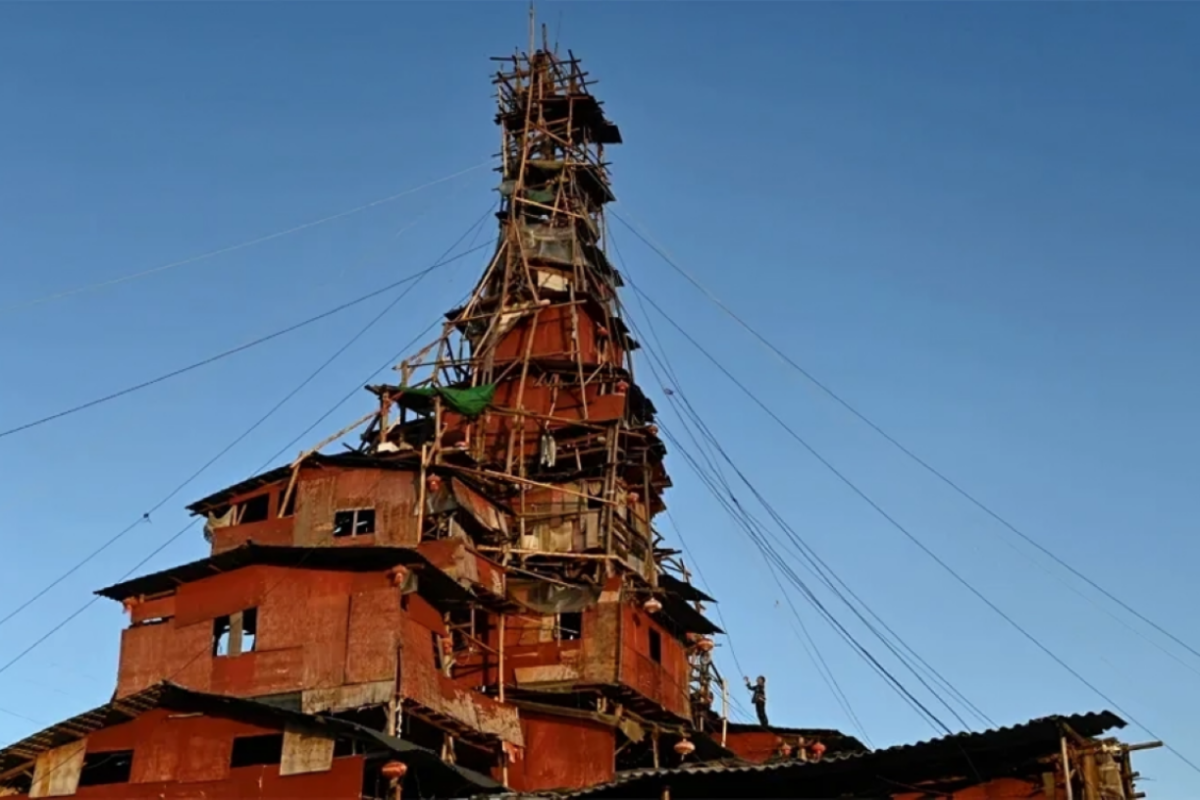
XINGYI, China – 8 June 2025 (BSS/AFP) – Amid the rubble of a razed village in China’s Guizhou province stands an extraordinary, makeshift tower — a testament to one man’s defiance, creativity, and unwavering dedication to home.
Chen Tianming, a 42-year-old local, has spent years transforming his family’s modest stone bungalow into a ten-storey, pyramid-like structure of wood planks, scrap materials, and dizzying staircases. Rising incongruously from flattened ruins, the house has become an unlikely symbol of resistance — and a burgeoning tourist attraction.
A Monument to Stubbornness and Imagination
Chen began his unusual construction journey in 2018 after local authorities demolished most of his village to make way for an ambitious 800-acre tourist resort. When his parents refused the government’s compensation offer, Chen stayed behind — the only one amid collapsing homes.
“At first, I simply wanted to renovate and expand our house,” Chen told AFP. “But then it became more of a passion project — a hobby I enjoyed.”
Built without official permits, the tower’s precarious upper floors sway with the wind. It’s held in place by a web of ropes and cables, leading some visitors to compare it to Hayao Miyazaki’s animated masterpiece Howl’s Moving Castle.
“People say it’s dangerous and should be torn down,” Chen added. “But I’ll never allow that to happen.”
Timeline: Chen Tianming’s Tower
| Year | Event |
|---|---|
| 2018 | Village is demolished for a planned resort; Chen refuses to leave. |
| 2019 | Fifth floor of his structure completed. |
| 2022 | Sixth floor completed. |
| 2023 | Seventh floor added. |
| Aug 2024 | Home officially declared an illegal construction; demolition ordered. |
| 2025 | Legal appeals ongoing; house attracts tourist attention. |
The Rise of a ‘Nail House’
Chen’s creation is now dubbed a “nail house” — a term used in China to describe properties whose owners refuse to vacate despite relocation incentives. These homes, often stubbornly standing in the way of large-scale development projects, have become symbols of resistance against rapid urbanisation.
After the resort development collapsed due to local government debt, Chen’s home became one of the last buildings standing. At one point, he even lived alone in the house for two months to guard it from possible demolition.
“Now that no one’s developing the land, there’s no reason to tear it down,” Chen said confidently.
He has spent tens of thousands of yuan fighting legal notices in court, losing several initial hearings but continuing to appeal. The latest court session has been postponed.
From Eyesore to Attraction
Ironically, what once made officials uneasy is now drawing admiration. Tourists and curious passersby are increasingly visiting Chen’s creation. On Chinese social media, users compare the house to the fantastical structures of Studio Ghibli animations like Spirited Away and Howl’s Moving Castle.
At dusk, Chen lights the home with lanterns, creating a surreal silhouette against the twilight. Locals and visitors often gather nearby to take photographs.
“It’s beautiful,” said He Diezhen, a local resident. “If it’s structurally sound, it could become a real landmark.”
Chen agrees. For him, the structure is more than just a home — it’s the realisation of a dream.
“Everyone dreams of building something of their own. I didn’t just dream — I built it.”




Comments