Monday, 6th April 2026

Khabor Wala Desk
Published: 18th March 2026, 11:57 AM
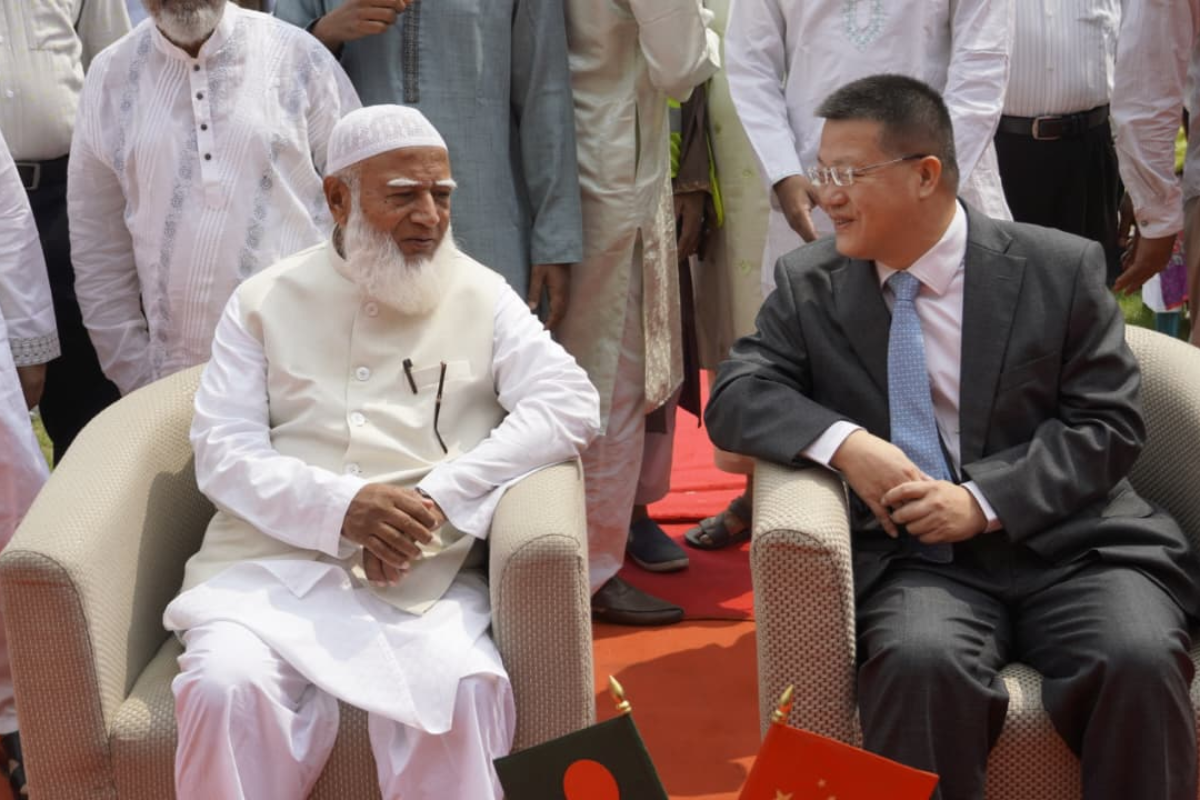
The Chinese Embassy in Bangladesh distributed Eid al-Fitr food packages to residents of Dhaka on Tuesday, 17 March 2026, at the grounds of Mirpur-10 Ideal High School, located in Dhaka-15 constituency. What initially appeared to be a routine humanitarian gesture quickly became the centre of political and diplomatic debate.
The event saw the presence of Chinese Ambassador Yao Wen and Bangladesh Jamaat-e-Islami leader Dr. Shafiqur Rahman. Over a thousand local residents received food parcels during the ceremony. While the distribution was organised solely by the Chinese Embassy, initial social media posts by Jamaat-e-Islami and some early media coverage framed it as a joint initiative between China and the political party, sparking questions about the propriety of a foreign diplomatic mission collaborating directly with a domestic political organisation.
Following the controversy, the Chinese Embassy issued an official statement clarifying that the social media narratives were “inconsistent with facts.” The embassy emphasised that the initiative was entirely its own, aimed at supporting local communities during the festive season. It also reiterated China’s continued friendly policy towards Bangladesh and its support for the governance of the democratically elected government.
According to the embassy’s website report, “Chinese Embassy in Bangladesh donated Eid al-Fitr food packages to residents in Dhaka.” While Ambassador Yao Wen and Dr. Shafiqur Rahman were present at the ceremony, the report made no reference to any political partnership. The embassy noted that Dr. Rahman described the gesture as an expression of China’s sincere friendship with the people of Bangladesh and expressed interest in grassroots-level cooperation, which drew public attention and debate. Critics argued that the visible association between a political leader and a foreign embassy could send mixed messages during what is fundamentally a humanitarian initiative.
At the ceremony, Ambassador Yao Wen highlighted that Bangladesh and China are Comprehensive Strategic Cooperative Partners. He stressed that the initiative’s purpose was to assist local residents in celebrating Eid peacefully and that China intends to continue supporting projects that improve people’s quality of life in Bangladesh. Dr. Rahman praised China as a “true friend” of Bangladesh, noting its non-interference in internal affairs and its credibility as a development partner.
The location of the event in Mirpur-10, an area associated with Jamaat’s political influence, intensified public scrutiny. Social media debates questioned whether the humanitarian effort inadvertently highlighted a specific political geography, despite there being no official government comment. Following the embassy’s clarification, Jamaat revised its earlier social media post to correctly reflect that the initiative was organised solely by the Chinese Embassy.
| Key Details | Information |
|---|---|
| Date | 17 March 2026 |
| Location | Mirpur-10 Ideal High School, Dhaka |
| Organiser | Chinese Embassy, Dhaka |
| Participants | Ambassador Yao Wen, Dr. Shafiqur Rahman |
| Beneficiaries | Over 1,000 local residents |
| Controversy | Social media misrepresentation as a joint political initiative |
The Mirpur-10 Eid food distribution highlights three intersecting dimensions: foreign diplomatic presence, political party visibility, and humanitarian messaging. In Bangladesh’s current sensitive political and international context, even a food parcel distribution can rapidly evolve into a matter of public and political debate, raising questions about the boundaries of diplomacy, politics, and charitable action.

Comments