Sunday, 5th April 2026

Khabor Wala Desk
Published: 22nd November 2025, 4:35 AM
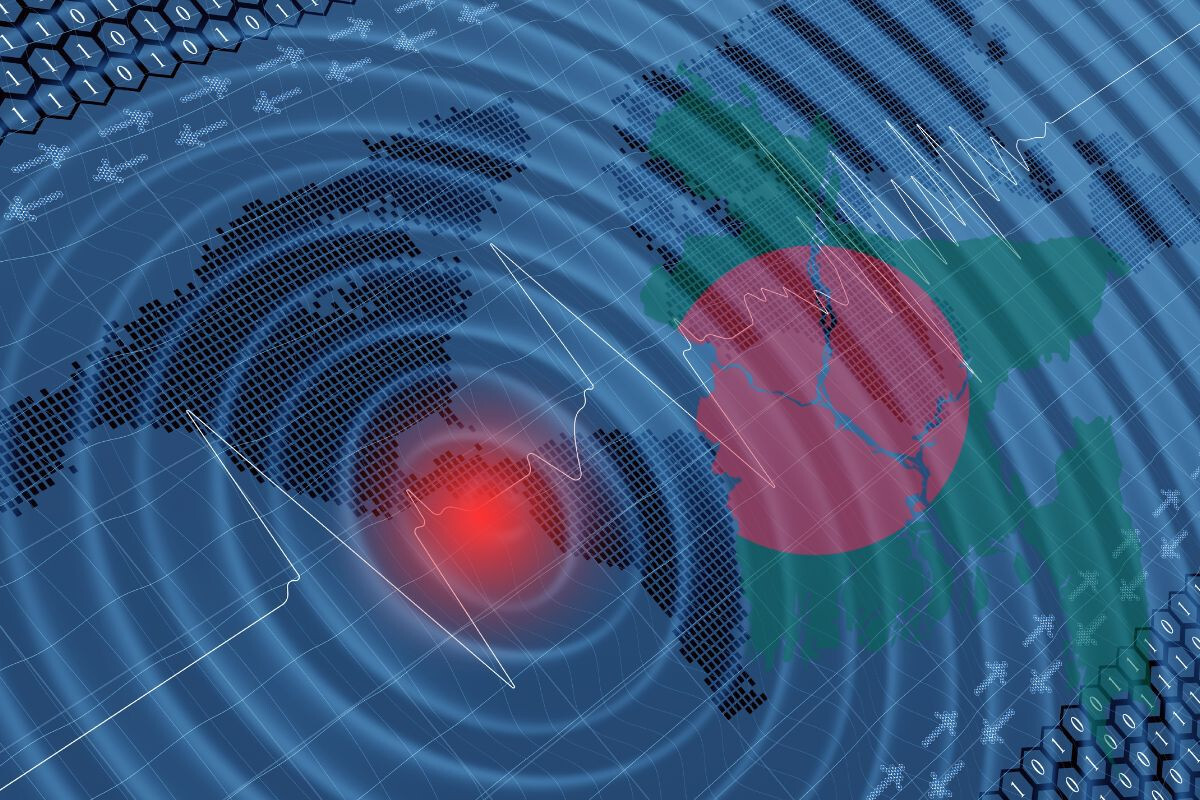
Bangladesh has been divided into three zones based on earthquake risk. Zone-1 represents high-risk areas, Zone-2 moderate risk, and Zone-3 low-risk regions. A map prepared by the Meteorological Department identifies the earthquake-prone regions of the country.
According to the published map, several districts in the northern and south-eastern parts of the country fall under Zone-1, considered the highest risk category. Typically, areas near fault lines or plate boundaries are more vulnerable to earthquakes. Notably, nine districts in the Sylhet and Mymensingh divisions, parts of Tangail, Gazipur, and Narsingdi in the Dhaka division, the entire Kishoreganj district, Brahmanbaria in the Cumilla division, and many areas of the hilly districts of Khagrachhari and Rangamati are marked as high-risk. Meanwhile, Khulna, Jashore, Barishal, and Patuakhali fall under Zone-3, the lowest risk category.
Records show that between 1976 and 2015, at least five significant earthquakes were felt in the country. Most of the epicentres were located in Sylhet, Moulvibazar, Rangamati, Bandarban, and Cox’s Bazar. This indicates the possibility of larger future quakes in these regions. Additionally, the areas bordering India’s Assam and Meghalaya—particularly Sylhet and Mymensingh—have also been identified as high-risk zones.
Experts report that five major seismic sources surround Bangladesh. One of these, Plate Boundary-1, stretches from Myanmar to Noakhali. Plate Boundary-2 runs from Noakhali to Sylhet, while Plate Boundary-3 extends from Sylhet towards India. The Dawki Fault and Madhupur Fault, located in Haluaghat of Mymensingh and the Madhupur region respectively, are also major seismic origins.
According to RAJUK statistics, there are around 2.1 million buildings in Dhaka. Of these, around 1.5 million are two-storey or lower, posing relatively less risk. However, nearly 600,000 buildings ranging from four to thirty storeys are considered highly vulnerable. A strong earthquake could lead to the collapse of these structures, causing massive casualties. Experts therefore emphasise strengthening vulnerable buildings to make them earthquake-resistant.
They further state that earthquakes are among the most severe and unpredictable natural disasters. While they cannot be prevented, early warning systems and predictions are crucial in reducing damage. Developed countries such as Japan, South Korea, and the United States have made significant progress and invested heavily in this research.
Speaking about Bangladesh’s preparedness, BUET Professor Dr Mehedi Ahmed Ansary said the country has long been at risk of earthquakes. He noted that Friday’s quake has intensified concerns. He added that if a 5.7 magnitude quake, with its epicentre 60 kilometres from Dhaka, can cause structural damage in and around the capital, a stronger quake would inevitably lead to a catastrophic situation. He stressed that many buildings in Dhaka are being constructed without adhering to building codes, which increases the danger. The government must take this issue seriously.
Khaborwala/TSN



Comments