Sunday, 5th April 2026

Khabor Wala Desk
Published: 29th July 2025, 3:42 PM
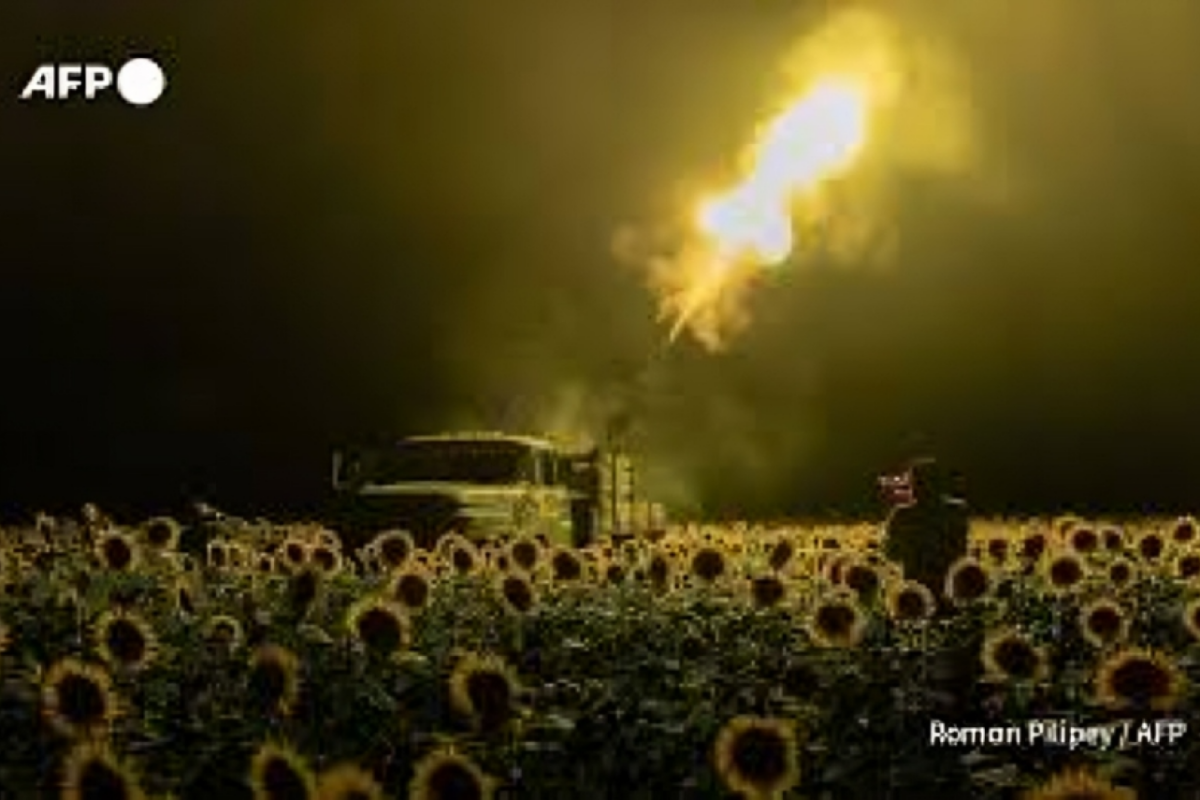
A chilling hum echoes through the night sky over eastern Ukraine. Explosions crack through the darkness, lighting up sunflower fields below. The acrid scent of gunpowder fills the air.
“There! Three kilometres away!” shouts a Ukrainian serviceman from an air defence unit. They’re armed with Soviet-era weapons, trying desperately to intercept Russian drones before they strike Ukrainian cities and towns.
These long-range drones—initially Iranian designs, now refined and deployed en masse by Moscow—have become one of the most destructive tools in Russia’s invasion, which began in early 2022.
Russia proudly claims industrial-scale drone production, even airing footage on state television of what it calls the world’s largest drone factory, assembling swarms of jet-black, triangle-shaped Gerans (Russian for “geraniums”).
Night of Chaos: Over 300 Drones Launched
During an AFP embed in July with a Ukrainian air defence unit in the Dnipropetrovsk region, Russia launched 344 drones that night alone — though previous barrages have reached over 700.
“It’s grim tonight, just like yesterday,” muttered one soldier, his eyes glued to a radar screen.
The Gerans are now flying higher and using adaptive flight paths to avoid detection. But Vasyl’s team, like many, must rely on outdated short-range systems.
| Unit Info | Details |
| Location | Dnipropetrovsk & Donetsk regions |
| Equipment | Soviet-era short-range weapons, machine guns |
| Main Threats | Geran & Gerbera drones |
| Sleep per Night | 2–4 hours average |
| Daily Routine | 24/7 duty, no home leave in 2+ years |
“They fly unpredictably now. It’s getting harder to bring them down,” says Vasyl, 49.
“We’re doing well, but I can’t promise it’ll be the same next week.”
“Nothing We Can Do”
In nearby Pavlograd, another serviceman, Oleksandr, studies a radar screen swarming with red dots—each one a potential incoming drone.
“There’s nothing we can do. That’s not our zone,” he says quietly.
He attempts to call his 20-year-old daughter in Pavlograd, but she doesn’t pick up.
“I warned her,” he mutters, lighting a cigarette.
Suddenly, an explosion breaks the silence. The sky glows red and smoke begins to billow across the horizon.
Patriot Missiles and Drone Interceptors
President Zelensky has successfully obtained Patriot air defence batteries from Western allies, but these are used sparingly—to protect critical infrastructure and large urban centres from missile attacks.
For smaller towns and front-line zones, Ukraine is relying increasingly on cheaper drone interceptors, and Zelensky has asked domestic manufacturers to produce up to 1,000 per day.
“What Ukraine really needs are people and modern weapons,” Vasyl asserts.
Psychological Toll of a Relentless War
The teams barely sleep—on average 2 hours a night, occasionally 4 on a good day, and maybe another hour between drone waves.
“The exhaustion is real,” Vasyl confides.
In the Donetsk region, another air defence soldier known by his call sign Wolf tells AFP he suffers from insomnia—not from the workload, but the psychological scars of past battles.
His comrade, Belyi, suffered a concussion and lost part of his hand when a shell exploded during earlier combat. Both men were miners before the war. Now, they fight drones around the clock.
Their families live in Kryvyi Rih, further west. Neither soldier has been allowed home since the invasion began more than two years ago.
WWII Guns Against Modern Drones
As the sun rises near Pavlograd, the soldiers’ exhaustion is plain—their eyes sunken, their faces drawn. Suddenly, the buzz of another drone wave is heard.
The unit opens fire with an anti-aircraft gun, but it jams. In desperation, they grab WWII-era machine guns, firing blindly into the sky.
Another threat is Gerbera drones—originally decoy aircraft, now equipped with cameras and real targeting capabilities.
“Only a fool wouldn’t be afraid,” Vasyl says.
He shows a picture on his phone—his two blond-haired children, now living in Kyiv.
“I’m doing this for them.”
Despite being outgunned and fatigued, Ukraine’s defenders remain steadfast. Their resolve, like their equipment, may be old—but it’s unyielding.




Comments