Sunday, 5th April 2026

Khabor Wala Desk
Published: 6th December 2025, 4:37 AM

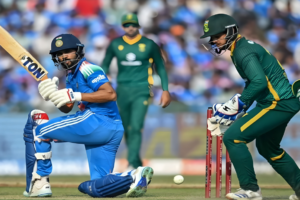
The ODI format faces a fresh controversy after dew played a massive role in the India–South Africa series, leading to tactical complications and unusual frustration inside the Indian dressing room. Even with top-tier performances with the bat, India have found victory slipping away due to uncontrollable weather factors.
The opening match offered signs of trouble when South Africa came close to chasing 350 in Ranchi, but the second ODI made the issue undeniable. India stormed to a huge total of 358, yet bowlers could not defend it as the dew rendered their attack largely ineffective. The ball slipped in their hands, spinners could not extract grip, and batting became noticeably easier in the late evening conditions.
India’s assistant coach, Ryan ten Doeschate, maintained that the sport may require innovations. He suggested a controversial yet theoretically helpful idea: move the start time forward by two hours to avoid the dew-heavy period in the late evening. Although he firmly admitted that broadcasters and logistics would likely prevent the change, his frustration highlighted the severity of the problem.
The dew factor alone would be troubling enough, but India have suffered double misfortune due to an unprecedented streak of tossing failures. Their run of 20 consecutive ODI toss losses stretching back from the 2023 World Cup has put them at a constant disadvantage. South Africa, unsurprisingly, used this streak to their advantage, choosing to chase every time dew was anticipated.
In Ranchi, South Africa fell short by just 18 runs. By Raipur, they were fully prepared. With Aiden Markram shining brilliantly through a well-timed century and the team batting deep, they chased down 359 with significant authority.
The series is now set for a decisive finale in Visakhapatnam — a venue famous for its heavy dew influence. This has created a new layer of tension, as many believe the toss could determine the winner before the match begins. The Indian camp fears another disadvantage if they are forced to bat first once again.
Speaking ahead of the contest, ten Doeschate stated, “Dew doesn’t just affect a few overs. It changes the nature of the entire second innings. You can’t grip the ball; bowlers lose control. If we could start earlier, perhaps the impact would reduce. But realistically, this topic rarely leads to change.”
He insisted that teams must learn to adapt, saying, “Yes, dew is not our fault, but coping with it is still our responsibility. The point is not to complain, but to find solutions. Right now, the imbalance between innings is too obvious.”
The debate is now larger than the current series. Should changes be made to protect the fairness of the ODI format? Should cricket boards consider adjusting timings? Or is dew a feature of the game that teams simply need to master?
As the final ODI approaches, the question remains unanswered — and the series may be settled not by batsmen or bowlers, but by nature itself.



Comments