Sunday, 5th April 2026

Khabor Wala Desk
Published: 16th September 2025, 11:58 AM
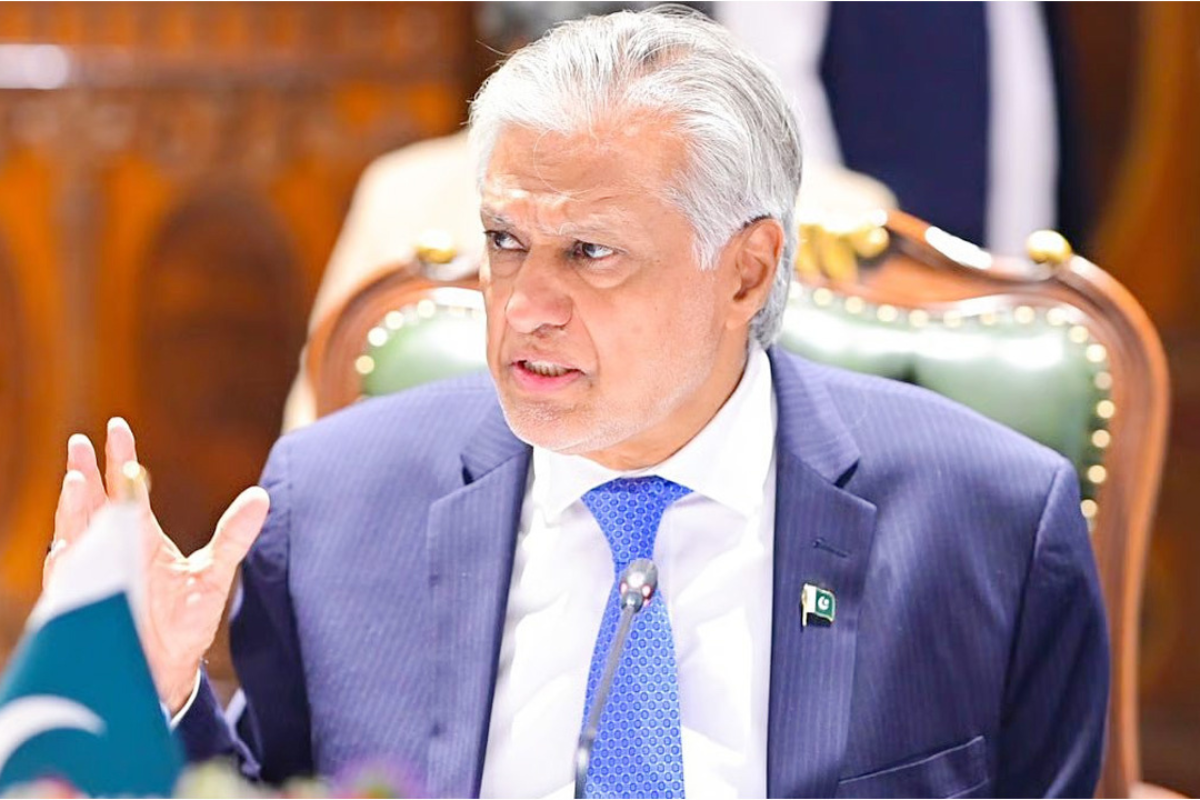
Pakistan’s foreign minister, Ishaq Dar, has said his country possesses a “very large and effective” armed force that has demonstrated its capability in conventional warfare — and indicated Pakistan would participate if a unified force outside the United Nations framework were formed to halt Israeli aggression in the Middle East. Dar made the remarks in an interview recorded in Qatar ahead of an Arab-Islamic summit and broadcast by Al Jazeera.
When asked whether Pakistan would join any such non-UN coalition to intervene in Gaza, Dar replied that a management structure akin to the UN Security Council could be established, including mechanisms such as severe economic sanctions against recalcitrant states — measures that, he said, can inflict grave economic harm.
Dar told the interviewer that discussions in recent days among Arab states and at Arab League talks have included the idea of forming a joint security force. He argued there is nothing wrong with such a concept and stated emphatically that countries should have a joint force, organised according to their capabilities, “not for aggression but for peace — to stop aggressors, to prevent occupation, and to deter those who refuse to listen to others.”
When pressed on Pakistan’s role as a nuclear-armed state, Dar said Pakistan would certainly fulfil its responsibilities as a member of the Ummah (Muslim community). He emphasised that Pakistan views its nuclear arsenal strictly as a deterrent and has no intention to use it offensively. At the same time he underlined Pakistan’s conventional military strength: a large, well-known and effective army, an effective air force and navy, and the capacity to defeat opponents by conventional means if challenged — a capability he said Pakistan has already demonstrated.
The Al Jazeera presenter raised the issue of precedent, referring to the 2011 US operation in Pakistan that killed Osama bin Laden, and asked whether Pakistan would respond in a similar unilateral fashion were it to suffer a comparable attack from the United States or another country. Dar replied forcefully: “We will not accept interference in our territorial sovereignty — whether the actor is large or small. We will respond. But I do not believe the United States or any other country will do such a thing. India did, and look what happened to them.”
Asked whether Pakistan still regards the United States as a reliable security partner in light of perceived US inaction to restrain Israel, Dar acknowledged that the US played a constructive role in brokering a ceasefire following recent India-Pakistan tensions. He reiterated Pakistan’s view that Israel’s strike in Qatar, which targeted Hamas leaders who were discussing a US ceasefire proposal, was unjustified and amounted to “piracy”. He described Israel’s repeated strikes across the region as conducted with apparent impunity, untouched by international law, human-rights norms or UN Security Council proposals.
Dar argued that these developments demonstrate the urgent need for major reform of the multilateral architecture, especially the UN Security Council. He said the Security Council was established to keep global peace, yet its resolutions are routinely ignored; Gaza is “in Israel’s hands” while Kashmir is “in India’s hands,” he observed, questioning what we can reasonably expect from the present multilateral system.
On the question of whether all Muslim nations are playing an equal role, Dar asserted that Pakistan believes all states, large or small, should enjoy equal dignity. He suggested that recent events between 7 and 10 May (a reference to unspecified clashes) showed that attempts at domination by certain states are losing their efficacy.
On ending the Gaza war, Dar said diplomacy and negotiation remain the best path; they require time but can deliver solutions if the parties come to the table in good faith. If talks are insincere or masked by malign intent, he warned, genuine negotiation will not be possible.
Asked whether Israel might strike Qatar and then Pakistan, Dar pointed to India’s earlier attempt — which, he said, failed despite Israel’s full support — and reiterated Pakistan’s preparedness. He stressed Pakistan seeks peace and, as a nuclear power, does not wish to destabilise the region because the consequences would extend far beyond national borders.
Dar also argued that if UN resolutions are ignored, the Security Council must have a mechanism to take real measures to restore control — and, if necessary, those measures could include intervention.
| Topic | Ishaq Dar’s position |
| Participation in a non-UN regional force | Pakistan would take part if such a coalition were formed to stop Israeli aggression |
| Nuclear posture | Nuclear weapons are purely deterrent; Pakistan has no intention to use them offensively |
| Conventional capabilities | Pakistan claims a large, capable army, air force and navy able to prevail in conventional conflict |
| Multilateral system | Urgent reform of the UN Security Council and multilateral mechanisms is needed |
| Preferred method to end Gaza war | Diplomacy and negotiation are best, but Pakistan will respond to violations of sovereignty |
| Role of Muslim states | All nations, large and small, should have equal dignity and role |
Dar’s remarks came amid intense regional diplomatic activity following Israel’s strike in Qatar and ahead of the Arab-Islamic summit in Doha. They reflect Pakistan’s positioning: a declared preference for negotiation and collective action, coupled with a clear statement of military readiness and calls for reform of the current international order.
Source: Dawn (reported via Don)


Comments