Sunday, 5th April 2026

Khabor Wala Desk
Published: 25th January 2026, 12:24 PM
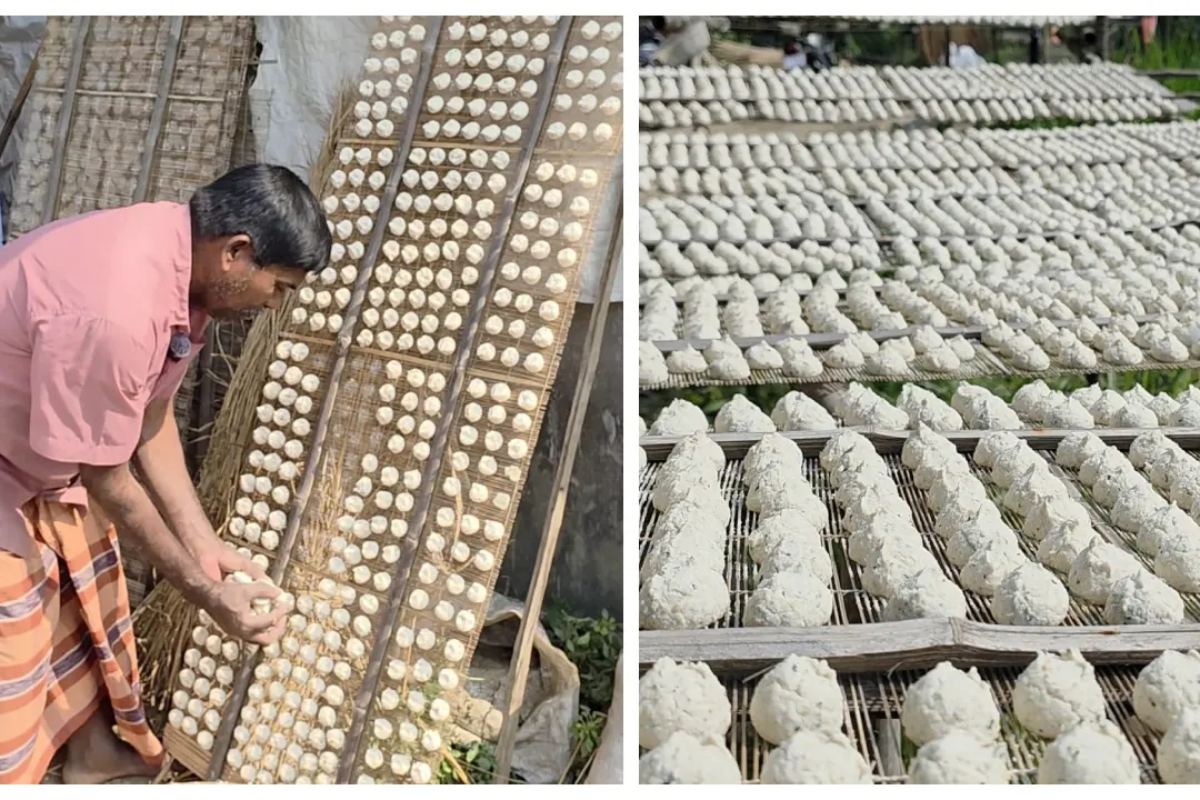
Before the first rays of dawn break over Puthia Upazila in Rajshahi, the village of Kashiapukur in Shilmaria Union comes alive. Along the paved roads, rows of mats are already laid out from the previous night, each bearing neatly arranged round balls of Kalai dal. As the morning sun gently touches these drying pulses, they carry within them not just centuries-old tradition, but the livelihood of hundreds of families.
For generations, the production of these dal balls has been the primary occupation for nearly 200 families in Kashiapukur. The craft, passed down from father to son, continues to sustain them economically. Today, sales of these dal balls provide each family with a monthly income ranging from 30,000 to 70,000 taka, significantly improving their financial stability.
During the winter and dry seasons, the village transforms into a hive of continuous activity. Preparation begins at midnight, with pulses such as mashkalai, pumpkin seeds, and parboiled rice soaked overnight. By 3 a.m., the dal is washed with cold water, and by dawn, the mixture is ready for processing. From 6 a.m., men and women work together, arranging the dal balls meticulously on mats. After three to four days of sun-drying, the product is ready for market.
The demand for Kashiapukur’s Kalai dal has now expanded far beyond Rajshahi. It is supplied to districts across Bangladesh and exported to neighbouring India via the Hili border in Dinajpur. This wider market has brought greater prosperity to local farmers, many of whom use the income to support their children’s education, renovate homes, or pursue new aspirations.
Monthly Income from Kalai Dal Production
| Component | Quantity / Rate | Approx. Monthly Earnings (Taka) |
|---|---|---|
| Dal Balls Produced | 2 maunds/day | 50,000 – 60,000 |
| Labour Cost | 4–5 workers × 70 Taka | 8,000 – 10,000 |
| Wholesale Price per kg | 160 – 350 Taka | – |
The history of Kalai dal in Puthia traces back to the British colonial period. Local lore suggests that it was once a favourite of Rani Bhuvan Mohini Devi, the Puthia queen. What was once a delicacy in royal kitchens has now become a staple in Bengali households.
Mohammad Nurul Islam of Kashiapukur reflects, “Dal ball-making has been our family’s sole occupation for generations. I have heard stories from my ancestors that even the Rani herself enjoyed them.” Farmer Sekandar Ali adds, “We produce about two maunds of dal balls daily. Selling wholesale across Rajshahi, I earn roughly 50,000–60,000 taka per month after expenses.” Meanwhile, local artisan Nazma Khatun notes, “Work starts before sunrise with a team of four or five women. Each earns 70 taka daily. This is my only profession and supports my household.”
Mita Sarkar, Additional Deputy Director (Crops) of the Rajshahi Department of Agricultural Extension, emphasises, “Kalai dal, deeply linked with Bengali culture and dietary habits, provides an additional income opportunity for farmers. Our incentives for cultivating mashkalai encourage production. With structured support and training, it can evolve into a strong rural industry.”
She further notes that neighbouring villages, such as Adail in Ujankhalshi Union, continue to preserve this ancestral craft. For these communities, Kalai dal is more than food—it is identity, pride in labour, and a living testament to the vitality of rural economies.

Comments