Sunday, 5th April 2026

Khabor Wala Desk
Published: 2nd March 2026, 5:48 AM
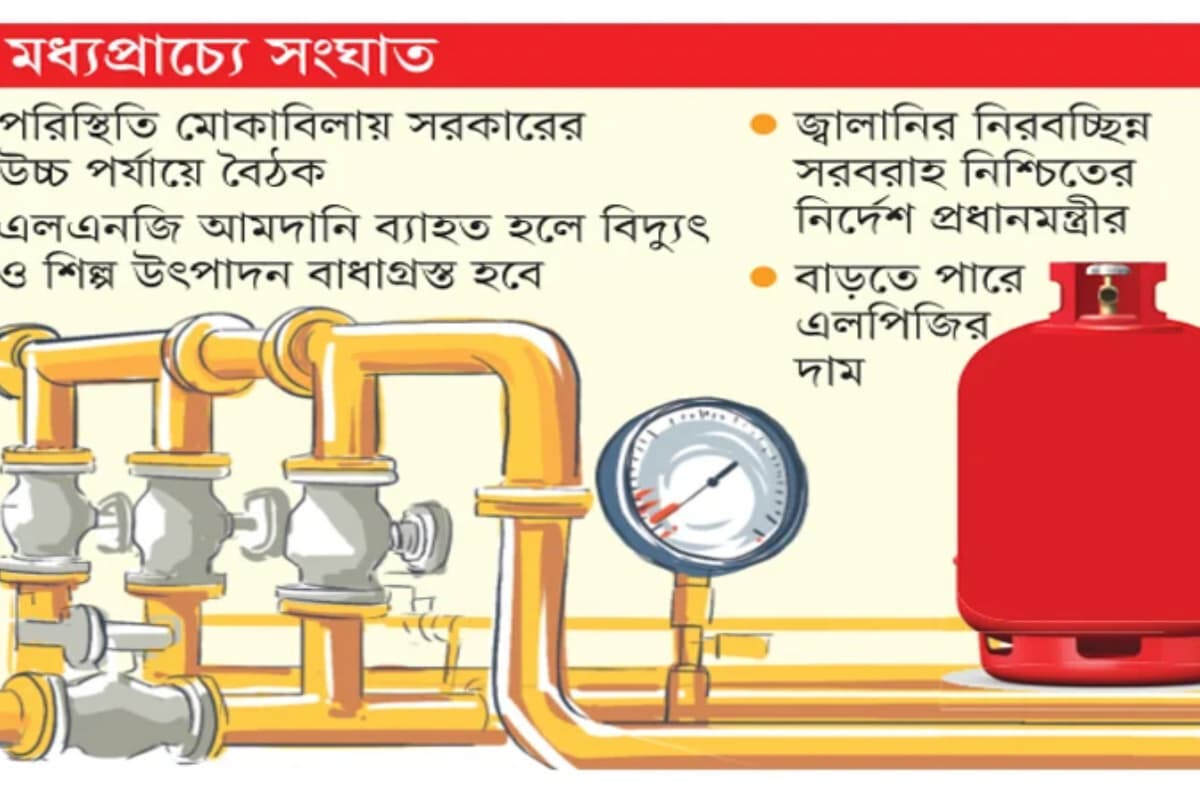
Rising tensions between Israel and Iran in the Middle East have heightened concerns over Bangladesh’s energy security. Experts warn that any disruption in the import of liquefied natural gas (LNG) or liquefied petroleum gas (LPG) could significantly impact electricity generation and industrial operations across the country.
Since January, the LPG market has experienced sharp instability. In February, consumers were compelled to purchase cylinders at nearly double the government-set price. Although prices have slightly eased, customers are still paying an additional 400–500 taka per cylinder. Analysts fear that ongoing Middle East conflicts could reignite volatility in the LPG market, creating further challenges for domestic energy supply.
Last Sunday, the Prime Minister was briefed on the national energy situation during a high-level meeting at the Secretariat. Attendees included the Foreign Affairs Advisor, the State Minister for Energy, and senior officials from the energy and commerce sectors. The Prime Minister emphasised the necessity of maintaining uninterrupted fuel supplies under all circumstances. Following the meeting, Foreign Affairs Advisor Humayun Kabir reassured journalists that Bangladesh would not face an immediate energy shortage despite regional tensions.
Bangladesh’s daily gas supply ranges from 2.6 to 2.7 billion cubic feet, with approximately 950 million cubic feet reliant on LNG imports. Annually, around 6 million tonnes of LNG are imported via 115 cargo shipments. Of this, approximately 4 million tonnes are secured under long-term contracts with Qatar, while the remainder comes from Oman and spot markets. Currently, two floating storage and regasification units in Moheshkhali regulate LNG temperatures and feed the national grid. Eleven cargo shipments are scheduled for March, nine of which have already safely navigated the Strait of Hormuz.
LNG Supply Overview
| Supply Item | Quantity |
|---|---|
| Daily gas supply | 2.6–2.7 billion cubic feet |
| LNG imports | ~950 million cubic feet |
| LNG from Qatar | 4 million tonnes |
| Total LNG cargo shipments | 115 |
Bangladesh imports around 1.8 million tonnes of LPG annually, predominantly controlled by private companies. Last November, a 44% drop in LPG imports triggered a severe shortage in January. Imports increased in February after government approvals, with 91,000 tonnes received through Chattogram and Mongla ports by 21 February—an increase of 44% compared with the previous month. Despite a reduction in customs duties and an official price cut of 15 taka for 12kg cylinders on 24 February, actual market prices remain between 1,600–1,850 taka per cylinder.
Bangladesh requires roughly 7 million tonnes of petroleum annually. The government has authorised imports of 2.82 million tonnes from January to June. While storage capacity allows for 36 days of supply, current reserves range between 15–30 days. Stockpiles include diesel (12 days), petrol (19 days), octane (29 days), and furnace oil (90 days). An additional 15–20 days of supply is en route via maritime routes.
Energy Secretary officials confirmed that, despite regional conflicts, alternative shipping routes will ensure delivery of remaining LNG cargoes. Prices of diesel, petrol, octane, and kerosene are expected to remain stable.
Energy expert Dr. M. Tamim noted that Middle East conflicts pose a severe warning for import-dependent nations like Bangladesh. Sudden price spikes in petroleum, LNG, and LPG remain a realistic risk.
In conclusion, while the government has taken proactive measures, international instability continues to pose a potential threat to Bangladesh’s energy security, underscoring the need for constant monitoring and contingency preparedness.


Comments