Sunday, 5th April 2026

Khabor Wala Desk
Published: 4th March 2026, 12:18 AM
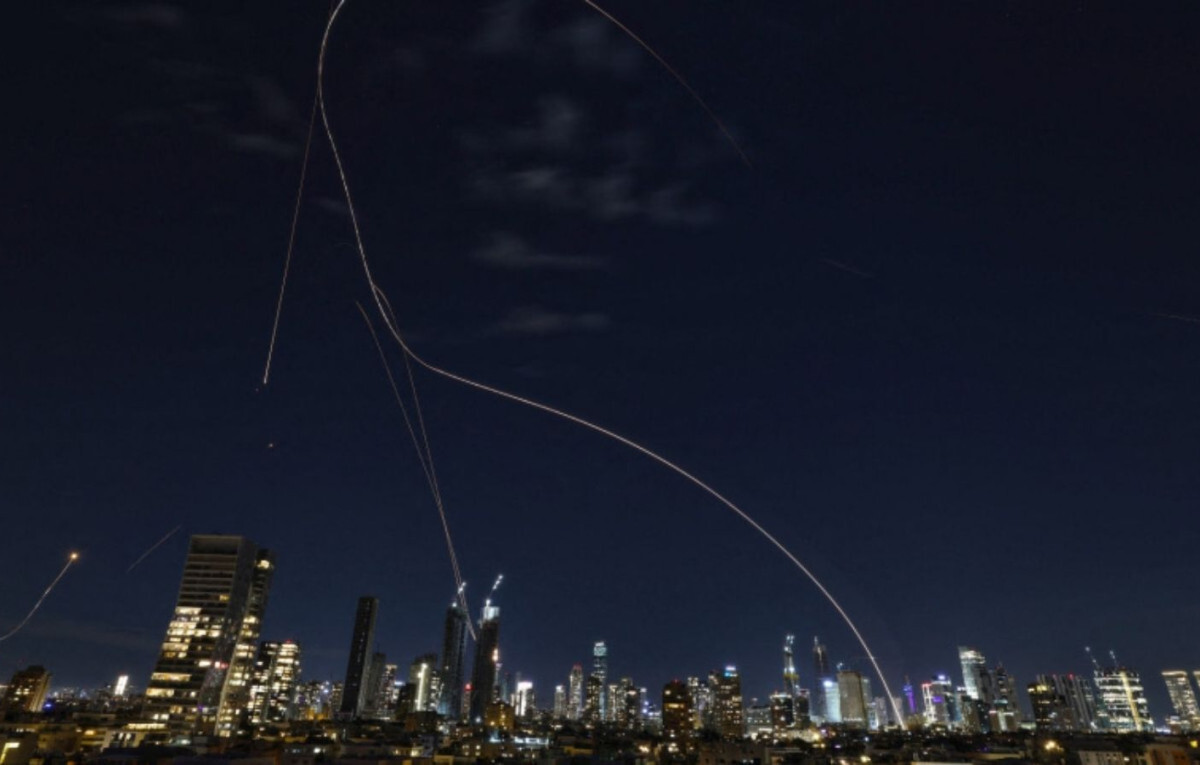
The escalating conflict in the Middle East has evolved into a high-stakes duel of mathematical exhaustion. It is a symmetrical struggle defined by two competing trajectories: the arc of incoming Iranian drones and ballistic missiles, and the rising streaks of Western interceptors rising to meet them. As the regional conflagration enters a critical phase, military analysts are asking a singular, pressing question: which side will run out of “arrows” first?
According to an analysis by AFP, citing data from open-source intelligence firm Mintel World, the opening 48 hours of the renewed hostilities saw Iran discharge a staggering 400 missiles and 1,000 drones targeting various installations across the UAE, Kuwait, Bahrain, Qatar, and Jordan.
Scott Benedict, an expert at the Middle East Institute and a former Marine officer, describes the situation as a classic survivalist race. “It is a competition of stockpiles,” he noted. “Like two archers firing at one another, the loser is simply the one whose quiver empties first.”
While US President Donald Trump has asserted that American interceptor stocks are “virtually limitless,” the logistical reality painted by defense researchers is far more sobering. Sophisticated anti-ballistic systems, such as the THAAD (Terminal High Altitude Area Defense) and the Patriot (MIM-104), are not only eye-wateringly expensive but are produced at a rate that cannot keep pace with high-intensity warfare.
The Logistics of Interception:
| System/Statistic | Estimated Annual Production | Usage in Recent 12-Day Conflict |
|---|---|---|
| THAAD Interceptors | ~96 units | 150 units (Estimated) |
| Patriot Interceptors | ~600 units | High-volume depletion |
| Interception Ratio | 2 Interceptors per 1 Ballistic Missile | N/A |
| Estimated Iranian Stockpile | 2,000+ Long-range missiles | Thousands of low-cost drones |
Etienne Marcuz, a researcher at the France-based Foundation for Strategic Research, warns that the current “burn rate” of interceptors is unsustainable. During a previous 12-day skirmish, Israel and its allies exhausted nearly 150 THAAD missiles—exceeding an entire year’s manufacturing output.
Faced with the reality that they cannot intercept their way to victory, the US-Israeli coalition has shifted its strategy. US Defence Secretary Pete Hegseth recently characterised the new doctrine as “shooting the archer rather than the arrow.” This involves prioritising the destruction of Iranian mobile launchers and production facilities over the reactive shooting of incoming projectiles.
However, Iran’s strategy appears to be one of “calibrated persistence.” By mixing high-end ballistic missiles with swarms of low-cost, expendable drones, Tehran forces its adversaries to expend million-dollar interceptors on thousand-dollar targets.
While the density of Iranian strikes has fluctuated, experts remain divided on the cause. Is Tehran conserving its remaining “quiver” for a grand, coordinated offensive, or has its launch capacity been significantly degraded by coalition strikes?
The consensus among analysts is that while Iran’s missile capability cannot be entirely neutralised, the war has become a test of industrial endurance. Without a political resolution, the region faces a protracted, “low-boil” conflict where the ultimate victor may not be the one with the best technology, but the one with the most resilient supply chain.


Comments