Sunday, 5th April 2026
Khabor Wala Desk
Published: 5th March 2026, 11:40 PM
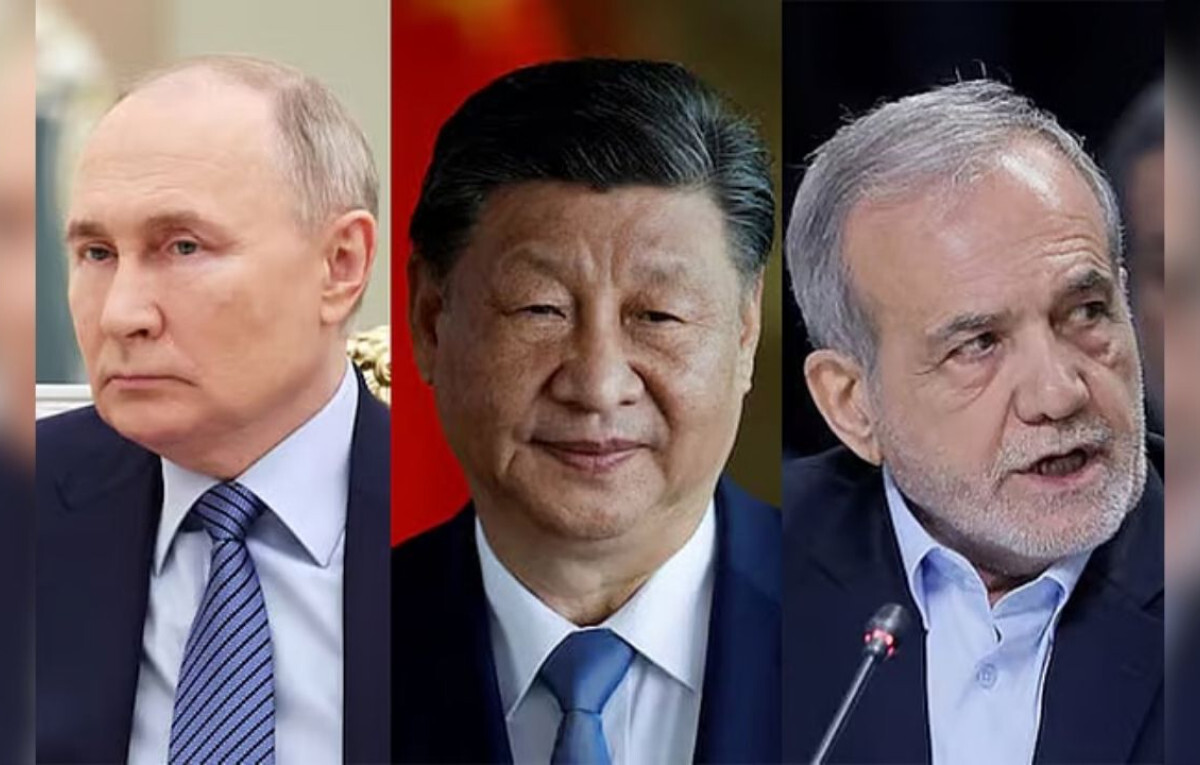
The escalating conflict involving Iran, Israel, and the United States has cast a harsh spotlight on the geopolitical alignment of the world’s emerging “triple axis.” While Moscow and Beijing have frequently voiced their opposition to Western hegemony, the current crisis reveals a calculated distance between rhetoric and military commitment. Despite the loss of over a thousand lives and the provocative assassination of Iran’s leadership, the expected “shield” from Russia and China appears more diplomatic than kinetic.
In the wake of the recent strikes, the Kremlin and Zhongnanhai were swift to issue condemnations. President Vladimir Putin described the targeted strikes against Iranian leadership as a “brutal violation of all norms of human morality,” while Chinese Foreign Minister Wang Yi cautioned his Israeli counterpart, Gideon Sa’ar, that “force can never be a true solution.”
However, beneath this veneer of solidarity lies a pragmatism defined by treaties that offer partnership without protection. While Russia and Iran signed a comprehensive Strategic Partnership Treaty in January 2025, experts note a glaring omission: a mutual defence clause. Unlike Moscow’s 2024 pact with North Korea, which mandates military intervention, the Iranian agreement merely obliges the parties to refrain from “hostile acts” against one another during a conflict.
For Russia, the priority remains the Ukrainian theatre and potential grand bargains with Washington. Andrei Kortunov of the Valdai Discussion Club suggests that Moscow is unwilling to risk a direct confrontation with the West over Tehran, especially as it seeks a mediated exit from its own regional quagmire. Similarly, China’s involvement is strictly framed by its “non-interference” doctrine.
| Feature | Russia-Iran Treaty (2025) | China-Iran Pact (2021) |
|---|---|---|
| Primary Scope | Defence, Intelligence, & Transport | Energy, Trade, & Infrastructure |
| Duration | Comprehensive / Long-term | 25-Year Cooperation |
| Military Clause | No Mutual Defence Obligation | Strictly Non-Interventionist |
| Economic Lever | North-South Transport Corridor | Belt and Road Initiative |
| Key Export | Military Hardware & Tech | 87.2% of Iran’s Crude Oil |
The relationship between Beijing and Tehran is particularly lopsided. While Iran relies on China for nearly 90% of its oil exports, making Beijing its economic lifeline, Iran remains a peripheral player in China’s global trade portfolio. This asymmetry allows China to play the role of a “protective mediator,” focusing on regional stability to safeguard its own energy interests rather than providing the sophisticated weaponry Tehran desperately seeks.
As Associate Professor Dylan Loh of Nanyang Technological University observes, China’s stance has turned “protective” in a defensive sense—aiming to prevent a regional collapse that would disrupt global markets. For the architects of Tehran’s foreign policy, the realization is setting in: while Moscow and Beijing are happy to use Iran as a counterweight to the US, they are not yet prepared to bleed for it.


Comments