Sunday, 5th April 2026

Khabor Wala Desk
Published: 5th December 2025, 2:24 AM
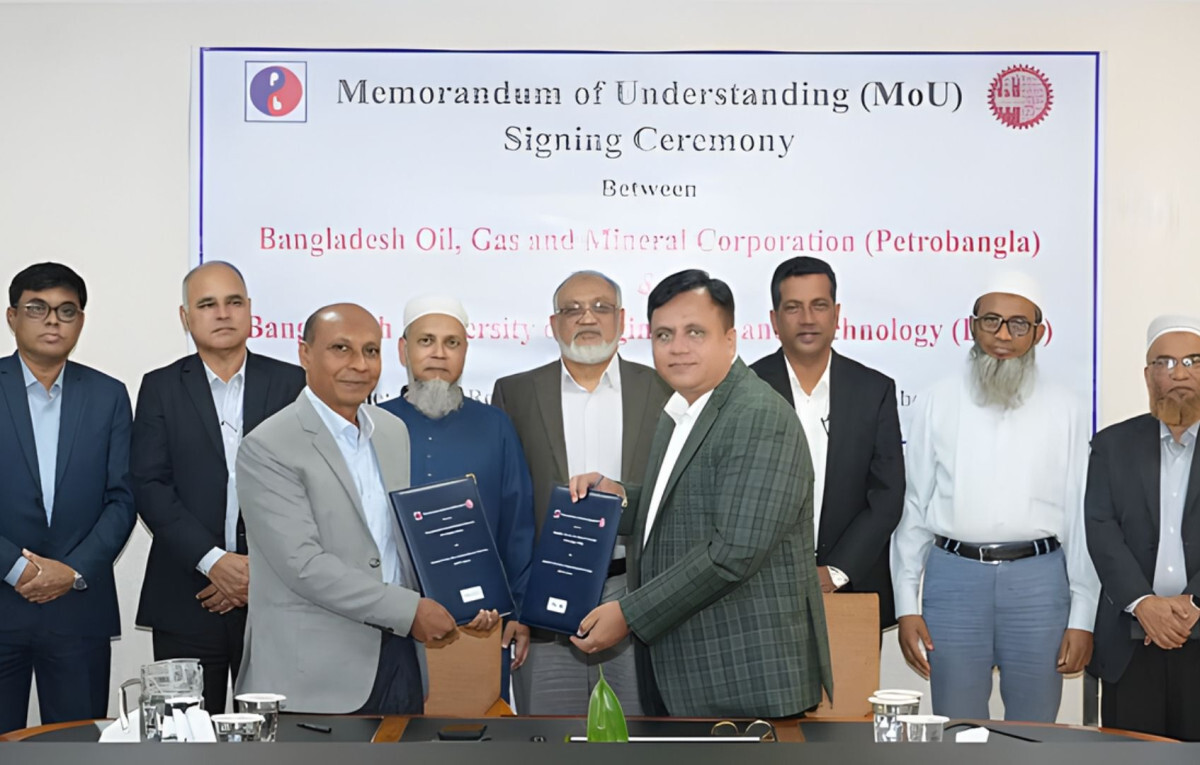
Bangladesh’s national oil, gas and mineral corporation, Petrobangla, has signed a five-year memorandum of understanding with the Bangladesh University of Engineering and Technology (BUET) aimed at expanding joint research and academic collaboration. The agreement was formalised on Thursday in a ceremony held at Petrobangla’s conference hall, marking a significant step towards stronger cooperation between industry and academia.
In its official statement, Petrobangla described the MoU as a strategic partnership that will benefit both parties by facilitating the sharing of knowledge, technological resources and professional expertise. The collaboration will focus on strengthening institutional capacity, enhancing research output, and providing structured opportunities for training. Additionally, the two organisations plan to arrange meetings, seminars and workshops to further broaden scientific understanding and skill development among students, researchers and technical personnel.
Present at the ceremony were BUET Vice-Chancellor Professor Abu Borhan Mohammad Badrizzaman and Petrobangla Chairman Md Rejanur Rahman. The document was signed by Petrobangla Secretary Md Amzad Hossain and Professor Muhammad Shariful Islam, Director of the Research and Innovation Centre for Science and Engineering (RISE), who represented BUET.
According to Petrobangla, the agreement opens the door for BUET academics and students to use corporate laboratories, specialised software and other technical resources. They will also have opportunities to visit drilling fields, coal mines, geological survey sites and processing facilities when relevant to academic research. Such access is expected to improve the quality of applied research and provide students with firsthand experience of the industrial processes that underpin Bangladesh’s energy and mineral sectors.
The MoU explicitly states that BUET may request non-confidential data from Petrobangla to support academic research. Information considered sensitive, restricted or related to national security will remain off-limits. Nonetheless, the provision of operational data and access to field sites is expected to substantially advance academic understanding and enable the practical application of engineering research.
A key feature of the partnership is its long-term outlook. The agreement contains an automatic renewal clause, allowing it to be extended for a further five years upon completion of the initial term. This reflects the intention of both parties to maintain a sustained relationship that supports continuous research and technological advancement.
The press release highlights that collaboration between educational institutions and specialised industries is a common global practice, recognised as essential for scientific progress and technological innovation. It underscores that this partnership is not merely about transferring knowledge from one institution to another, but rather about achieving mutual growth and strengthening the country’s scientific and engineering capabilities.
BUET, widely known as Bangladesh’s foremost engineering university, has a distinguished record of producing graduates who excel in influential positions both at home and overseas. By partnering with Petrobangla, the university aims to further enhance its research capacity and ensure that academic programmes reflect the realities and demands of the nation’s energy and mineral sectors.
Petrobangla officials stated that the collaboration will help develop a highly skilled workforce capable of addressing emerging challenges in the energy industry. With greater access to research facilities and field operations, BUET researchers are expected to generate insights that could contribute to improving resource exploration, energy efficiency and technological innovation.
Both organisations expressed optimism that the MoU would strengthen Bangladesh’s scientific and technological foundation, support long-term national development and open new pathways for advanced engineering research.

Comments