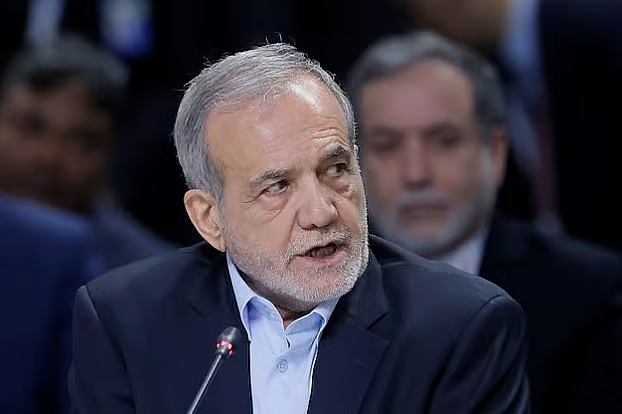
Iranian President Masoud Pezeshkian has formally challenged the authority of United States President Donald Trump regarding Iran’s nuclear programme. During a recent address, Pezeshkian asserted that the United States possesses no legal or sovereign right to strip Iran of its nuclear capabilities. These remarks come amidst a period of heightened diplomatic friction between Tehran and Washington, as both nations continue to navigate a long-standing impasse over nuclear enrichment and international sanctions.
Sovereignty and International Law
According to reports from the Iranian Students’ News Agency (ISNA), President Pezeshkian questioned the legal basis for the restrictions proposed by the Trump administration. He was quoted as saying: “Trump says, ‘Iran cannot use its nuclear rights.’ But he does not state for what crime this obstruction is being imposed. Who is he to take away the rights of a nation?”
The Iranian leadership maintains that its nuclear activities are governed by the Treaty on the Non-Proliferation of Nuclear Weapons (NPT), to which Iran is a signatory. Under Article IV of the NPT, member states are granted the “inalienable right” to develop research, production, and use of nuclear energy for peaceful purposes without discrimination. Tehran argues that any unilateral attempt by the United States to bypass these international frameworks constitutes a violation of national sovereignty.
Historical Context and the JCPOA
The current tension is deeply rooted in the 2018 decision by the Trump administration to unilaterally withdraw the United States from the Joint Comprehensive Plan of Action (JCPOA). This landmark 2015 agreement sought to limit Iran’s nuclear programme in exchange for the lifting of crippling economic sanctions. Following the US withdrawal and the subsequent “maximum pressure” campaign, Iran gradually exceeded the limits set by the deal, citing the failure of other signatories to provide the promised economic relief.
| Key Event | Year | Description |
| JCPOA Signing | 2015 | Iran, the P5+1, and the EU agree on a nuclear framework. |
| US Withdrawal | 2018 | President Trump exits the deal and reimposes sanctions. |
| Strategic Action Plan | 2020 | Iran’s Parliament passes a law to increase uranium enrichment levels. |
| Pezeshkian Inauguration | 2024 | Masoud Pezeshkian takes office, advocating for a “constructive” but firm foreign policy. |
Diplomatic Implications
The rhetoric from President Pezeshkian reflects a broader strategy of defiance against unilateral Western dictates while leaving the door ajar for diplomacy based on “mutual respect.” The Iranian government continues to state that its programme is purely civilian, intended for medical isotopes, agricultural research, and power generation. However, the United States and its allies remain concerned regarding the purity levels of Iran’s enriched uranium, which currently exceed the 3.67% limit established in the 2015 accord.
By questioning the authority of the American executive, Pezeshkian is positioning the nuclear issue as a matter of fundamental national dignity. This stance is intended to signal to the international community that any future negotiations must recognise Iran’s legal rights as a sovereign state, rather than being dictated by the domestic policies of a foreign power. As the geopolitical landscape shifts, the rhetoric from Tehran suggests that the path to a renewed agreement remains contingent on the removal of what they perceive as unlawful external interference.