Sunday, 5th April 2026

Khabor Wala Desk
Published: 13th August 2025, 1:33 PM
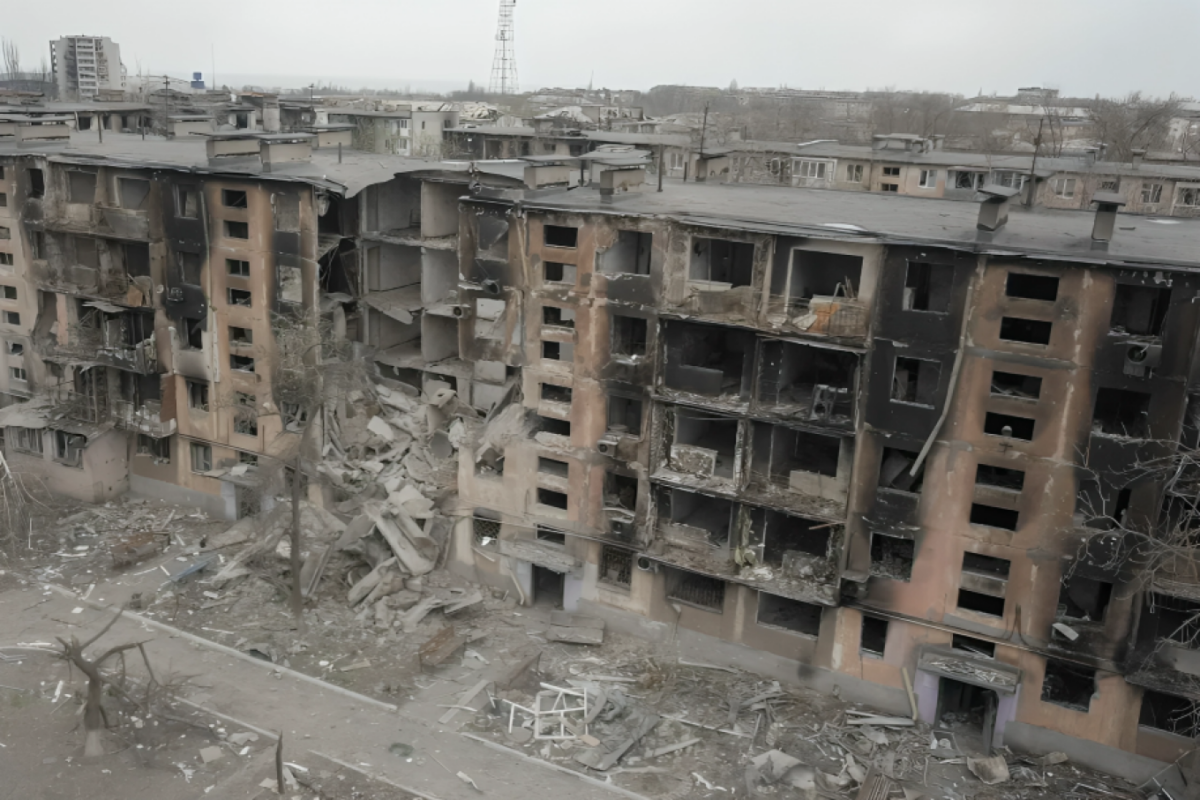
Sun-seekers crowded the beaches of Mariupol in Russian-controlled eastern Ukraine, a city devastated by war that Moscow now seeks to transform into an unlikely seaside resort.
“Take a dip in the Sea of Azov!” said 52-year-old local Ivan, who, like other beachgoers, enjoyed the good weather and mild waters of the coastline now entirely under Russian control.
“Mariupol was, is and will be Russian,” he added.
The slogan mirrors Moscow’s repeated messaging since it captured the city in May 2022 after a prolonged siege. Exiled Ukrainian authorities estimate that 22,000 civilians died in the offensive, while the UN reports that 90 percent of Mariupol’s housing was damaged or destroyed.
Some 300,000 of the pre-war population of 540,000, predominantly Russian-speaking, have fled, according to exiled city officials.
President Vladimir Putin hailed Mariupol’s “liberation,” while Kyiv and the majority of the international community condemned it as an occupation. In September 2022, Russia announced the annexation of four Ukrainian regions, including Donetsk, where Mariupol is located, though it does not fully control all areas.
Mariupol’s defenders during the early weeks of Russia’s offensive, particularly those who held out in the final days at the Azovstal steelworks, remain symbols of Ukrainian resilience.
Reconstruction and Propaganda
Russia promised in 2022 to rebuild Mariupol within three years, intending to showcase the city as a model of prosperity in occupied Ukraine.
Denis Kochubey, Mariupol’s exiled deputy mayor, described Moscow’s efforts as “a large-scale propaganda project” aimed at erasing the memory of Russia’s actions by presenting a facade of development.
AFP reporters observed cement mixers and construction activity, alongside Russian military vehicles moving between Mariupol and front-line positions, about a two-hour drive away.
New apartment blocks have appeared near the Azovstal site. Pensioner Galina Giller, 67, received a one-bedroom flat for free from Moscow-installed authorities in May 2024.
“They wrote to me saying I would get an apartment without any preconditions. They gave us the keys, we came to see it, and I ordered furniture,” she said.
Giller, who fled initially to Donetsk and then Crimea in 2022, expressed sorrow for ordinary Ukrainians. Like many residents willing to speak to AFP, she is a Russian speaker with Ukrainian citizenship and now also holds a Russian passport. Moscow has distributed 3.5 million passports in occupied Ukrainian regions, a policy Kyiv condemns as illegal.
Residents holding Russian passports gain access to social benefits and protection from property expropriation. In March, Putin issued a decree requiring Ukrainians in Russian-controlled areas to “regularise their legal status” by obtaining Russian citizenship or registering as foreign residents.
Daily Life under Russian Administration
Mariupol now uses the Russian ruble, phone prefixes, and car plates. Parks feature Russian flags, and posters honour Russian soldiers as “heroes of our time,” referencing Mikhail Lermontov’s classic work.
“I don’t see any occupation here. I can travel freely on Russian territory,” said 33-year-old Renald, wearing a Wagner t-shirt.
Those opposing Russian control often remain silent or have left the city, fearing imprisonment for “collaborating with Kyiv” or “discrediting” the Russian army.
Many central Mariupol buildings have been restored. Cafés, supermarkets, and bars have reopened, with techno music drawing crowds. Lenin Avenue hosts eateries such as “Mak Fly” serving burgers and fries.
The bombed-out theatre, which Ukraine claims was deliberately targeted despite sheltering civilians, is also being rebuilt. Amnesty International reports that the March 2022 strike killed “at least a dozen people and likely many more.”
Cultural Rewriting
One notable symbol of Russian control is the Zhdanov Museum, inaugurated in 2025 on the site of a former local folklore museum. Dedicated to Mariupol-born Soviet politician Andrei Zhdanov (1896-1948), the museum celebrates his role in Soviet cultural policy. Museum director Pavel Ignatev dismissed accusations that Zhdanov authorised repression.
Life Outside the City Centre
Outside the centre, quiet roads reveal homes gutted by fighting. Many doors still bear bullet holes and Russian markings such as “Children,” “Residents,” or “Bodies.” Despite Moscow’s ambitions, Mariupol remains far from the seaside resort vision, with frequent power and water cuts.
Residents like Sergei, 52, live in partially destroyed houses with weeds in the garden. He has sought compensation from authorities multiple times but received no guidance.
AFP reports note allegations of corruption over reconstruction funds, with some exiled authorities stating that Russian-installed officials are reallocating “ownerless” homes and apartments to those who remained or whose properties were destroyed during the siege.
Housing Market
Real estate agent Luisa Nalivay claims her firm has been active in Mariupol since the end of fighting. Housing prices have risen from 85,000 rubles per square metre in 2022 (≈$1,050) to 200,000 rubles ($2,500) today, aided by low two percent mortgage rates for Russians relocating to Mariupol.
“Many people from Russian regions want to move here for work, the climate, or family reasons,” Nalivay said.
Air quality is reportedly good as metalworks remain inactive, attracting newcomers such as Elena from Yekaterinburg, who purchased property for investment purposes.
Surveillance and Fear
Despite the superficially revived city, fear and surveillance are pervasive. Residents are warned against speaking to foreigners. One anonymous local recounted:
“After I spoke to you, a big guy warned me against speaking to foreigners. I told him he could go and talk to the police if he wanted. I did not say anything incriminating.”
Mariupol remains a city divided between reconstruction efforts, propaganda, and the lingering memory of war.
Data Table
| Aspect | Details |
| Pre-war population | 540,000 (predominantly Russian-speaking) |
| Estimated civilian deaths | 22,000 (exiled authorities) |
| Housing damage | 90% damaged or destroyed (UN) |
| Residents fled | ~300,000 |
| Russian passports distributed | 3.5 million across occupied territories |
| Notable reconstructions | Apartment blocks, bombed theatre, Zhdanov Museum |
| Housing price rise | 85,000 → 200,000 rubles/m² |
| Currency & administration | Russian ruble, phone prefixes, car plates, passports |
| Risks | Arrests for dissent, propaganda enforcement, surveillance |

Comments