Sunday, 5th April 2026

Khabor Wala Desk
Published: 30th March 2026, 8:46 AM
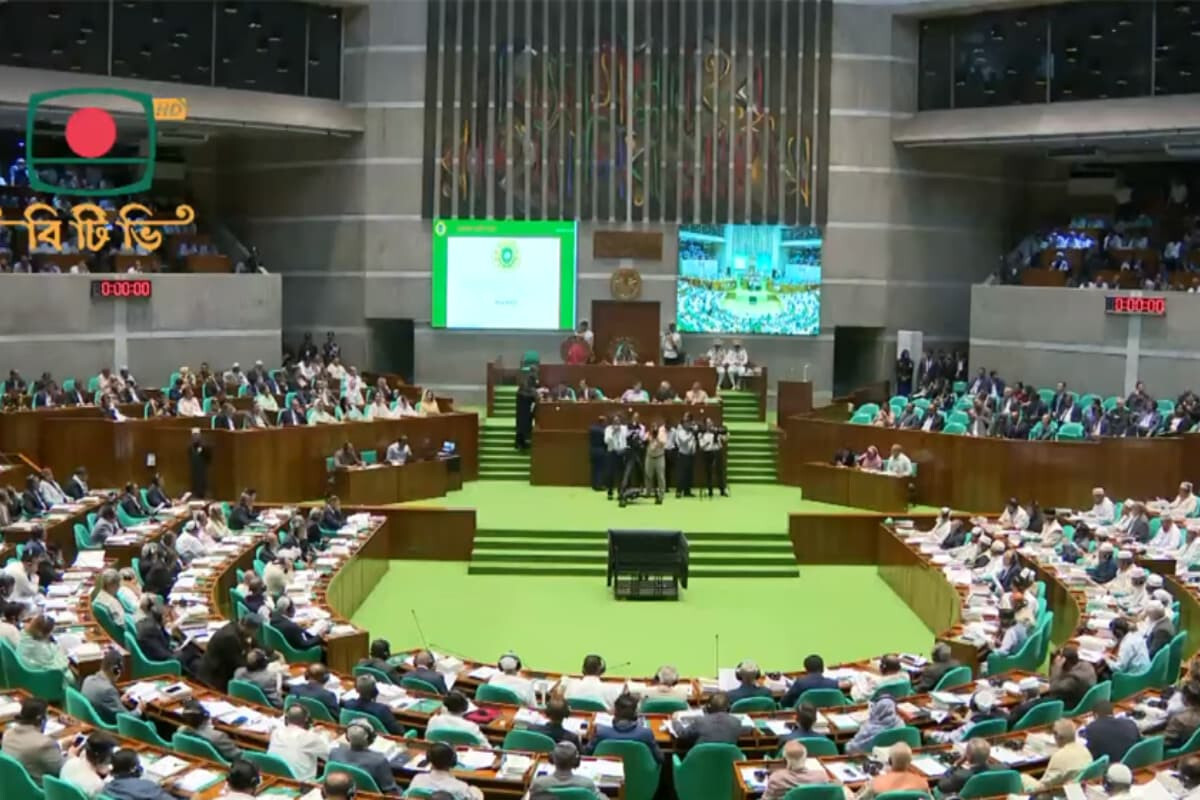
The recently concluded referendum, held under the authority of the so-called “Referendum Ordinance,” has effectively rendered the ordinance obsolete, with no requirement to pass it as a bill in Parliament, according to Home Minister Saluddin Ahmed.
Speaking to reporters on Sunday evening (29 March) following a special committee meeting at the National Parliament Building, the minister confirmed the government’s decision.
The ruling party’s stance has drawn a formal note of dissent from Jamaat-e-Islami, reflecting ongoing disagreements over legislative matters.
Beyond the referendum ordinance, at least 15 of the 133 ordinances issued by the caretaker government have not found unanimous approval between the government and opposition parties. The ruling party seeks amendments to ordinances related to the Human Rights Commission, judicial appointments, enforced disappearances, and the Anti-Corruption Commission, prompting objections from Jamaat.
Addressing questions on the referendum ordinance, Home Minister Ahmed explained, “The purpose for which the referendum ordinance was enacted has already been fulfilled. The referendum has taken place, and there will be no further referenda under this ordinance. Therefore, there is no point in reintroducing it as a bill for parliamentary approval.”
He elaborated that, under Article 93 of the Constitution, ordinances must be presented to Parliament, and their fate determined within 30 days of a parliamentary session. “This particular ordinance was not part of the Constitution; it was a temporary legal instrument for conducting a referendum, and its function has concluded,” he added.
Regarding the committee’s proceedings, Minister Ahmed said that discussions encompassed all 133 ordinances. While many will pass as originally drafted, some will be presented in amended form. Given time constraints, not all ordinances can be introduced before the 10th of the month; the remaining ones will be taken up in a subsequent session.
The minister acknowledged that both government and opposition members of the special committee issued notes of dissent on certain ordinances. “Their statements will be duly reflected in the committee report. During parliamentary readings, all members will have the opportunity to voice their positions,” he noted.
On the fate of ordinances not introduced within the 30-day limit, he clarified, “Any ordinance not brought as a bill within the prescribed period automatically lapses. This poses no difficulty, as they can be reintroduced in the next session, especially those with lasting effects, such as boundary demarcation and administrative appointments.”
The third day of the special committee meeting, chaired by Zainul Abedin, convened in the Cabinet Room from 8:30 pm for three hours. Key participants included Chief Whip Nurul Islam, Law Minister Md. Asaduzzaman, Dr. Muhammad Osman Faruk, A.M. Mahbub Uddin, State Minister for Public Administration Md. Abdul Bari, Muhammad Nawshad Zamir, State Minister for Social Welfare Farzana Sharmin, and Md. Mujibur Rahman. Representing Jamaat were Mojibur Rahman and G.M. Nazrul Islam, with Mohammad Nazibur Rahman attending at the committee’s invitation.
| Ordinance Category | Government Position | Opposition Response |
|---|---|---|
| Referendum Ordinance | Not required to pass | Note of dissent (Jamaat) |
| Human Rights Commission | Amend | Objection |
| Judicial Appointments | Amend | Objection |
| Anti-Corruption Commission | Amend | Objection |
| Enforced Disappearances Prevention | Amend | Objection |
| Remaining 128 ordinances | Pass as-is or amend later | Mixed responses |
With the majority of ordinances either set for approval or deferred, the parliamentary agenda for the coming sessions will focus on converting essential ordinances into law while ensuring dissenting voices are formally recorded.




Comments