Sunday, 5th April 2026

Khabor Wala Desk
Published: 5th December 2025, 2:02 AM
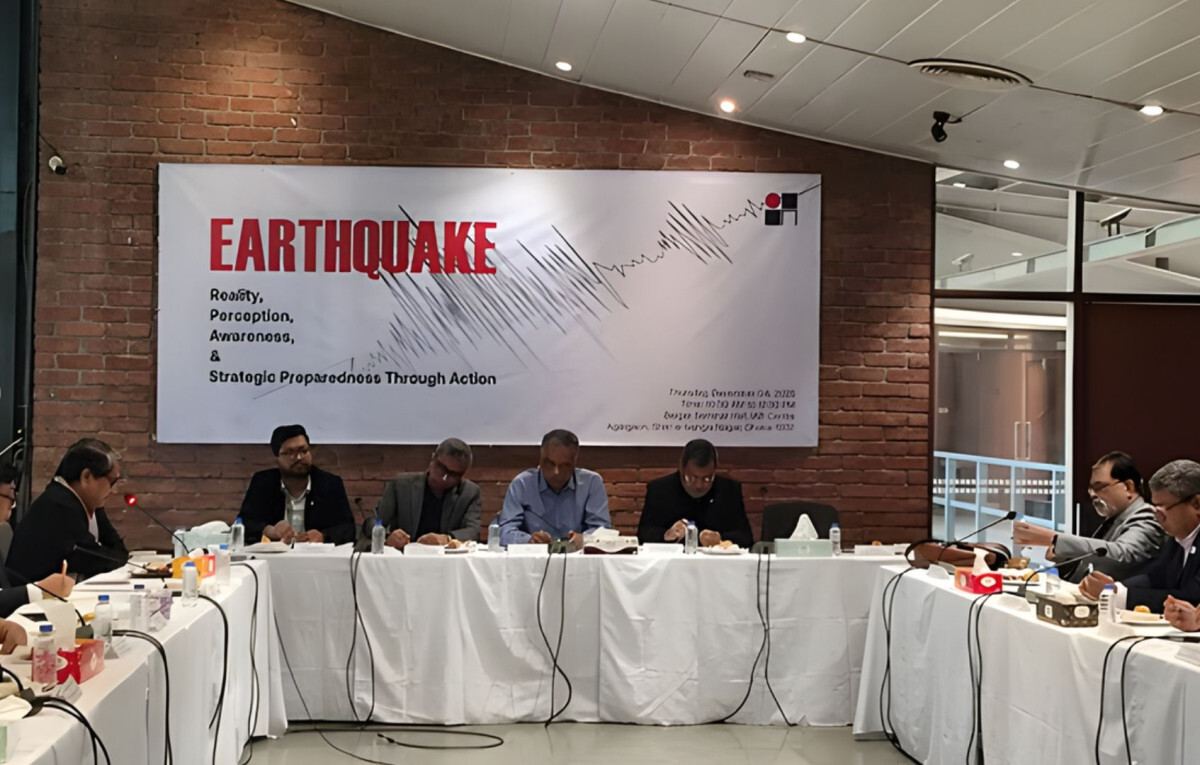
Ensuring the protection and continuity of essential services during major disasters such as earthquakes has become an increasingly urgent concern among architects, engineers and disaster-management specialists in Bangladesh. Hospitals, the Secretariat, fire service stations and key administrative buildings at the district level must remain fully functional during emergencies, they warned. Alongside this, experts emphasised the need for designating open spaces where the public can gather during disasters, strengthening civil defence mechanisms, and conducting regular nationwide drills to raise awareness about earthquake preparedness.
These observations were shared on Thursday at a discussion event titled “Earthquake: Reality, Perception, Awareness and Strategic Preparedness Through Action”, organised by the Institute of Architects Bangladesh (IAB) in Agargaon, Dhaka.
Eminent structural engineer Emeritus Professor Dr Shamim Z Basunia explained that Bangladesh’s vulnerability does not stem from a lack of technical knowledge, but from inconsistent application. “If the structural engineers who possess the skills and experience carry out their responsibilities properly, and if construction supervision is done with diligence, there is no reason to be afraid,” he said, stressing the importance of enforcing engineering standards at every stage of development.
Former Chief Architect of the Ministry of Housing and Public Works, Kazi Golam Nasir, highlighted that in the aftermath of an earthquake, vital government buildings—such as hospitals, fire service stations, and the Secretariat—must remain intact. “If these buildings collapse, disaster management collapses with them,” he cautioned. He called for systematic assessment of key structures to determine their earthquake resilience, along with the expansion of narrow roads to allow emergency vehicles and rescue teams unhindered access during disaster response.
He further warned of the high likelihood of fires following an earthquake, noting that gas-line control systems should be positioned outside buildings to reduce the risk of explosions. Strengthening oversight of construction materials and strictly enforcing building regulations are equally crucial, he added.
Patrick D’Rozario of the Bangladesh University of Engineering and Technology (BUET) cited the Japanese experience, noting that even when surrounding buildings were destroyed during a major tsunami, the country’s disaster management centres remained standing due to stringent standards. He stressed the need for hospitals and government facilities in Bangladesh to be designed as earthquake-resilient hubs capable of functioning during crises. He also reminded policymakers that the Bangladesh National Building Code includes separate guidelines for hospitals, which must be rigorously monitored.
Colonel Tajul Islam, Director (Operations) of the Fire Service and Civil Defence, underscored the urgent need for identifying risky buildings, designating safe open spaces in every neighbourhood, and mapping chemical warehouses. “If we want to reduce casualties during an earthquake, nationwide awareness drills must begin immediately,” he emphasised.
Several experts pointed out major infrastructural gaps in Dhaka. Professor Badrudozza Mia, Chair of the Department of Geology at Dhaka University, called for the establishment of a comprehensive Earthquake Research Institute, noting that the country lacks adequate data for accurate risk assessment. Chief Urban Planner of RAJUK, Md Ashraful Islam, highlighted that Dhaka has only 19 fire stations despite having 92 wards. He argued that each ward should have its own fire station as well as playgrounds that can double as emergency gathering places. “A major earthquake would leave behind massive concrete debris, and we currently lack both the space and equipment to remove it,” he warned.
Public Works Department Superintendent Engineer Shakhawat Hossain reported that following the 21 November earthquake, officials identified non-structural cracks in 277 buildings, prompting a need for thorough inspections of government facilities. Director-General of the Housing and Building Research Institute, Md Gias Uddin Hayder, stated that work to update the building code is under way, but enforcement remains the primary challenge.
Joint Secretary of the Ministry of Disaster Management and Relief, Golam Mostafa, expressed concern that Bangladesh’s preparedness remains inadequate. “Most of our activities are project-based; once a project ends, so does the work,” he noted.
Architect Kazi Azizul Maula, former BUET professor, urged authorities to study the unique seismic characteristics of the region and develop preparation strategies accordingly. He called for revitalising the Seismological Research Centre under the Meteorological Department.
Other speakers emphasised the importance of preserving playgrounds and open spaces for public safety, maintaining school grounds for gathering during emergencies, and reactivating civil defence units at neighbourhood level.
The event was moderated by IAB Vice-President Architect Nowazish Mahbub and presided over by President Professor Abu Sayeed M Ahmed. Additional remarks were delivered by BUET Professor Rakib Ahsan, IAB Vice-President Khan Md Mahfuzul Haque Jaglul, and IAB General Secretary Masud Ur Rashid.



Comments