Sunday, 5th April 2026

Khabor Wala Desk
Published: 8th March 2025, 7:25 AM
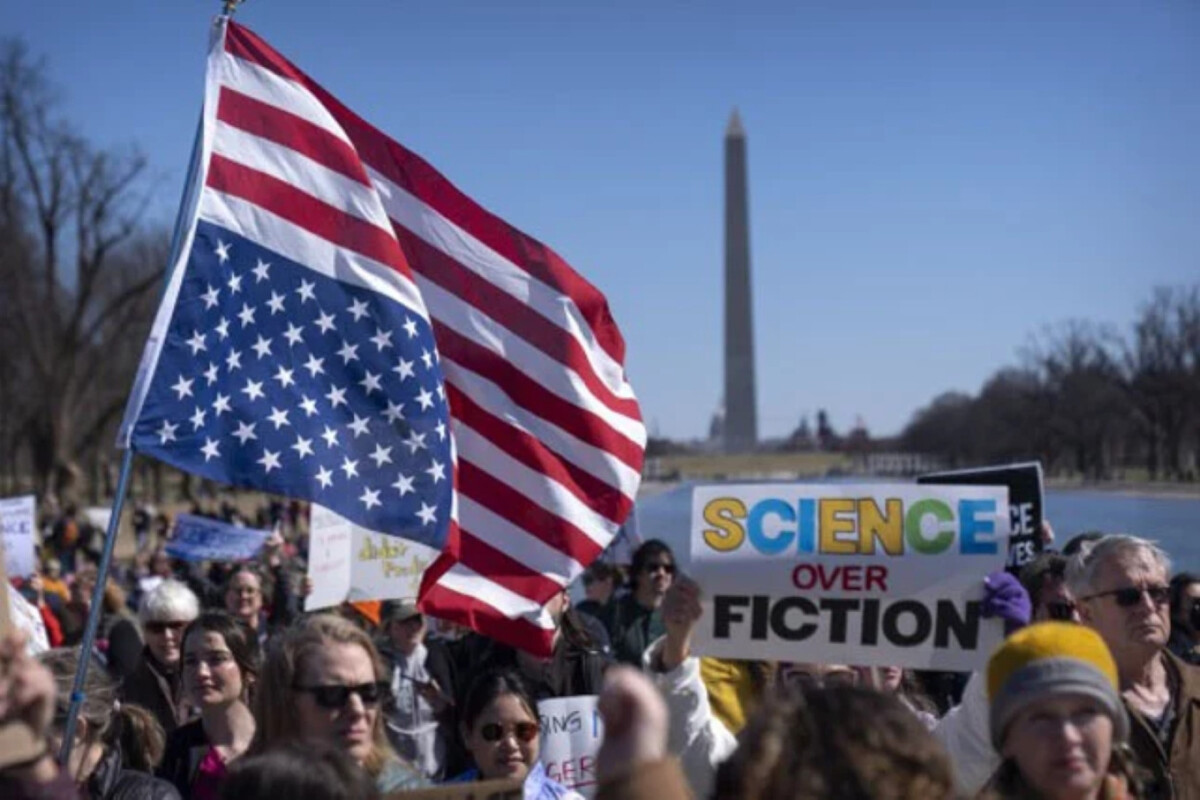
WASHINGTON, 8 March 2025 (BSS/AFP) – Scientists, academics, and professionals took to the streets in cities across the United States on Friday, protesting against sweeping cuts to research funding and the dismissal of key staff across multiple federal agencies by President Donald Trump’s administration.
Since returning to office, Trump’s government has significantly reduced federal research budgets, withdrawn from the World Health Organization and the Paris Climate Agreement, and sought to eliminate hundreds of positions dedicated to health and climate research.
In response, researchers, doctors, students, engineers, and even elected officials organised demonstrations in New York, Washington, Boston, Chicago, and Madison, Wisconsin, voicing their alarm at what they see as an unprecedented assault on scientific progress.
“I have never been this angry,” said Jesse Heitner, a researcher at Massachusetts General Hospital in Boston, who joined over 1,000 demonstrators in Washington.
“They are setting everything ablaze,” he told AFP at the Lincoln Memorial, expressing particular outrage over the appointment of vaccine sceptic Robert F. Kennedy Jr. as the head of the Department of Health and Human Services.
“If you appoint someone who believes the Earth is flat to lead NASA, that is simply unacceptable,” he said.
‘An Unprecedented Attack on Science’
Protesters held signs reading, “Fund science, not billionaires” and “America was built on science,” as they rallied outside key government buildings.
“What we are witnessing is unlike anything we have seen before,” said Grover, a university researcher in his 50s, who preferred not to disclose further details due to professional concerns.
Dressed in a white lab coat and holding a pink sign that read “Stand Up for Science,” Grover revealed that his employer had advised staff to remain discreet, fearing financial repercussions such as the suspension or cancellation of federal grants.
“I have been involved in research for over 30 years, and I have never experienced anything like this,” he said, warning that the government’s actions could have severe long-term consequences.
Concerns Over a ‘Brain Drain’
Many researchers voiced fears over the future of their grants and overall funding security. Some universities have already been forced to scale back their intake of doctoral students and research staff due to financial uncertainty.
For young scientists, the situation is particularly concerning.
“I should be at home studying, not out here fighting for my right to have a career,” said Rebecca Glisson, a 28-year-old doctoral student in neuroscience.
Glisson, who is set to defend her thesis in Maryland next week, expressed deep anxiety about her future, as the laboratory where she had planned to work has already suffered funding cuts.
Chelsea Gray, a 34-year-old environmental scientist specialising in shark conservation, had long aspired to work for the National Oceanic and Atmospheric Administration (NOAA), one of the agencies under threat due to its climate research.
However, given the current state of affairs, she has begun the process of obtaining an Irish passport.
“I followed all the right steps to build a successful career, and now I am watching it all collapse,” Gray told AFP.
“I want to stay in the United States and contribute as a scientist,” she said.
“But if that is no longer an option, I must keep all my doors open.”
Wider Implications
Experts warn that continued funding cuts and administrative interference in scientific research could push American researchers to seek opportunities abroad, leading to a ‘brain drain’ that could severely impact the country’s leadership in scientific innovation.
Similar protests were seen in 2017, when Trump’s first administration attempted to slash environmental and health research budgets, leading to the first-ever March for Science. Many scientists now fear that the damage inflicted by current policies could take years, if not decades, to undo.



Comments