Sunday, 5th April 2026

Khabor Wala Desk
Published: 6th January 2026, 11:32 AM
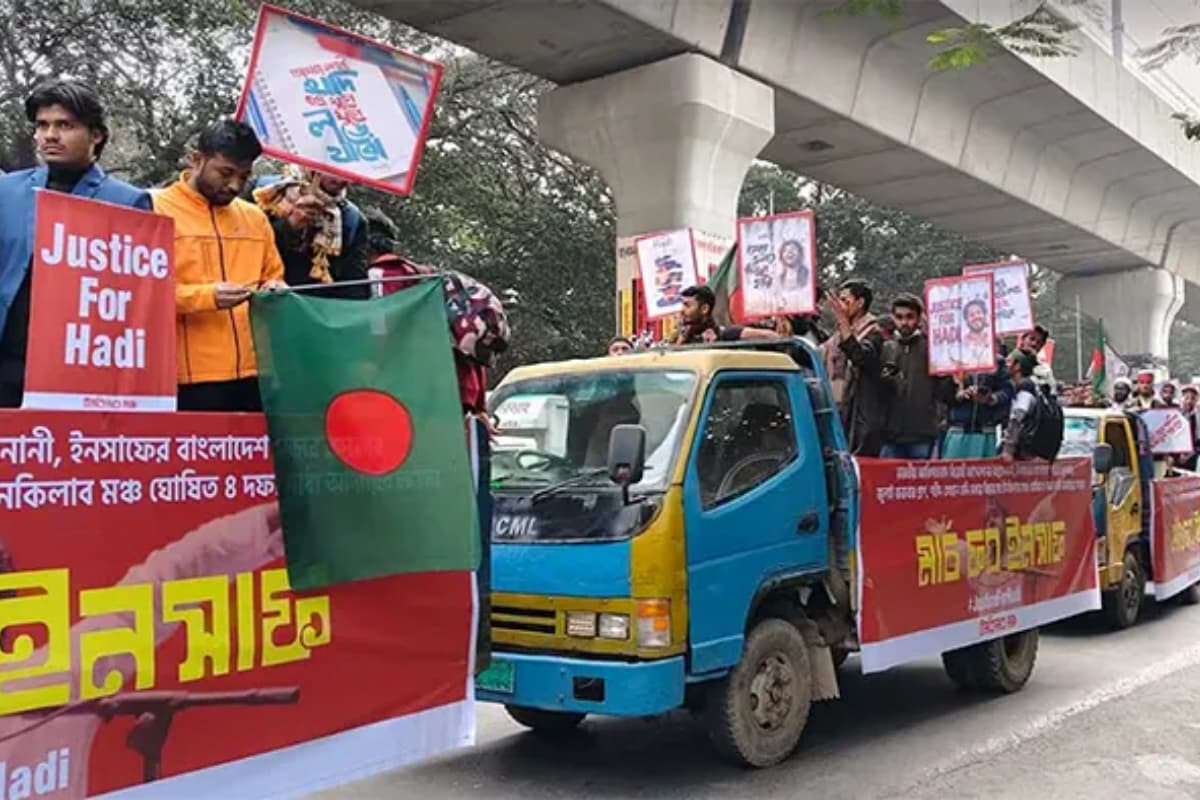
At 11:30 a.m. on Tuesday, the “March for Justice,” organised by the Inquilab Mancha, commenced from Shahbagh, the heart of Dhaka. The event drew a diverse crowd comprising political and social leaders, activists, and ordinary citizens, all united in demanding accountability for recent violent incidents.
Sharif Osman, the spokesperson for Inquilab Mancha, told reporters, “Our objective is the full implementation of four core demands. The public’s anger over the recent murder of Hadi has been particularly striking, and this march is a direct response to that outrage.”
The march route was designed to traverse several key areas of the city to maximise visibility and public engagement. Participants proceeded from Shahbagh through Science Lab, City College, Mohammadpur-Tin Rasta, Rayerbazar-Badhbhumi, Mirpur 10, Uttara, Bashundhara, Badda, Rampura, and Jatrabari, before returning to Shahbagh in the afternoon.
Sharif Osman added, “We envision a society where justice is guaranteed, and citizens can live safely. Should these four demands not be implemented promptly, our movement will escalate further.”
The four-point agenda of Inquilab Mancha is as follows:
| No. | Demand | Details |
|---|---|---|
| 1 | Justice for the murder | Ensure trial within 24 days for the murderer, conspirators, accomplices, and harbourers. |
| 2 | Cancellation of Indian work permits | Revoke all work permits of Indian nationals residing in Bangladesh. |
| 3 | Legal action at international level | File a case in international court if India refuses to hand over the perpetrators. |
| 4 | Arrest of hidden Awami Leaders | Identify, apprehend, and prosecute fascist operatives concealed within civil and military intelligence agencies. |
Local sources confirmed that the police had completed all necessary preparations to secure the entire route and ensure the convenience of the public. Special security measures were deployed at major intersections and key points along the march path.
Analysts observe that the march is not merely a reaction to a single murder but represents a broader movement for social justice and citizen security. Such public mobilisations are seen as potential precedents for holding the state accountable and strengthening legal protections for citizens.
Throughout the day, social and traditional media channels were abuzz with updates from the march, highlighting the growing civic consciousness and political engagement among Dhaka’s residents. Observers note that this demonstration could mark a pivotal moment in shaping public discourse on justice and accountability in Bangladesh.


Comments