Sunday, 5th April 2026

Khabor Wala Desk
Published: 29th January 2026, 8:38 PM
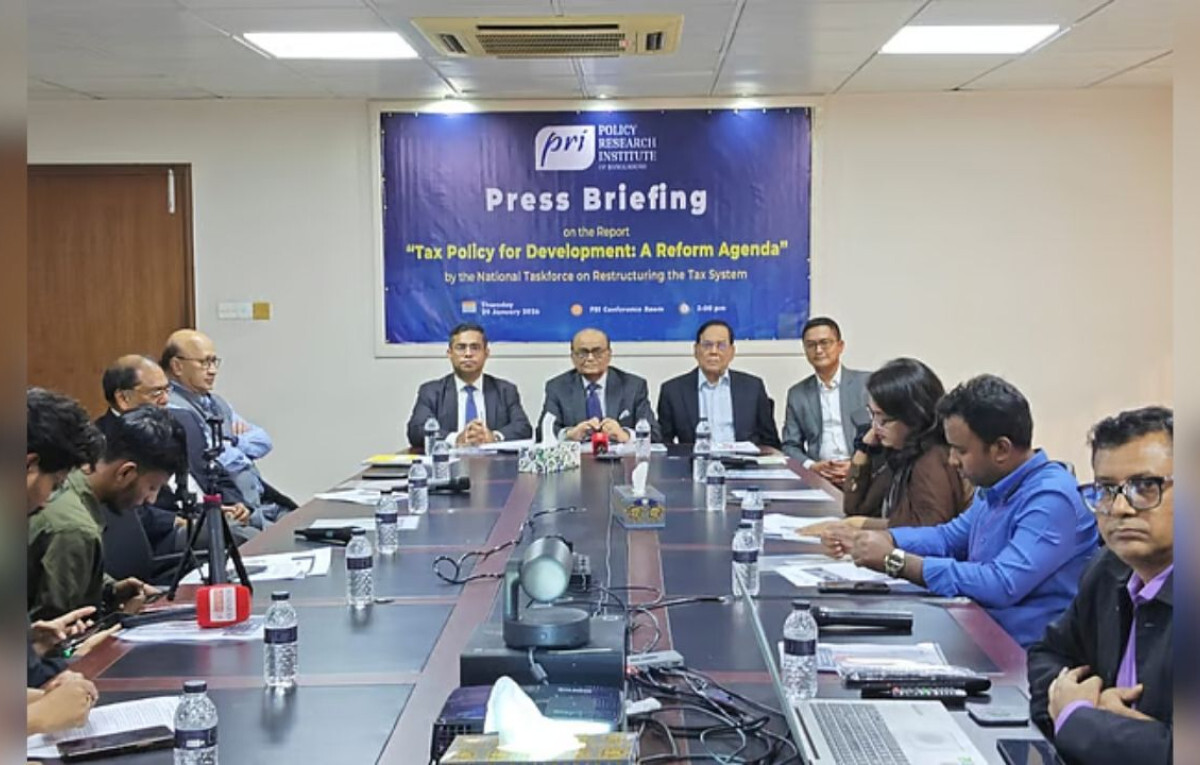
In a bold move to overhaul the nation’s fiscal landscape, the Policy Research Institute (PRI) has proposed a transformative roadmap to increase Bangladesh’s tax-to-GDP ratio to between 15% and 20% by 2035. This ambitious target represents a staggering leap from the current level, which languishes at approximately 6%—one of the lowest in the world.
During a press conference held at the PRI’s Banani office on Thursday, the task force unveiled a report titled “Tax Policy for Development: A Reform Programme for Reconstructing the Tax System.” While the document has been formally submitted to the Chief Adviser, it awaits final review before public release.
The crux of the proposal lies in rebalancing the tax structure to ensure social equity and ease of doing business. Currently, the ratio of indirect taxes (such as VAT and customs duties) to direct taxes (income tax) stands at a skewed 70:30. The task force recommends a phased shift to a 50:50 equilibrium.
By reducing the dependency on customs duties—slashing their contribution to total revenue from 28% to a mere 7.5%—the experts aim to stimulate investment and consumption, which are currently stifled by high tariffs.
The report identifies 55 priority areas across three main pillars: direct tax (32 items), VAT (10 items), and trade tax (13 items). The projected shifts in the economic landscape are detailed in the table below:
| Economic Indicator | Current Level (Approx.) | 2035 Target |
|---|---|---|
| Total Tax-to-GDP Ratio | 6.0% | 15.0% – 20.0% |
| Direct Tax Contribution to GDP | 2.5% | 9.0% – 10.0% |
| Customs Duty Contribution to GDP | 2.5% | 1.0% |
| Customs Duty in Total Revenue | 28.0% | 7.5% |
| Direct vs. Indirect Tax Ratio | 30:70 | 50:50 |
Dr Zaidi Sattar, Chairman of PRI and head of the task force, emphasised that the current “complex” tax structure acts as a barrier to trade. He argued that excessive protectionism for local markets makes domestic sales more lucrative than exports, preventing the emergence of billion-dollar industries beyond the ready-made garment (RMG) sector.
“If we do not dismantle these trade barriers, Bangladesh will face severe anti-dumping challenges following its graduation from Least Developed Country (LDC) status,” Dr Sattar warned.
To achieve these targets, the task force suggested several radical changes:
VAT Consolidation: Moving from the current seven or eight different VAT rates toward a simplified dual-rate system, eventually reaching a single uniform rate.
Personal Income Tax: Increasing the personal tax contribution to allow for a reduction in corporate tax rates, thereby fostering a more business-friendly environment.
Digital Integration: ICAB Vice President Mohammed Mehedi Hasan noted that while a 4% penalty exists for failing to file returns, it is rarely enforced due to a lack of data. Establishing a comprehensive national database is deemed essential for compliance.
This fiscal overhaul is not merely about collection; it is a strategic repositioning of the Bangladeshi economy to ensure long-term sustainability and global integration.




Comments