Sunday, 5th April 2026

Khabor Wala Desk
Published: 5th October 2025, 8:26 AM
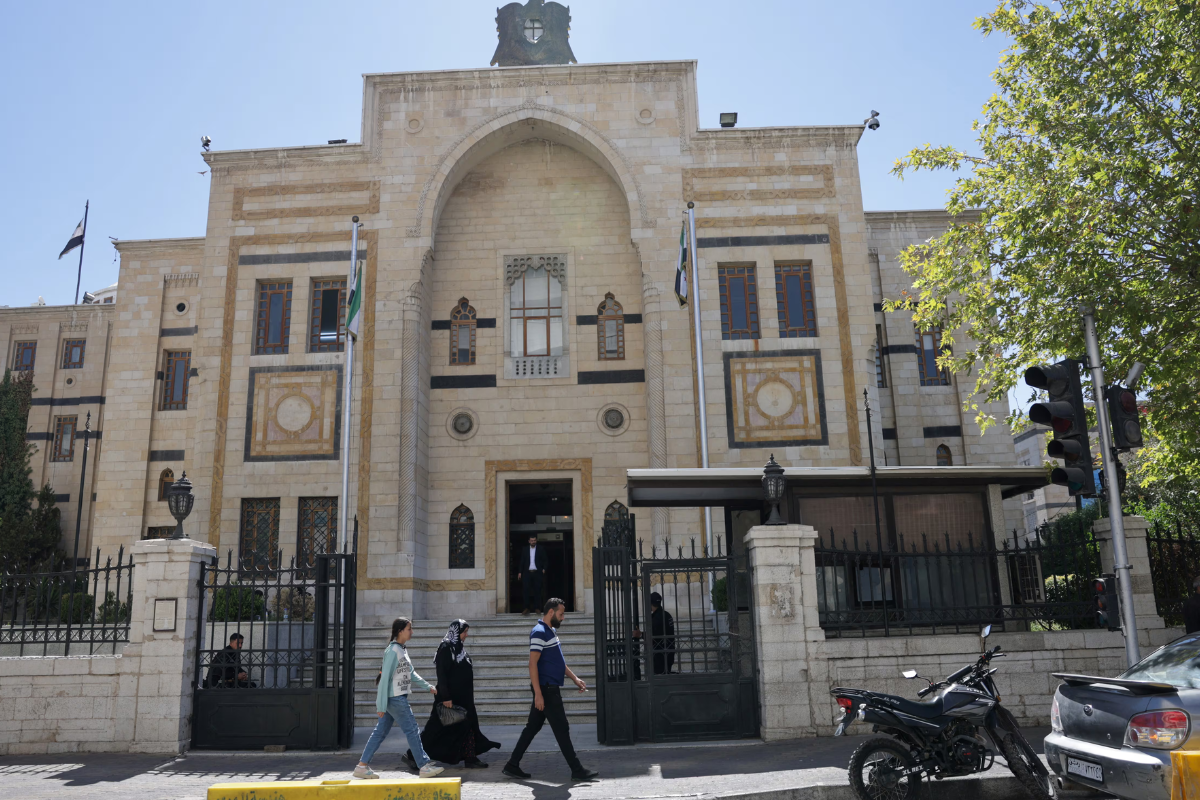
Syria is selecting members of its first post-Assad parliament on Sunday in a process widely criticised as undemocratic, with one-third of the assembly appointed directly by interim leader Ahmed al-Sharaa.
The formation of the new assembly is expected to consolidate Sharaa’s authority. His Islamist forces led the coalition that overthrew Bashar al-Assad in December, following more than 13 years of civil war and five decades of one-family rule.
According to the organising committee, over 1,500 candidates—only 14 percent of whom are women—are competing for seats in the 210-member assembly, which will serve a renewable 30-month mandate.
Sharaa is to appoint 70 representatives, while the remaining two-thirds will be selected by local committees appointed by the electoral commission, itself under Sharaa’s control.
However, certain areas, including southern Syria’s Druze-majority Sweida province, which suffered sectarian violence in July, and the Kurdish-controlled northeast, are currently excluded. Their 32 seats will remain vacant.
“I support the authorities and I’m ready to defend them, but these aren’t real elections,” said Louay al-Arfi, 77, a retired civil servant, speaking at a café in Damascus.
“It’s a necessity in the transitional phase, but we want direct elections to follow,” he added to AFP.
The new authorities have dissolved Syria’s former rubber-stamp legislature. Under a temporary constitution announced in March, the incoming parliament will exercise legislative powers until a permanent constitution is adopted and new elections are held.
Sharaa has stated that direct elections are impossible at present, citing the millions of Syrians who lack proper documentation after fleeing abroad or being displaced internally during the civil war.
Selection Process
Rights groups have sharply criticised the process, arguing it concentrates power in Sharaa’s hands and fails to represent ethnic and religious minorities.
In a joint statement last month, more than a dozen NGOs warned that Sharaa “can effectively shape a parliamentary majority composed of individuals he selected or ensured loyalty from,” which risks “undermining the principle of pluralism essential to any genuine democratic process.”
“You can call the process what you like, but not elections,” said Bassam Alahmad, executive director of the France-based Syrians for Truth and Justice, one of the NGOs.
At a Damascus meeting this week, candidate Mayssa Halwani, 48, acknowledged the criticism: “The government is new to power and freedom is new for us,” she said.
Meanwhile, Nishan Ismail, 40, a teacher in the Kurdish-controlled northeast, said: “Elections could have been a new political start after Assad’s fall, but the marginalisation of numerous regions shows that the standards of political participation are not respected.”
Negotiations on integrating Kurdish civil and military institutions into the new central government have stalled, with Damascus rejecting calls for decentralisation.
In Sweida, activist Burhan Azzam, 48, expressed similar concerns: “The authorities have ended political life in Syria,” he said, adding that the selection process “doesn’t respect the basic rules of democracy.”
Assembly Overview
| Feature | Detail |
| Total seats | 210 |
| Appointed by Sharaa | 70 |
| Selected by local committees | 140 |
| Women candidates | 14% of total |
| Excluded regions | Druze-majority Sweida, Kurdish northeast (32 seats vacant) |
| Candidate restrictions | Must not support former regime or promote secession/partition |
| Notable candidate | Syrian-American Henry Hamra (first Jewish candidate since 1940s) |
| Mandate | Renewable 30 months |
| Oversight | Temporary constitution; legislative powers until permanent constitution adopted |


Comments