Sunday, 5th April 2026

Khabor Wala Desk
Published: 3rd January 2026, 11:03 AM
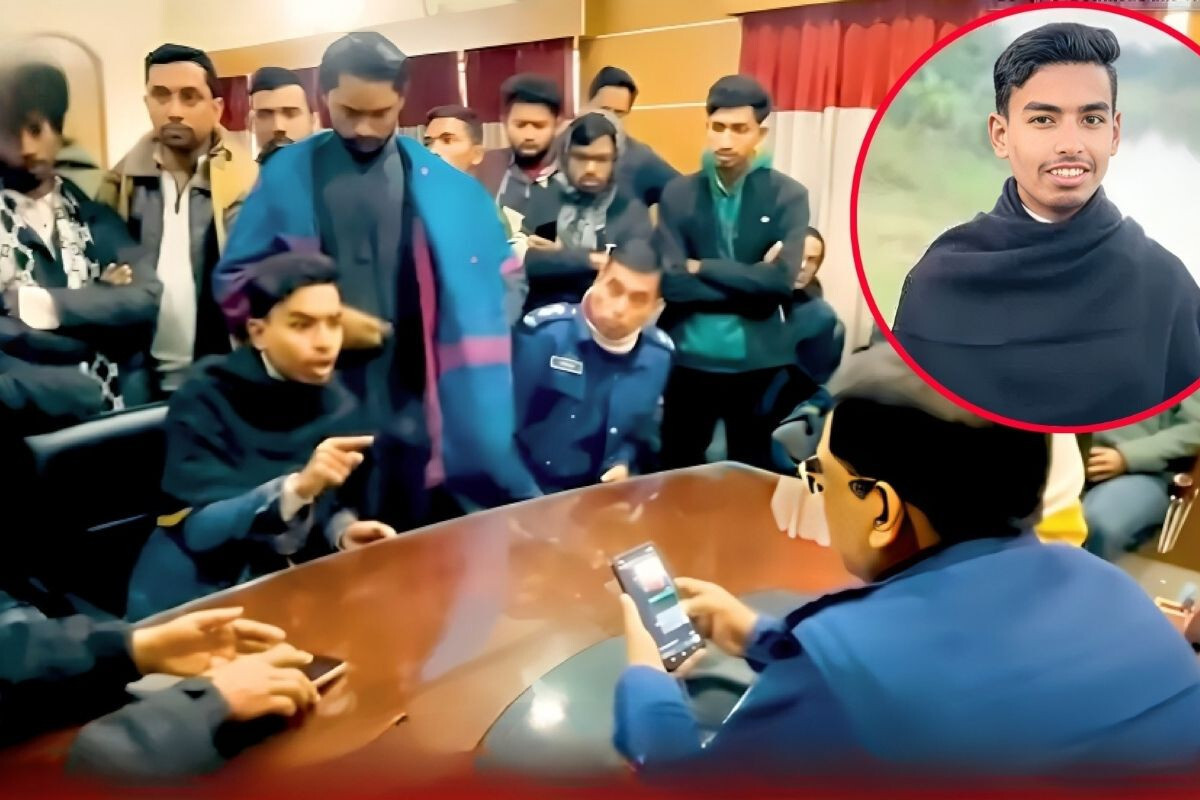
A heated confrontation inside Shayestaganj Police Station in Habiganj has ignited widespread debate and condemnation across the district, after a senior local leader of the Anti-Discrimination Student Movement was accused of issuing veiled threats by invoking memories of past violence. The incident, captured on video and rapidly circulated on social media, has raised serious questions about political pressure on law enforcement and the boundaries of protest politics.
The episode took place on Friday afternoon, 2 January, within the premises of Shayestaganj Police Station. Video footage shows a tense exchange between the officer-in-charge, Abul Kalam, and Mahdi Hasan, who introduced himself as the Habiganj district member secretary of the Anti-Discrimination Student Movement. During the argument, Mahdi Hasan allegedly referred to previous violent incidents in a manner that many observers have interpreted as intimidation rather than political rhetoric.
At one point, he claimed that the government had been “reformed” through the movement and suggested that the group maintained influence within the administration. He further questioned the role and authority of the police. Most controversially, he alluded to the July movement, referencing the arson attack on Baniachong Police Station and the killing of Sub-Inspector Santosh by burning—remarks that were widely perceived as a warning rather than a historical reflection.
According to police sources, the confrontation followed the detention of a young man named Enamul Hasan Nayan earlier that morning. Nayan had been brought to the station for questioning, with police suspecting his previous involvement with the Bangladesh Chhatra League. Upon learning of his detention, Mahdi Hasan, accompanied by several associates, arrived at the station and demanded his release, identifying themselves as “July fighters”. Despite initial resistance, police eventually released Nayan after prolonged arguments and sustained pressure.
Legal experts have since weighed in on the matter. A senior lawyer practising at the Habiganj court observed that such public statements, if recorded and authenticated, could later be treated as self-incriminating evidence should a criminal case be filed. In his view, remarks that recall or appear to justify serious acts of violence may expose the speaker to significant legal risk.
Responding to the allegations, Mahdi Hasan stated that he had been extremely angry at the time and described his comments as a “slip of the tongue”, adding that he later realised the gravity of his words. Meanwhile, Superintendent of Police Yasmin Khatun confirmed that she had reviewed the video and spoken with those involved. She explained that Nayan was taken in solely for questioning and that the confrontation escalated after student leaders presented images and videos in support of their demand.
Summary of the Incident
| Issue | Details |
|---|---|
| Location | Shayestaganj Police Station, Habiganj |
| Date and time | 2 January, afternoon |
| Allegation | Threatening remarks referencing past violence |
| Detained individual | Enamul Hasan Nayan |
| Police action | Questioned and later released |
| Legal implications | Statements may be used as evidence |
The incident has once again brought into sharp focus the uneasy relationship between student politics and law enforcement. Local civil society members warn that such confrontations not only undermine routine policing but also erode public confidence in the rule of law, posing broader challenges for democratic governance and institutional independence.



Comments