Sunday, 5th April 2026

Khabor Wala Desk
Published: 28th November 2025, 2:52 AM
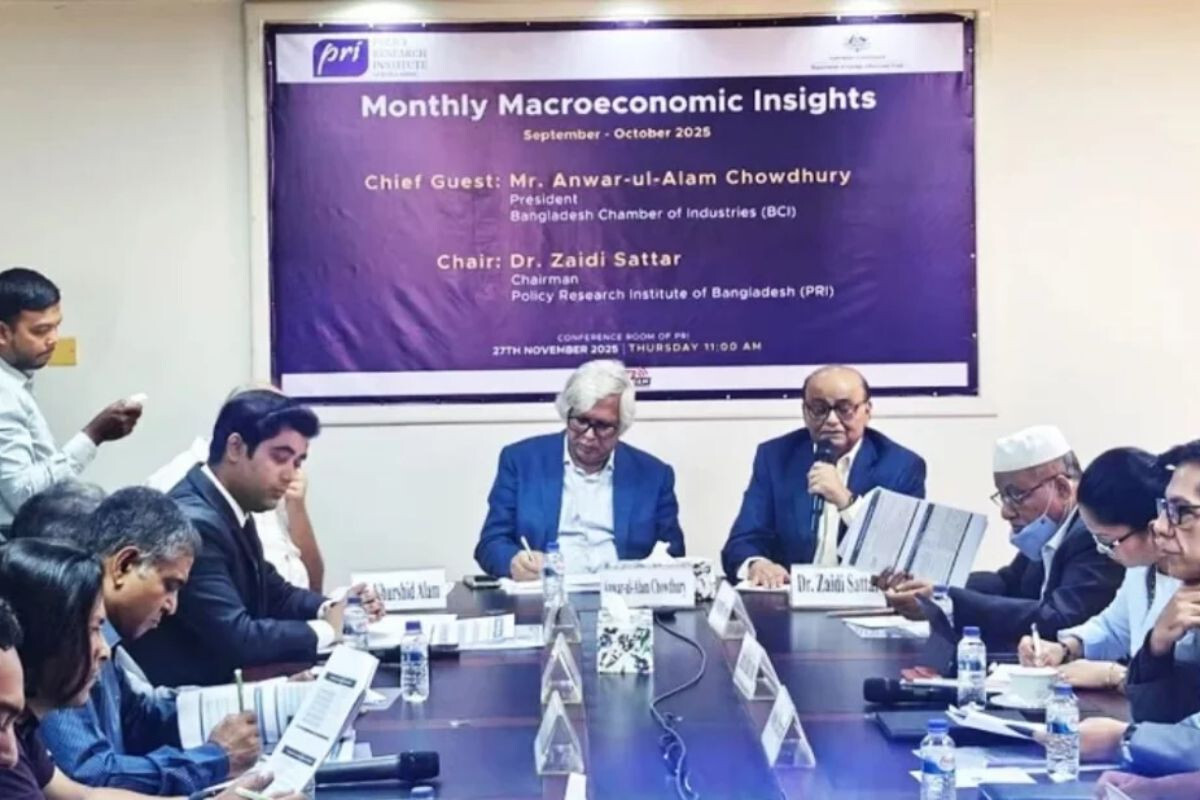
The country’s economy is experiencing severe strain, said Anwar-ul-Alam Chowdhury Parvez, President of the Bangladesh Chamber of Industries (BCI). He stated that despite repeated calls, the government is not listening to the business community or giving them due importance. He made these remarks on Thursday while speaking as the chief guest at the monthly economic review event held at the Policy Research Institute (PRI) office in Banani.
He said loan flow to the private sector has declined significantly. Those who are now taking loans are mainly doing so to repay existing bank loans and prevent them from becoming irregular or defaulted. The former BGMEA president said the economic strain is evident, yet the government shows no interest.
The seminar on the economic situation of September–October was chaired by PRI Chairman Dr Zaidi Sattar. The keynote paper was presented by the organisation’s Chief Economist, Dr Ashikur Rahman.
Anwar-ul-Alam said that despite raising fuel prices, the government has failed to ensure adequate supply. Since 2022, production has been disrupted due to the fuel shortage. Nearly 50 percent of small enterprises have shut down. Many people have moved to Dhaka and started driving autorickshaws, raising the city’s population to 35 million.
Regarding non-performing loans (NPLs), he said the IMF labelled Bangladesh as moderately risky when the NPL rate was 17 percent. Now that it has exceeded 35 percent, he questioned how the IMF would classify the current situation. The loan rescheduling period, previously six months, has now been reduced to three months, which he believes will increase the NPL burden further.
PRI Chairman Dr Zaidi Sattar said the Real Effective Exchange Rate (REER) index has been rising since May, which should concern exporters. Bangladesh Bank can no longer purchase dollars to depreciate the taka. Therefore, easing import restrictions is the only practical solution, as it will also support exporters. A more active import flow would help maintain a flexible exchange rate and create a more favourable export environment.
He said that although economic momentum has slowed, stability has returned. More liberal policies are needed to increase employment. Despite the decline caused by U.S. retaliatory tariffs, Bangladesh is still faring better than India and Pakistan.
Presenting the keynote paper, economist Dr Ashikur Rahman said that without tough measures, high NPLs will pose medium-term risks to the economy. This could limit opportunities for both current and future generations. Managing NPLs is now the biggest challenge.
He remarked that the country’s economy is facing one of the most difficult periods in modern history. Most NPLs lack effective collateral, making market valuation complex and hindering resolution.
He added that approximately Tk 6.4 trillion in unpaid loans in the financial sector is placing substantial pressure on the economy. The large volume of bad debt forces banks to maintain high interest rates, rely on central bank liquidity support, and reduce lending to productive sectors. This creates a “vicious cycle”—reduced investment, rising inflation, and weakening growth. Without proper management, the country may fall into a trap of “high interest rates, high inflation, low investment, and low growth.” This is not just a banking sector issue; it is a macroeconomic constraint.
PRI estimated that the total volume of risky assets—including restructured, rescheduled, and defaulted loans—may now stand at around Tk 9.5 trillion.
Panel speakers included former NBR Chairman Dr Nasiruddin Ahmed, North South University Professor Dr A K M Atiur Rahman, BUILD Research Director Dr Wasel Bin Sadat, and Picard Bangladesh DMD Amrita Makin Islam.
Dr Wasel commented that honest taxpayers are being penalised, which goes against the principles of tax justice. As a result, nearly 85 percent of the economy remains in the informal sector. He also noted that political party manifestos fail to reflect the true economic reality.
Dr Nasiruddin Ahmed said tax policy should be formulated by politicians and the business community, not bureaucrats. Employment shortages and the lack of quality, skills-based education should be top priorities for the next government.
Dr Atiur Rahman added that without the July movement, the true extent of NPLs would have remained hidden.
Khaborwala/TSN

Comments