Sunday, 5th April 2026

Khabor Wala Desk
Published: 7th January 2026, 2:56 PM
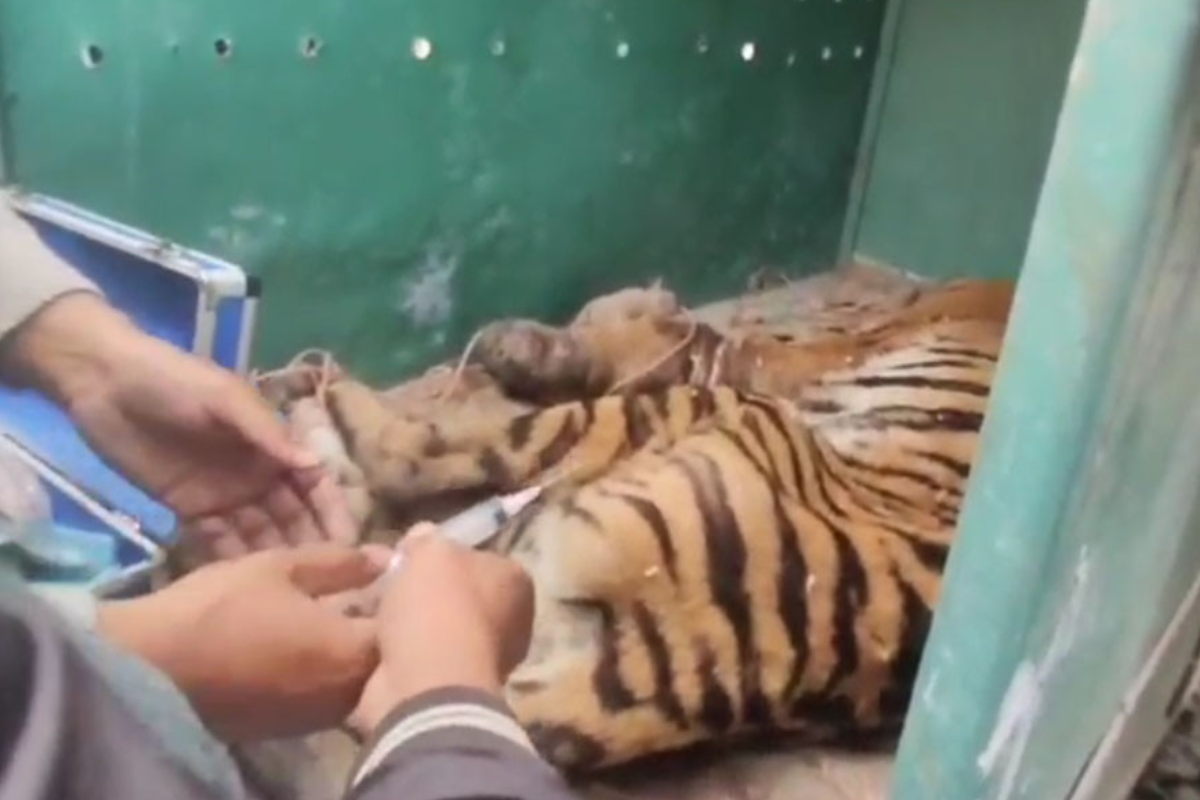
Wildlife authorities and veterinary specialists are working to rehabilitate a four-year-old female tiger that was trapped in a deer-hunting snare in the Sundarbans, facing three significant challenges before she can be safely returned to her natural habitat. Although initially extremely weak, the tiger has begun consuming food and water, and her alertness is gradually returning. However, her left forelimb remains seriously injured, she suffers from dehydration, and her muscle strength requires substantial recovery before she can hunt effectively.
The rescue took place on 4 January in the Chandpai range of the Sundarbans East Forest Division. On Wednesday, 7 January, a joint press conference at the Khulna Press Club was held by the Sundarbans Forest Department, wildlife officers, and veterinary experts to update the media on the tiger’s condition.
Khulna Regional Forest Conservator Imran Ahmed said the tiger is currently under intensive care at the Forest Department’s Wildlife Rescue and Rehabilitation Centre in Khulna. “Her condition is improving steadily,” he stated. “While she was initially extremely weak, she has now resumed drinking water and consuming food. Her alertness and activity levels are returning, but she remains under close observation.”
A team of veterinary specialists led by Professor Hadi Nur Ali Khan from Bangladesh Agricultural University conducted a detailed assessment on Wednesday morning. Dr Nazmul Huda, Additional Veterinary Officer at Central Veterinary Hospital, Dhaka, reported that the tiger’s left forelimb had been severely injured in the snare. “The good news is that her bones appear intact, which is highly encouraging. With proper care, she could return to the wild within two to three weeks,” he said.
| Challenge | Issue | Significance |
|---|---|---|
| 1 | Left forelimb injury | Must regain full function of her paw to hunt effectively |
| 2 | Dehydration | Weakness from prolonged lack of water must be restored |
| 3 | Muscle recovery | Strength and agility must be sufficient to catch prey independently |
Dr Huda added, “In the wild, no one will provide her food; she must hunt for survival. If she cannot use her paw properly, or regain strength and stamina, releasing her would be unsafe. Despite this, we remain optimistic.”
The press conference was also attended by Razzul Karim Chowdhury, Divisional Forest Officer of Sundarbans East, Professor Md Golam Haider from Gazipur Agricultural University, and Dr Md Golam Azam Chowdhury from the Central Disease Investigation Laboratory.
Authorities noted that investigations are ongoing into the deer poaching network responsible for setting snares, as well as the circumstances leading to the tiger’s capture. Experts stressed the need for rapid response measures, citing limitations in veterinary facilities, emergency equipment, and trained personnel in the region. The injured tiger has been kept in a secure, isolated environment to prevent infection, and officials urged the public to avoid crowding the area.
The tiger’s eventual return to the Sundarbans depends entirely on overcoming these three critical challenges, ensuring she is physically and behaviourally prepared to survive independently in her natural habitat.



Comments