Sunday, 5th April 2026

Khabor Wala Desk
Published: 23rd March 2026, 4:15 PM
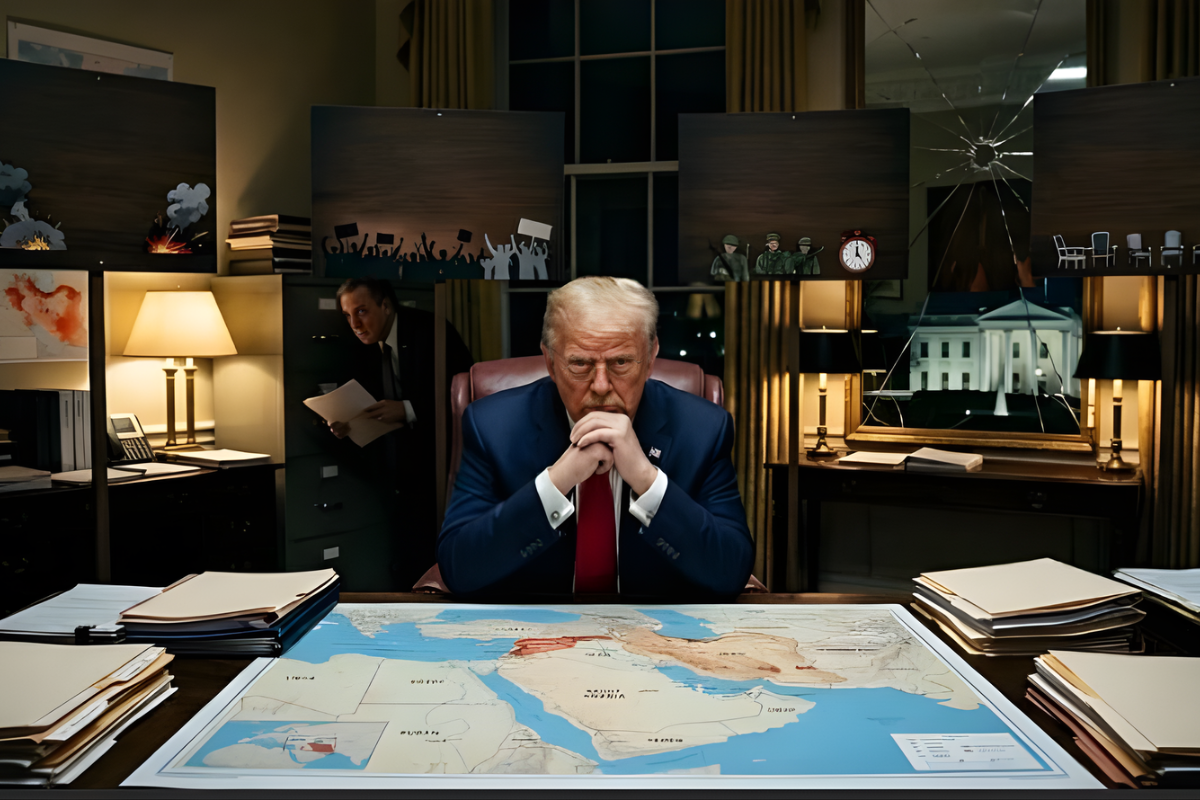
U.S. former President Donald Trump’s approach to the ongoing Iran conflict has entered a period of extreme uncertainty, which the British magazine The Economist likened to Florida’s unpredictable weather. The situation has escalated rapidly: on Friday, 20 March, Trump suggested that military objectives could lead to a swift end to hostilities, only to issue a 48-hour ultimatum to Iran the following day demanding the reopening of the Strait of Hormuz, threatening strikes on Iran’s power infrastructure if ignored.
As the conflict enters its fourth week, Trump faces four primary courses of action—each fraught with risk and offering no guarantee of a decisive or satisfactory resolution.
1. Diplomatic Negotiation
Engaging in dialogue or seeking a diplomatic settlement is theoretically the least destructive path. However, analysts describe it as almost impossible under current conditions. Mutual distrust between the United States and Iran is profound, and the parties’ demands are directly opposed: the U.S. insists on halting Iran’s missile programmes and cutting support for regional militias, while Iran demands war reparations and the removal of all U.S. military bases from the Middle East.
2. Declare Victory Unilaterally
Trump could attempt to end the war by declaring victory, asserting that Iran’s naval capabilities and missile facilities have already been neutralised. While this might appeal to domestic audiences, the strategy carries significant risk: should Iran continue to block the Strait of Hormuz or target U.S. and Israeli installations, such a victory would appear hollow and undermine U.S. credibility internationally.
3. Maintain the Status Quo
A third option is to continue airstrikes while maintaining the current level of engagement. Hardliners in Washington argue that sustained pressure could destabilise Tehran’s government. Yet the danger remains that Iran may not collapse but instead escalate asymmetric warfare, targeting shipping lanes and prolonging global economic uncertainty. The strain on U.S. and Israeli defence systems would increase, with no guarantee of regime change.
4. Escalate Conflict Intensely
The fourth and most dangerous option is a full-scale escalation aimed at forcing Iran into submission. Measures under consideration include strikes on power plants, seizing Kharg Island, and confiscating enriched uranium stockpiles, as proposed by U.S. Treasury Secretary Scott Bessent. Analysts warn that this could trigger a catastrophic regional conflict. Iran has already threatened retaliatory strikes on neighbouring countries’ power and water infrastructure. An attack similar to the 18 March missile strike on Qatar’s LNG plant—which temporarily threatened 3% of global LNG supply—illustrates the potential for widespread economic disruption if major facilities are hit.
The Economist notes that while initiating a conflict is relatively easy, concluding it honourably and safely now represents Trump’s greatest challenge. No option currently offers a stable, peaceful outcome, leaving the Middle East and global markets highly vulnerable.
Trump’s Iran Conflict: Strategic Options Overview
| Option | Description | Potential Risk |
|---|---|---|
| Diplomatic Negotiation | Engage in talks with Iran | High improbability due to mutual distrust and conflicting demands |
| Declare Victory | Unilateral end of war | Could appear hollow; Iran may continue hostilities |
| Maintain Status Quo | Continue airstrikes at current intensity | Prolonged conflict, asymmetric attacks, economic disruption |
| Escalate Conflict | Intensify military operations (power plants, Kharg Island, uranium) | Regional catastrophe, retaliatory strikes, energy supply shocks |
The unfolding scenario illustrates that military action alone cannot guarantee peace. Trump’s decision-making now hinges on weighing immediate tactical gains against long-term geopolitical stability, with global energy security and regional safety hanging in the balance.
Source: The Economist


Comments