Sunday, 5th April 2026

Khabor Wala Desk
Published: 15th October 2025, 9:06 AM
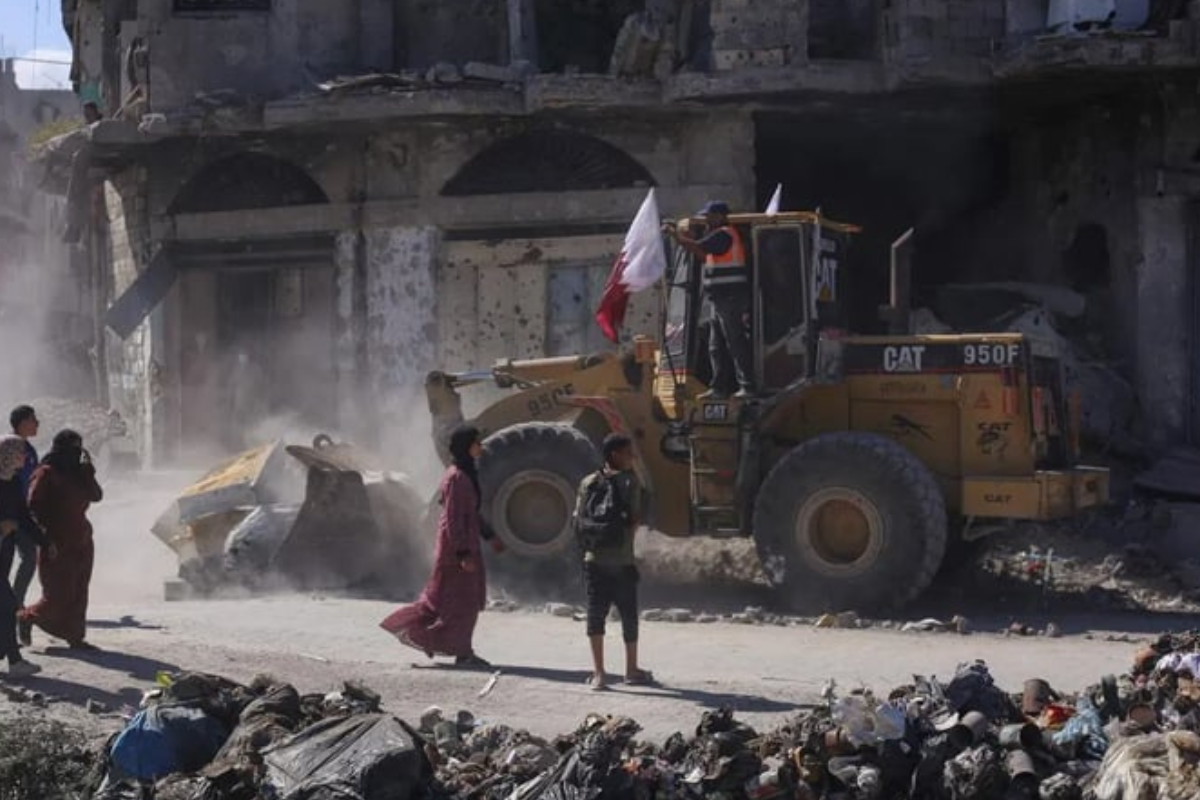
Unexploded bombs and other ordnance scattered across the Gaza Strip pose an “enormous” threat to civilians returning to their devastated homes under the current US-led ceasefire, the humanitarian organisation Handicap International (HI) warned on Tuesday, urging Israel to allow the entry of vital demining equipment.
“The risks are enormous — an estimated 70,000 tonnes of explosives have been dropped on Gaza since the start of the war,”
said Anne-Claire Yaeesh, the organisation’s Director for the Palestinian Territories.
Handicap International, which specialises in mine clearance and assistance to victims of anti-personnel mines, cautioned that Gaza now faces one of the world’s most severe contamination crises following two years of conflict.
The ongoing war — triggered by Hamas’s unprecedented 7 October 2023 attack on Israel — has left the enclave riddled with unexploded ordnance (UXO), including undetonated bombs, grenades, shells, and bullets.
Yaeesh described Gaza’s current landscape as a “minefield buried under rubble”:
“The layers of debris and accumulation are immense, and the risks are worsened by the extremely complex nature of the environment — narrow streets, damaged infrastructure, and densely populated neighbourhoods.”
The NGO emphasised that displaced residents returning to sift through the remains of their homes are at grave risk of triggering hidden explosives.
| Estimated Explosive Impact in Gaza | Details |
| Explosives dropped since 2023 | ~70,000 tonnes |
| Unexploded ordnance rate (UNMAS) | 5–10% of fired munitions |
| Main risk areas | Gaza City, Khan Yunis, Rafah |
| Primary UXO types | Bombs, mortars, shells, cluster munitions, small arms ammunition |
According to the UN Mine Action Service (UNMAS), roughly 5 to 10 percent of munitions fired on Gaza failed to detonate, leaving behind tens of thousands of lethal remnants.
However, UNMAS told AFP that restrictions imposed during the war had prevented large-scale survey operations, meaning the UN currently lacks “a comprehensive picture of the explosive threat” across Gaza.
“Our teams have not been able to conduct full-scale assessments, so the extent of contamination remains unclear,”
a UNMAS spokesperson said.
Since the latest ceasefire — the third since the war began — came into effect last Friday, requests for technical assistance from humanitarian agencies have “surged sharply”, the UN body noted.
Former UK military deminer Nicholas Orr, who previously worked in Gaza for Handicap International, said he was denied authorisation to operate demining missions earlier this year.
“I couldn’t get clearance because Israeli aerial surveillance might have mistaken my activities for attempts to repurpose unexploded bombs into weapons,”
Orr told AFP in March.
With thousands of displaced residents now making their way back to Gaza City, Deir al-Balah, and northern towns, the danger has shifted to main roads, many of which are littered with buried munitions or debris concealing UXOs.
“In the coming days, a large part of our efforts will focus on ensuring the safety of debris management operations,”
said UNMAS, stressing that clearing the main arteries used by aid convoys and returnees is a top priority.
The UN Office for the Coordination of Humanitarian Affairs (OCHA) added that its workers would begin assessing “key roads for explosive hazards”, though progress remains slow due to limited resources.
UNMAS revealed that it has only a limited number of armoured vehicles available in Gaza, restricting daily operations to a handful of sites.
| Demining Capacity in Gaza (as of October 2025) | Status |
| Armoured vehicles in operation | Fewer than five |
| Vehicles awaiting entry at border | Three |
| Full-scale survey capability | Not yet authorised |
| Explosive disposal equipment | Pending Israeli clearance |
The UN agency further confirmed that it has not received authorisation from Israeli authorities to import the necessary heavy equipment and controlled detonation tools required to neutralise UXOs safely.
“We currently have three armoured vehicles at the border waiting to enter Gaza, which will allow safer and larger-scale operations once clearance is granted,”
the UNMAS statement said.
Experts warn that unless demining begins immediately, Gaza’s reconstruction and safe resettlement will be impossible. With hundreds of thousands of people displaced, humanitarian agencies fear a sharp rise in accidental deaths from leftover munitions.
“People will return home, walk through rubble, and unknowingly trigger an explosive device — this is what we are trying to prevent,”
said Yaeesh.
As the ceasefire holds for now, the hidden war beneath Gaza’s ruins — the silent threat of unexploded bombs — remains one of the most urgent and deadly challenges facing the territory’s recovery.



Comments