Sunday, 5th April 2026

Khabor Wala Desk
Published: 26th February 2026, 1:31 AM
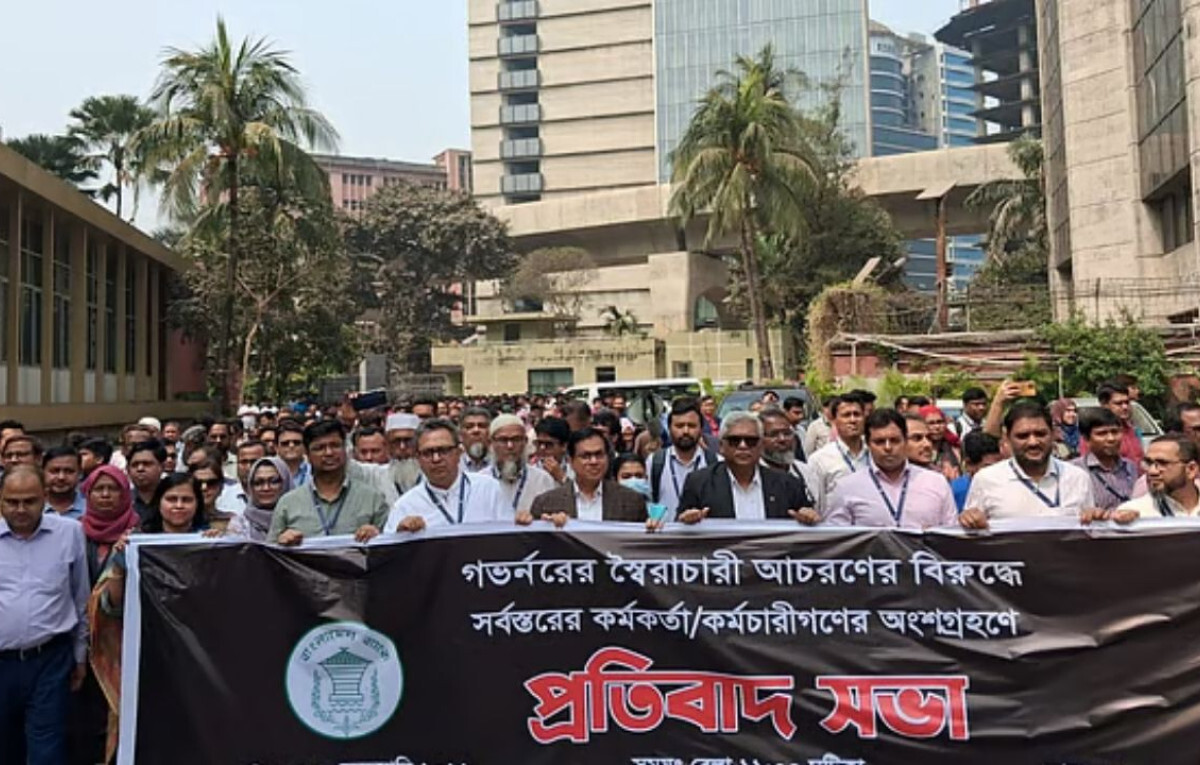
The tenure of Ahsan H. Mansur as the Governor of Bangladesh Bank reached a turbulent conclusion today, following a week of escalating internal strife and staff demonstrations. In a move that has sent ripples through the financial sector, the government has revoked Dr Mansur’s appointment and named Md. Mostakur Rahman, a prominent businessman and chartered accountant, as his successor. This marks a historic first for the nation, as it is the first time a figure from the private business community has been appointed to the central bank’s helm.
The atmosphere within the central bank was electric throughout Wednesday, with additional police units deployed to prevent violence as the internal power struggle spilt into the corridors. The Bangladesh Bank Officers’ Welfare Council organised a large-scale protest, accusing the outgoing Governor of “autocratic” leadership.
The grievances were sparked by the recent issuance of show-cause notices and the swift transfer of three senior officials who had publicly criticised the bank’s policies. Protesters threatened a “pen-down strike” from Thursday unless these disciplinary actions were immediately rescinded.
“We sought autonomy for the central bank, but instead, we were met with autocracy,” stated Shahriar Siddiqui, a director and assistant spokesperson. “Morale has been shattered as the Governor continuously questioned the quality of our officials and filled the institution with contractual advisors.”
Before his departure, Dr Mansur held a final, impromptu press conference where he defended his record. He argued that the disciplinary measures were essential for maintaining institutional discipline. He claimed that certain officials were being manipulated by “vested interests” seeking to return struggling banks to the hands of “looter owners.”
Addressing the calls for his resignation, Dr Mansur remained stoic: “It takes me only two seconds to resign. I came here to serve the nation during a crisis.” He defended the central bank’s liquidity support to fragile banks, asserting that without such intervention, a catastrophic collapse of depositor confidence would have ensued.
| Position | Outgoing Official | Incoming Official | Background |
|---|---|---|---|
| Governor | Dr Ahsan H. Mansur | Md. Mostakur Rahman | Businessman & Accountant |
| Key Policy Change | Structural Bank Mergers | To Be Determined | Focus on Private Sector Insight |
| Disciplinary Status | 3 Officials Transferred | Review Pending | Internal Morale Crisis |
The situation turned physical late in the afternoon. Following the announcement of the new appointment, a “mob” of approximately 30 bank officials forcibly removed Ahsan Ullah, an advisor to the Governor. Witnesses reported scenes of harassment, with officials shouting slogans and physically manhandling the advisor into a vehicle. The incident was reportedly led by high-ranking directors and additional directors, highlighting a severe breakdown in the bank’s chain of command.
Former Finance Advisor Salehuddin Ahmed expressed concern over the abrupt change. While acknowledging that a new government has the right to alter economic strategies, he noted that Dr Mansur was a highly respected economist who had initiated critical reforms, including the merger of five banks into the Unified Islamic Bank.
“The role of the Governor is highly sensitive, requiring constant engagement with international donors and creditors,” Mr Ahmed noted. “A sudden change in leadership, particularly under such volatile circumstances, may not send a positive signal to the global financial community.”
As Md. Mostakur Rahman prepares to take office, he faces the dual challenge of restoring internal order and stabilising a banking sector currently undergoing its most significant structural overhaul in decades.



Comments