Sunday, 5th April 2026

Khabor Wala Desk
Published: 8th February 2026, 11:34 PM
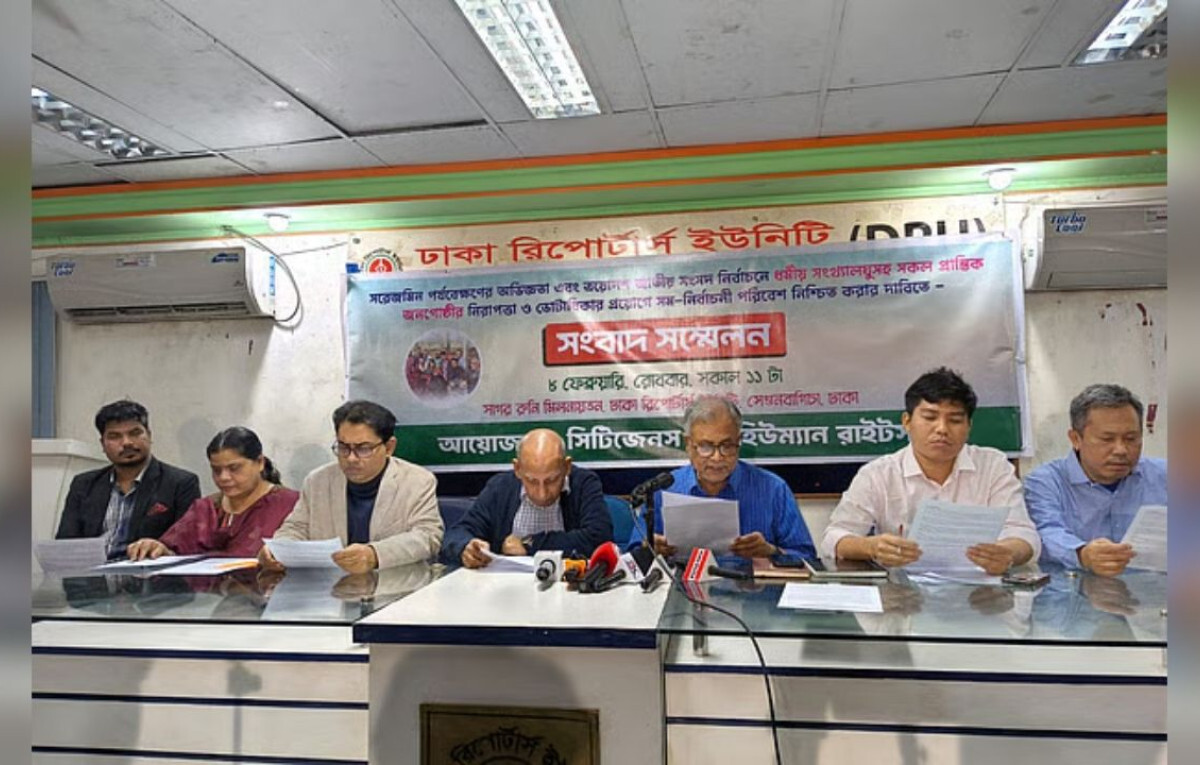
In a poignant address at the Dhaka Reporters’ Unity’s Sagar-Runi Auditorium, the advocacy group Citizen for Human Rights has issued a formal challenge to the interim government and the Election Commission. The organisation has put forward a comprehensive five-point charter of demands aimed at safeguarding the disenfranchised and minority communities as Bangladesh prepares for the 13th National Parliamentary Elections.
The press conference, titled “Field Observation Experiences and Demands for a Level Playing Field,” highlighted a disturbing trend of pre-electoral violence. A fact-finding mission conducted on 1 February 2025 in the Raozan and Mirsharai regions of Chattogram revealed harrowing accounts of targeted attacks.
Zakir Hossain, Chief Executive of Nagarik Uddyog, detailed the findings, noting that at least 12 homes belonging to the Hindu community in Raozan were set ablaze. In several instances, arsonists reportedly locked the doors from the outside while residents were asleep inside. Similar atrocities were mirrored in Mirsharai, where seven homes were razed. These acts, the group argues, are not merely criminal; they are strategic tools of voter suppression designed to intimidate minorities into staying away from the polling stations.
The organisation’s primary demand is the establishment of a High-Level Central Administrative Cell to monitor security in minority-concentrated constituencies. The full list of demands is summarised below:
| Number | Key Demand | Targeted Action |
|---|---|---|
| 1 | Special Security Zones | Directive to law enforcement for heightened patrols in minority areas. |
| 2 | Judicial Inquiry | Immediate investigation into violence in Raozan and Mirsharai. |
| 3 | Reparations | Full compensation and rehabilitation for victims of arson and assault. |
| 4 | Psychosocial Support | Mental health assistance for families traumatised by communal violence. |
| 5 | Institutional Oversight | The Human Rights Commission must prioritise minority safety in its monitoring. |
The rhetoric at the conference was sharp. Professor Robaet Ferdous of Dhaka University contended that ethnic and religious minorities have suffered disproportionately under the current interim tenure. He argued that while the Constitution provides for the safety of all faiths, the reality has devolved into a “state of secondary citizenship” for non-Muslims.
Sotej Chakma, International Affairs Secretary of the Indigenous Youth Forum, warned of a “depopulation process” (number-zeroing), noting that persistent insecurity is forcing minority families to seek refuge abroad. He stressed that unless the state guarantees the right to vote without fear, the marginalisation of these citizens will become irreversible.
The assembly concluded with a stern appeal to all political parties. Citizen for Human Rights urged them to move beyond rhetoric and take active responsibility for the post-election safety of their constituents. The current “stagnant” administrative response, they claim, is emboldening perpetrators and undermining the very foundations of a democratic transition.

Comments