Sunday, 5th April 2026

Khabor Wala Desk
Published: 8th October 2025, 8:16 AM
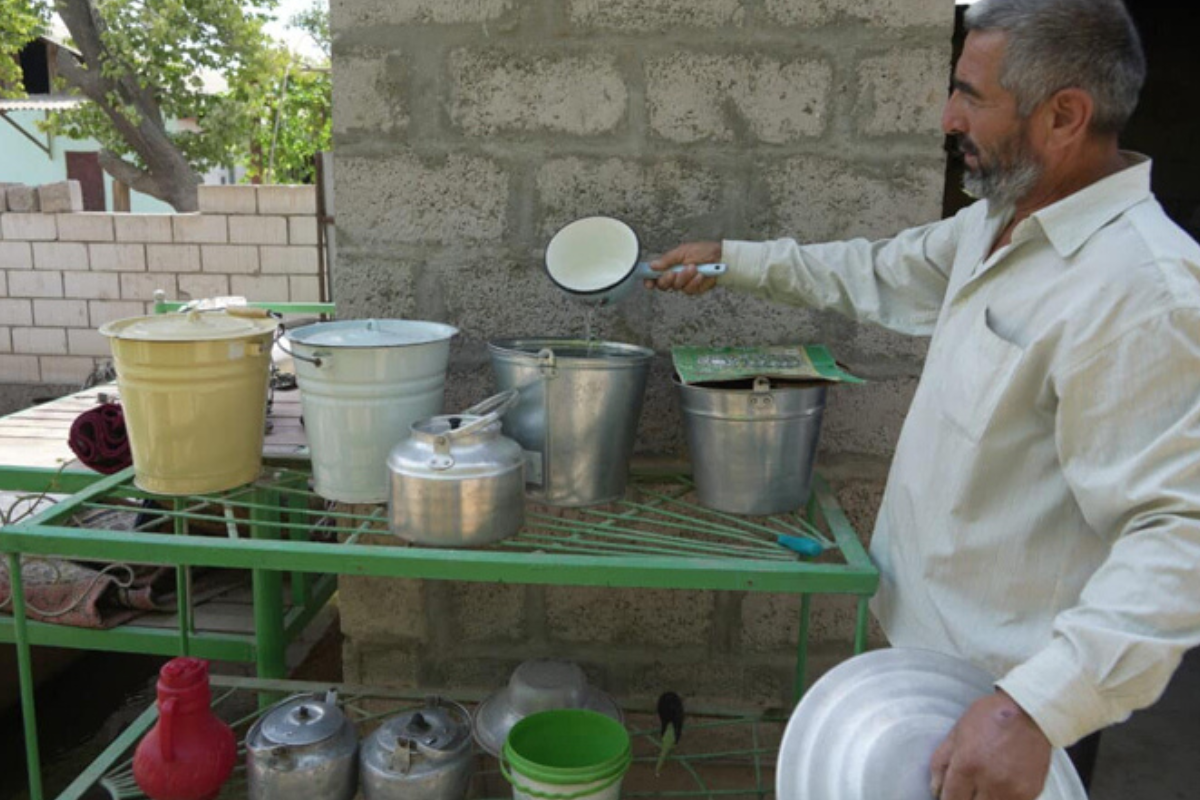
In Balkh district (widely known by its Soviet-era name Kolkhozobod) in southwestern Tajikistan, labourer Nematoullo Bassirov faces a daily dilemma: to quench his thirst, he must draw water from a local stream and hope it does not make him ill.
Despite Tajikistan’s abundant water reserves, fed by 25,000 mountain glaciers, access to clean and safe drinking water remains a privilege in this economically struggling Central Asian nation.
“There’s all sorts of dirt in it,” Bassirov told AFP, as he scooped out garbage bags, food wrappers, and empty energy drink cans from the small canal. “Sometimes I find diapers, or droppings from my neighbour’s geese.”
The stream is used by the entire village. “After irrigating the crops, muddy water arrives here containing pesticides,” the 58-year-old added. His sister-in-law was rinsing grapes in the same water, ready to place on the dinner table.
Tajikistan’s water crisis is not for lack of resources. With 25,000 glaciers, Tajikistan and Kyrgyzstan control roughly two-thirds of Central Asia’s water reserves, yet only 41 percent of the population has access to safe drinking water, according to 2023 official data. Connection to sanitation networks is even lower, at just 15 percent, the lowest in the region.
| Indicator | Tajikistan | Central Asia Average |
| Population with safe drinking water | 41% | 87.5% |
| Population connected to sanitation networks | 15% | 60% |
| Annual deaths from unsafe water (1990–2020) | 1,620 | – |
Much of the country’s infrastructure dates from the Soviet era and was further damaged during the 1990s civil war, leaving 25 percent of facilities out of service. Hydraulic engineer Abdourakhim Abdoulloev noted the routine challenges:
“This drinking water supply station serves 2,800 households. But the equipment needs repairs for supply to resume.”
As the poorest nation in the former Soviet Union, Tajikistan faces severe economic constraints. The Eurasian Development Bank predicts a funding deficit of $1.2 billion by 2030.
A study in Nature reported an average of 1,620 deaths annually linked to unsafe water from 1990 to 2020. Researchers from Saudi Arabia and Pakistan have forecasted an upward trend in water-related mortality.
President Emomali Rahmon, in power since 1992, has made water diplomacy a cornerstone of his foreign policy, advocating numerous UN resolutions. A poster in Balkh declares: “Thanks to the life-giving rivers flowing from snow-capped Tajik mountains, thirsty deserts turn into oases.”
Authorities have launched a 15-year plan to improve safe drinking water access nationwide, highlighting the growing challenge posed by a rising population.
“Providing drinking water and sanitation services is a top priority,” the strategy reads.
At the polluted river in Balkh, women washed dishes and laundry in hazy water, while schoolgirls scrubbed green paint from brushes and children bathed.
Meanwhile, Malika Ermatova, 30, lives on arid land where water is trucked in and stored in a four-ton tank under her yard.
“We use this water for everything—drinking, laundry, cleaning, watering the garden,” she said, surrounded by her three children. “But the water degrades quickly. We change it every three to four weeks.”
Her region, Khatlon, bordering Afghanistan, regularly experiences summer temperatures exceeding 40°C, exacerbating water scarcity.
Back in Balkh, Bassirov attempts to make the stream water safer by letting impurities settle and then boiling it. Despite these precautions, his family suffers frequent illnesses.
“My stomach can no longer tolerate the water,” he admitted.
Key Takeaways
| Aspect | Details |
| Population with safe drinking water | 41% |
| Access to sanitation | 15% |
| Glacier reserves | 25,000 (shared with Kyrgyzstan) |
| Annual water-related deaths | 1,620 (1990–2020) |
| Government response | 15-year national plan to improve water access |
| Infrastructure | 25% non-functional; largely Soviet-era |
| Household coping strategies | Bucket settling, boiling, trucked water |
Despite vast natural reserves, Tajikistan’s citizens face daily struggles for potable water, illustrating how infrastructure decay and economic limitations can undermine even the richest environmental resources.




Comments