Sunday, 5th April 2026

Khabor Wala Desk
Published: 25th October 2025, 2:34 PM
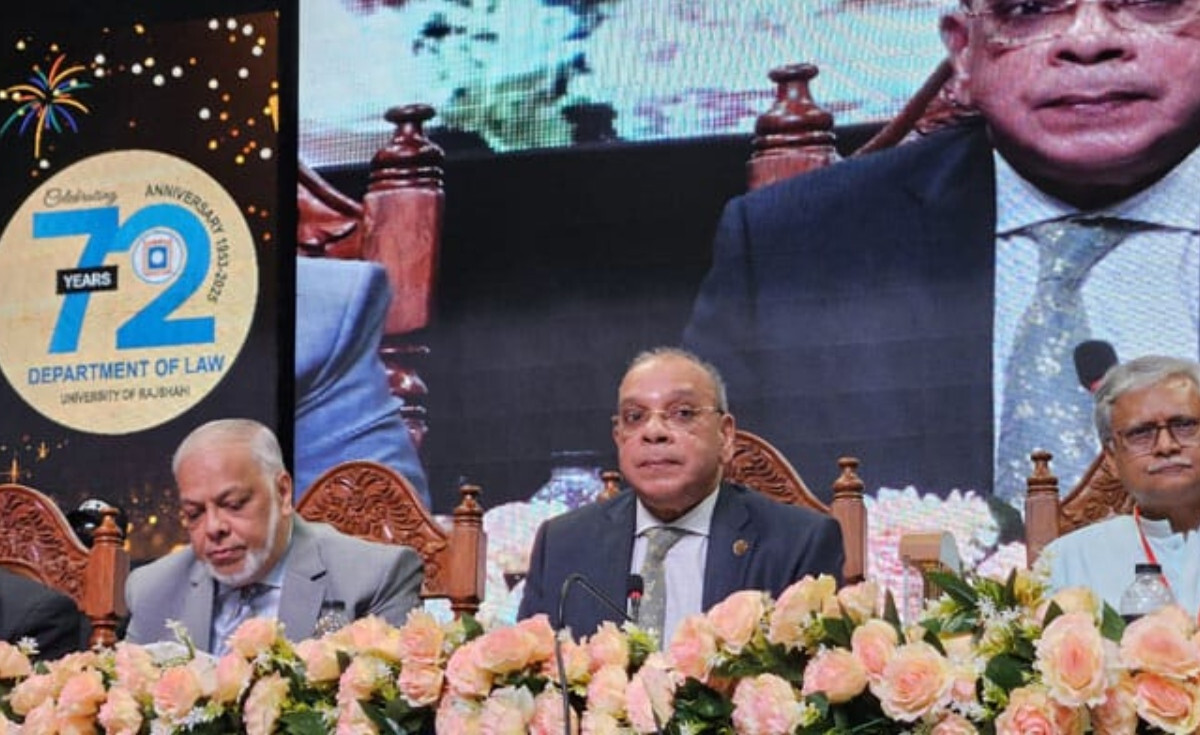
A program was held today at the Kazi Nazrul Islam Auditorium on the occasion of the 72nd founding anniversary of the Department of Law at the University of Rajshahi. The Chief Guest of the event was Dr. Syed Refaat Ahmed, Chief Justice of Bangladesh.
In his speech, the Chief Justice stated, “Law is not merely a collection of rules; it reflects the moral conscience of a nation. When justice is upheld, the state stands firm; when justice fails, even the strongest state collapses.”
Referring to the Universal Declaration of Human Rights by the United Nations, he further said, “When humanity witnesses the horrific consequences of injustice and inhumane state power, the Universal Declaration of Human Rights guides mankind toward a new moral consciousness. When the state fails to uphold citizens’ dignity and silences their voices, fighting for justice becomes a moral imperative.”
Highlighting the history of Bangladesh’s independence struggle, the Chief Justice said, “Our history bears witness to this truth. The 1952 Language Movement was not only about language—it was a struggle for justice, dignity, and the right to exist. Similarly, in 1971, the Bengalis fought not just for a flag or political independence, but for dignity, equality, and the right to self-determination.”
He emphasized the roadmap for judicial reform, institutional independence of the judiciary, and the necessity of establishing a modern, technology-driven justice system. The Chief Justice stated, “In the post-July Revolution era, we are at a crossroads where realizing true judicial independence requires creating an administratively autonomous, morally courageous, and constitutionally strong judiciary.”
He also mentioned that immediately after assuming office, he announced a “roadmap” for judicial reform, which includes the plan to establish a separate Supreme Court Secretariat. “This Secretariat will serve as the central structure of judicial administration, ensuring complete accessibility to justice for the general public,” said the Chief Justice.
Referring to the in-principle approval by the Interim Government’s Advisory Council on October 23 of the Supreme Court Secretariat Ordinance, 2025, he said, “The Supreme Court Secretariat Ordinance, 2025 is the result of a meticulously planned strategic effort over the past 15 months.”
The Chief Justice added, “During these 15 months, strategic understanding and coordination between the Chief Justice’s office and the executive branch of the Interim Government played a crucial role, which will continue in the future. What we now need is mutual cooperation, trust, and foresight to ensure the judiciary’s structural independence is long-lasting.” He called on all relevant stakeholders—including the legal community practicing in district courts, the Supreme Court Bar Association, judges of district courts, and the Bangladesh Judicial Service Association—to take coordinated initiatives to make this structural transformation sustainable.
He stressed, “All stakeholders must recognize a fundamental truth: they are mutually accountable. The foundation of their relationships must be cooperation, reason, and mutual respect. Any mistrust or unilateral action could weaken the institutional independence painstakingly built over the past 15 months. To ensure judicial autonomy, a culture of mutual trust and coordination among stakeholders must be cultivated.”
Addressing lawyers, academics, and young law graduates, he said, “Studying law is not merely professional training; it is a pursuit of justice. Every lawyer and judge must remember that behind every law is a life, behind every judgment is a fate. The true value of justice lies in impartial and humane adjudication.”
Emphasizing the importance of technology-driven justice, the Chief Justice stated, “Even in the 21st century, we still carry the legacy of colonial structures. Therefore, in the era of artificial intelligence and automation, our judicial system must adapt with data-driven management, digital connectivity, and a humane perspective.”
Recalling the contribution of the University of Rajshahi to the country’s legal field, he said, “This university has produced countless eminent jurists. I believe it will continue to produce legal professionals who are enlightened not only in knowledge but also in humanity. The revival of justice is our call of the time. The freedom, equality, and justice guaranteed by the Constitution must reach every citizen’s doorstep—this is our responsibility. I urge everyone concerned to contribute their utmost from their respective positions.”
The event was presided over by the Chairman of the Department of Law, University of Rajshahi. Special guests included Justice Zubayer Rahman Chowdhury, Justice S.M. Emdadul Haque, and Justice A.K.M. Asaduzzaman of the Appellate Division of the Supreme Court of Bangladesh. Present were High Court judges, deans and faculty members from various faculties of the University of Rajshahi, officials of the Supreme Court Registry, distinguished lawyers, academics, and young law graduates.
Sharif


Comments