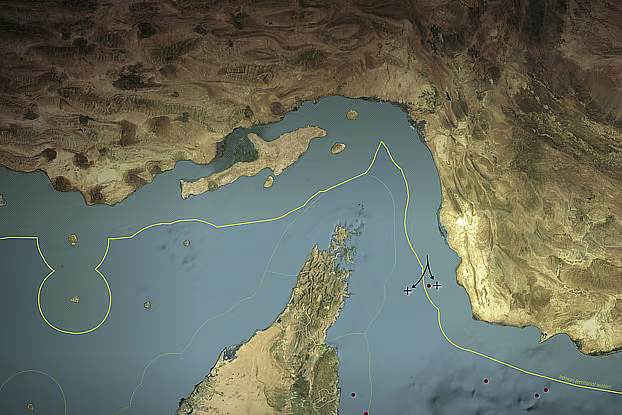
The strategic landscape of the Strait of Hormuz has undergone a dramatic shift within a single 24-hour window. What began on Friday as a diplomatic breakthrough, hinting at the restoration of global maritime commerce, has rapidly regressed into a renewed military standoff between the United States and the Islamic Republic of Iran.
Brief Diplomatic Thaw and Market Reaction
On Friday, Iranian Foreign Minister Abbas Araghchi announced via social media that the Strait of Hormuz would be fully reopened, albeit with the caveat that Iran would continue to “coordinate” maritime traffic through the passage. This development was initially met with optimism by Washington. US President Donald Trump responded on his Truth Social platform, stating, “Iran just announced that the Strait of Hormuz is fully open and ready for full transit. Thank you!”
The immediate economic impact was substantial. Global crude oil prices plunged by 10% within hours of Araghchi’s post. However, this stability proved short-lived following a policy clarification from the White House.
Reinstatement of the Naval Blockade
The prospect of a reopened waterway vanished when President Trump declared that the US naval blockade on Iranian ports would remain “completely” in force until a definitive peace treaty is reached. In direct response to this continued economic pressure, the Islamic Revolutionary Guard Corps (IRGC) announced on Saturday that the Strait would be closed once again.
The IRGC issued a formal warning stating that any vessel approaching the Strait would be viewed as cooperating with “the enemy.” They explicitly noted that ships defying this directive would be targeted. This stance was underscored by a kinetic incident approximately 20 miles off the coast of Oman, where two vessels were fired upon. The captain of one targeted tanker reported that the assault originated from Iranian gunboats.
Summary of Key Developments and Positions
| Category | Status / Detail |
| Strait Status | Closed by IRGC following brief reopening announcement. |
| Market Impact | Initial 10% drop in oil prices; subsequent volatility. |
| US Stance | Blockade remains until a permanent peace treaty is signed. |
| Iranian Position | Transit restricted as long as US port blockades continue. |
| Military Incident | Gunship fire reported 20 miles off the Omani coast. |
| Deadline | Current two-week ceasefire expires on 21 April 2026. |
Military Threats and Leadership Rhetoric
The rhetoric from Tehran has intensified. A statement released in the name of Iran’s Supreme Leader, Mojtaba Khamenei—who has not been seen in public for over six weeks since succeeding his father—asserted that the Iranian Navy is prepared to make enemies “taste the bitterness of defeat.”
Furthermore, Senior Military Official General Mohammad Naqdi issued a specific technological threat, stating that in the event of renewed hostilities, Iran would deploy missiles manufactured as recently as May 2026. He claimed that while Iran had the capacity to halt oil production entirely, it had exercised “patience” to avoid global instability.
Diplomatic Uncertainty and the Ceasefire Deadline
The current two-week ceasefire is set to expire on 21 April 2026. President Trump has indicated that an extension is not guaranteed, suggesting that a failure to reach an agreement could lead to the resumption of aerial bombardments.
Beyond maritime access, the two nations remain deadlocked over several critical issues:
-
The transfer and removal of Iran’s highly enriched uranium.
-
The cessation of ongoing uranium enrichment programmes.
-
The specific terms of a comprehensive peace agreement.
While Iranian sources informed CNN that they anticipate a second round of negotiations next week, the US administration has not publicly confirmed its plans. However, high-level activity at the White House suggests internal deliberations are intensifying. On Saturday afternoon, Defence Secretary Pete Hegseth, CIA Director John Ratcliffe, and the Chairman of the Joint Chiefs of Staff were observed entering the White House for consultations.