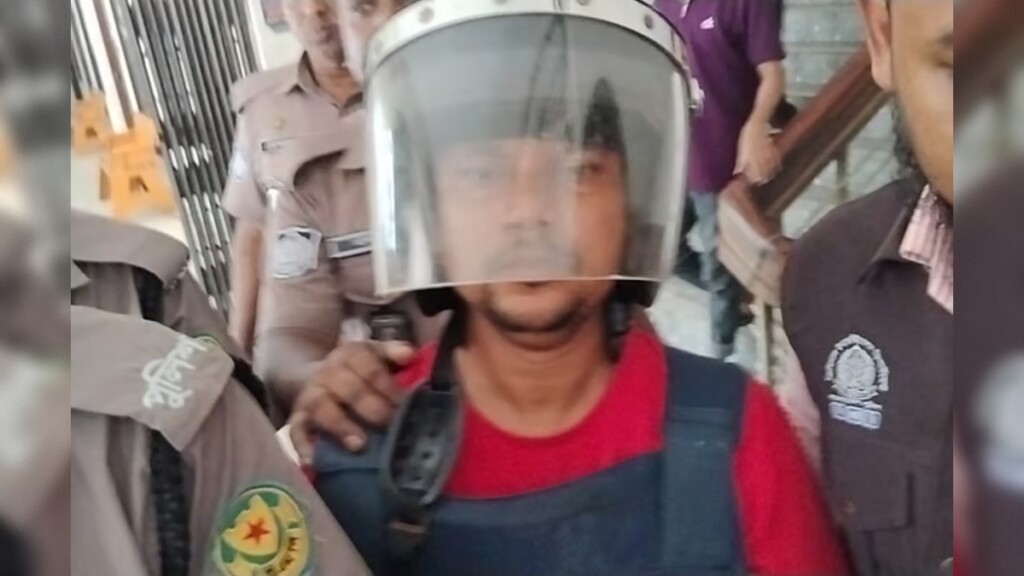
DHAKA — A Dhaka court has placed Haridas Chandra Tarani Das, a temple organiser from Gaibandha, on a four-day police remand in connection with a high-profile money laundering case. Haridas, who recently drew national attention for initiating the construction of an 81-foot-tall statue of Rama in Palashbari, was arrested by the Criminal Investigation Department (CID) of the police on Sunday night.
Following his arrest in his home district, Haridas was formally charged under the Money Laundering Prevention Act in a case filed with Uttara West Police Station in Dhaka. On Monday afternoon, the investigation officer, Detective Branch (DB) Inspector K M Rakibul Huda, produced the suspect before the Chief Metropolitan Magistrate’s Court of Dhaka, requesting a seven-day remand to facilitate interrogation.
Under tight security, Haridas was brought to the court premises in a white unmarked police vehicle at around 4:00 pm. Clad in a red T-shirt and a traditional lungi, he was fitted with a bulletproof vest and a helmet, and his hands were bound in handcuffs. Once inside the courtroom dock at 4:24 pm, officers removed his helmet and handcuffs before the formal hearing commenced.
In the remand petition, the prosecution argued that a preliminary investigation had uncovered credible evidence connecting the accused to illegal hundi operations and money laundering. Authorities discovered massive, suspicious financial transactions across multiple bank accounts and mobile financial services (MFS) registered under his name. Investigating officers emphasised that a custodial interrogation is crucial to trace the origins of these funds, identify the depositors, and uncover any other accomplices involved in the suspected shadow network.
In contrast, defense counsel Shyamal Kumar Roy filed a petition seeking bail and the immediate cancellation of the remand request. Roy argued that the allegations were entirely fabricated, alleging that the arrest was part of a larger conspiracy to instigate religious tension and disrupt legitimate spiritual activities. He maintained that Haridas, a simple organiser, has no connection to financial crimes. “His only crime is constructing a beautiful temple where thousands of devotees gather to pray,” the defence lawyer argued before the court. “Is building a place of worship a punishable offence?”
The state prosecutor, Kabir Hossain, strongly countered these claims, dismissing the defence’s arguments as a baseless fabrication. Hossain insisted that concrete evidence existed of transactions involving millions of taka. The prosecution asserted that religious activities were being used as a front to legitimise embezzled funds and facilitate illegal overseas transfers. Investigators need to determine if any external organisations or foreign entities are linked to these transactions.
Addressing Metropolitan Magistrate Md Ripon Hossain directly, Haridas claimed his innocence, explaining that he was a simple farmer before transitioning to managing the temple. He asked the court whether accepting voluntary donations from devotees for religious purposes could be classified as a crime.
After hearing arguments from both sides, Magistrate Md Ripon Hossain rejected the bail petition and authorised a four-day remand, permitting detectives to question the suspect in custody.