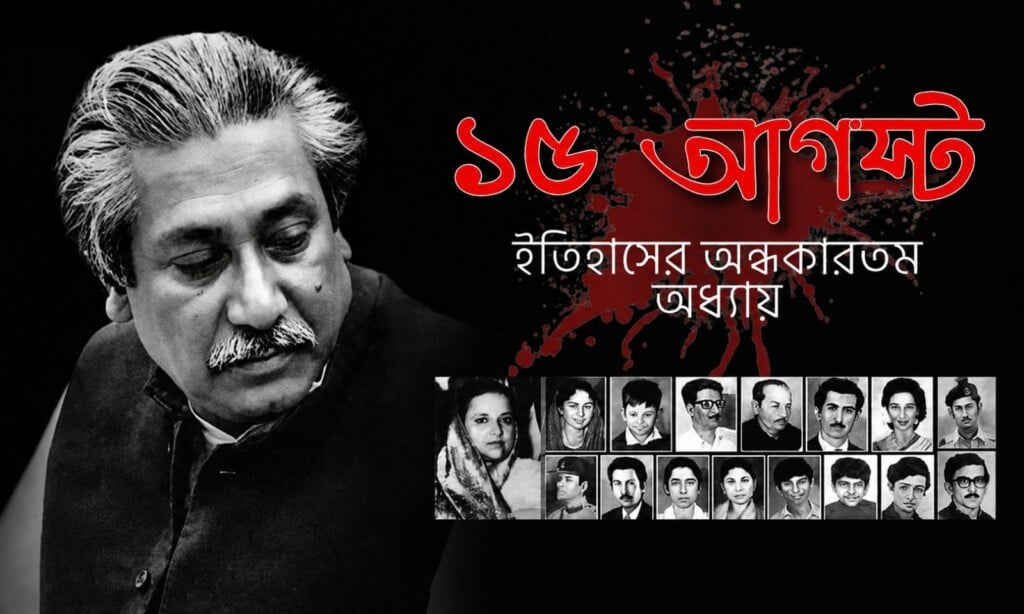
15 August remains one of the most painful and consequential dates in Bangladesh’s modern history. On this day in 1975, Sheikh Mujibur Rahman, the country’s founding leader, was killed along with most members of his family at his residence in Dhaka. The assassination, carried out only a few years after Bangladesh achieved independence, became a defining rupture in the country’s political history and left an impact that continued to shape national politics for decades.
Sheikh Mujibur Rahman’s political career was closely linked to the struggle for Bengali political, cultural and economic rights. From the Language Movement and demands for greater autonomy to the Six-Point Movement, the mass uprising of 1969 and the independence struggle of 1971, he emerged as a central figure in the mobilisation of Bengali nationalism. After Bangladesh secured independence through the Liberation War, he assumed leadership of the newly established state at a time when the country faced enormous challenges.
The task of rebuilding Bangladesh was daunting. The war had devastated infrastructure, disrupted transport and communications, damaged productive capacity and displaced millions of people. Food supplies were under severe pressure, while the new administration had to establish functioning institutions and restore economic activity. The government also had to develop a constitutional and legal framework for a state that had emerged from a destructive war.
The post-independence period, however, was marked by serious political and economic difficulties. Inflation, shortages, administrative weaknesses, political unrest and food insecurity placed considerable pressure on the government and the population. The devastating famine of 1974 further deepened the country’s crisis. Against this troubled backdrop, the events of 15 August 1975 brought a dramatic and violent end to Sheikh Mujibur Rahman’s political life.
The killings extended far beyond the country’s founding leader. His wife, Begum Fazilatunnesa Mujib, his sons Sheikh Kamal and Sheikh Jamal, and his youngest son Sheikh Russell were among those killed. Other members of the extended family also lost their lives. The scale of the killings transformed the event from a political assassination into a profound national tragedy.
The death of Sheikh Russell, who was still a child, remains one of the most emotionally charged aspects of the tragedy. He had no political role, yet was killed alongside other members of his family. His death has consequently come to symbolise the devastating human cost that political violence can impose on civilians and family members who have no involvement in political conflict.
Sheikh Mujibur Rahman’s two daughters, Sheikh Hasina and Sheikh Rehana, survived because they were abroad at the time. Their survival did not lessen the personal devastation. They lost their parents and several close family members in a single night and spent years outside Bangladesh before returning to the country.
Sheikh Hasina subsequently entered the centre of Bangladeshi politics and became a leading figure of the Awami League. She served as prime minister for several terms and presided over a long period in which Bangladesh experienced major economic and infrastructural changes. During her governments, projects such as the Padma Bridge and Dhaka’s mass rapid transit system were completed, while electricity generation, road connectivity, digital services and social protection programmes expanded.
Bangladesh’s broader economic transformation, however, cannot be attributed to government policy alone. The growth of the ready-made garment sector, agricultural productivity, remittances from overseas workers, private investment and the contribution of millions of workers have all played significant roles. Over several decades, the country moved from a predominantly low-income economy towards lower-middle-income status and achieved eligibility to graduate from the United Nations’ least developed country category.
The political meaning of 15 August has remained contested, particularly as Bangladesh has experienced successive periods of political confrontation. The fall of Sheikh Hasina’s government on 5 August 2024 was followed by attacks, vandalism and arson at several sites associated with Sheikh Mujibur Rahman and his political legacy. The historic residence at Dhanmondi 32, closely associated with the events of 15 August 1975, was also attacked and set on fire. Statues and other memorials connected with the former leader were damaged in different parts of the country.
Those developments reignited debate over the preservation of historical memory in Bangladesh. Political changes can alter the way societies interpret their past, but national history extends beyond the fortunes of individual governments or political parties. The Language Movement, the struggle for autonomy, the Liberation War, the establishment of Bangladesh and the people involved in those events form interconnected parts of the country’s historical record.
Remembering 15 August, therefore, involves more than commemorating a tragic event. It also raises broader questions about political violence, democratic institutions, historical evidence and the responsibilities of future generations. Bangladesh’s history contains deeply contested political narratives, but disagreement over those narratives need not lead to violence or the destruction of historical sites.
The legacy of 15 August has also been shaped by the political developments that followed the assassination. The country underwent major changes in its system of governance and political direction, while the consequences of the killings continued to influence political discourse, electoral competition and debates over national identity. The eventual legal proceedings concerning the assassination also became an important chapter in Bangladesh’s judicial and political history.
For Bangladesh, the enduring significance of 15 August lies partly in the fact that it demonstrates how political violence can alter the course of a nation. The assassination removed the country’s founding political leader and most of his immediate family while creating a legacy of grief, controversy and political division that persisted for generations.
History is not preserved merely through ceremonies. It survives through evidence, records, education, public discussion and the protection of historically significant places. Understanding difficult chapters of the past requires acknowledging both their human cost and their wider political consequences.
Fifty-one years after the killings, 15 August remains deeply embedded in Bangladesh’s national history. Sheikh Mujibur Rahman and the family members who died with him continue to occupy an important place in the country’s historical narrative. At the same time, the tragedy offers a wider lesson: political disagreements may be profound, but a stable society must seek to resolve them through institutions, dialogue and democratic means rather than violence.
The day is therefore remembered not only as a moment of national mourning but also as a reminder of the consequences of political intolerance. Preserving historical memory, examining the past through reliable evidence and ensuring that future generations understand the costs of political violence remain essential to building a more peaceful and democratic society.