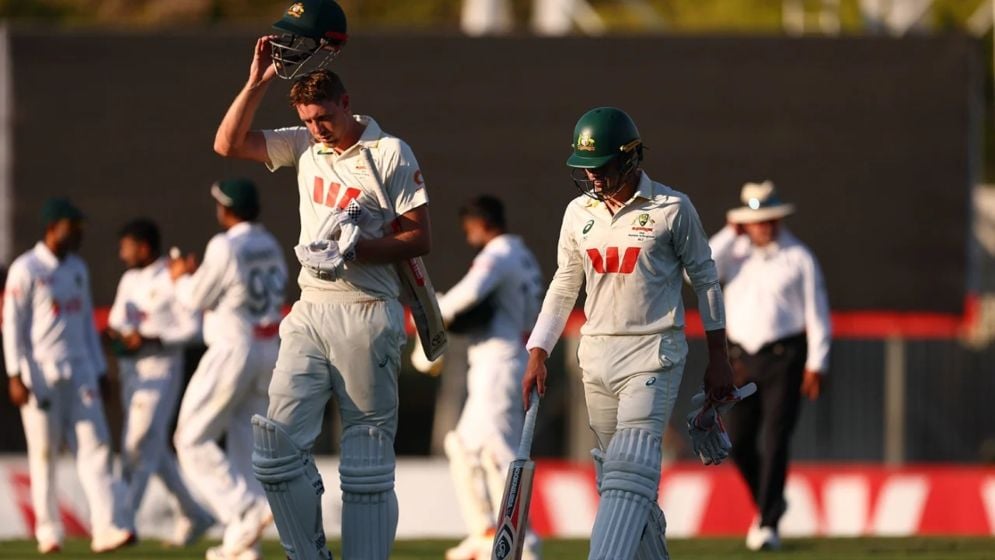
Australia’s troubles following their shock defeat to Bangladesh in Darwin could deepen, with the hosts facing a possible penalty for maintaining a slow over-rate during the first Test.
Bangladesh secured a memorable nine-wicket victory on the fourth day, inflicting one of the most damaging defeats on Australia in the long history of Test cricket. Yet the result may not be the only setback for Pat Cummins’ side. Their failure to complete the required number of overs could now have consequences for both the players and Australia’s position in the World Test Championship (WTC).
Australia bowled only 86 overs on the third day, four short of the minimum 90 overs expected under the regulations. Test sides are generally required to maintain an average rate of 15 overs per hour, although the match officials can take a range of circumstances into account when assessing whether a team should be penalised.
If Australia are found guilty of the shortfall, the International Cricket Council (ICC) can impose financial penalties on the players. Under the applicable rules, players may be fined five per cent of their match fee for every over their side falls behind the required rate. The team can also lose WTC points, making the matter considerably more serious than a straightforward financial sanction.
Australia’s players reportedly receive around US$20,000 each for a Test. On that basis, a four-over shortfall could potentially result in a fine of US$4,000 per player, with the total reaching approximately US$44,000 for the 11 players in the starting XI. The final amount, however, would depend on the match referee’s assessment and the penalty ultimately imposed.
A four-point deduction would also reduce Australia’s WTC points from 84 to 80. Despite that possible reduction, their percentage of wins would remain unchanged. Australia currently sit at the top of the WTC standings with a 77.78 per cent win percentage, while South Africa are second on 75 per cent. Bangladesh have moved into fourth place with a 66.67 per cent win percentage.
Bangladesh themselves had a slow over-rate during their first innings. However, they bowled Australia out in just 53 overs, which could prevent them from facing a penalty under provisions relating to shortened innings.
The regulations provide exemptions in certain circumstances. A team may avoid an over-rate sanction if an innings lasts fewer than 80 overs, or where a match concludes without the required volume of play because both sides are dismissed within the relevant limits. Such provisions have previously protected Australia during difficult over-rate situations, including during the Ashes.
That exemption may not apply in Darwin because Bangladesh’s first innings lasted 138 overs, leaving Australia exposed to disciplinary action.
The match referee will nevertheless consider the circumstances surrounding the slow over-rate before reaching a final decision. Factors such as extreme weather, the frequency of wickets and other legitimate delays can be taken into account when determining whether a team should be punished.
Australia have experienced the consequences of over-rate penalties before. Four WTC points were deducted from them following a slow over-rate in the 2020 Boxing Day Test. The lost points subsequently proved significant in the race for the inaugural WTC final, which Australia failed to reach.
For Cummins and his team, the potential penalty therefore carries a warning beyond the immediate financial cost. With WTC standings ultimately influenced by every available point, another deduction could become increasingly important as the championship cycle develops. Bangladesh’s victory has already delivered a major blow to Australia’s momentum; an additional disciplinary setback would make the Darwin Test even more costly.