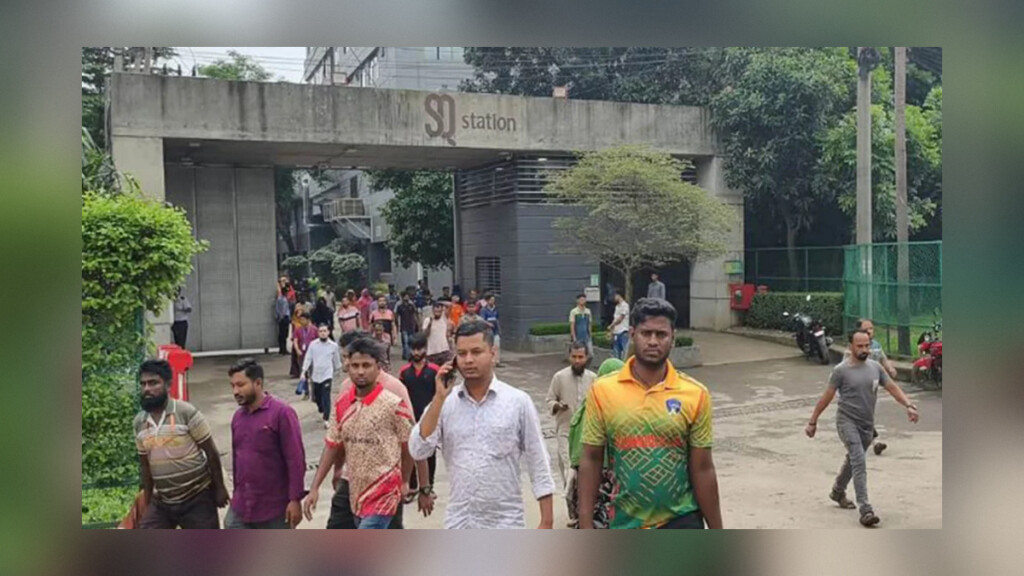
A severe gas shortage has disrupted industrial operations in Mymensingh’s Bhaluka industrial zone, forcing 20 factories to send their workers home early on Thursday (20 August). Workers reported for duty in the morning as usual, but were gradually released by lunchtime as factories struggled to maintain production amid sharply reduced gas pressure.
Mohammad Ansar Uddin, superintendent of Industrial Police-5, said the gas shortage had become particularly acute from Thursday morning. Although workers arrived at their workplaces, the factories could not operate normally because of insufficient gas supplies. The affected factories subsequently released their workers in phases around lunchtime.
Production at other factories in the industrial area has also been severely affected. According to industrial police, factories located in and around Bhaluka municipality and near the Titas Gas office are receiving some gas pressure, while factories farther away are receiving little or no gas. Overall production at major factories in the industrial zone has fallen to an average of around 50 per cent, according to the police.
The scale of the disruption is significant. Mymensingh’s industrial zone has 293 factories, of which 99 depend on gas for their operations. Almost all of the gas-dependent factories are currently facing difficulties. Some are attempting to keep parts of their operations running by using electricity or generators, but these alternatives have not been sufficient to compensate for the loss of gas supply.
Textile and yarn manufacturing units appear to be among the hardest hit. At Toyo Spinning Mills in Gouripur, 43 of its 50 machines have had to be shut down. The remaining seven are being operated using electricity supplied by the Power Development Board.
At Seema Spinning Mills in Bhaluka, all 30 machines have been stopped, resulting in a reported 50 per cent decline in production. Production at Bashar Spinning, Nortex Textile and Delta Spinners has also fallen by 50 per cent or more. At Experience Textile, 40 per cent of the machines have been shut down because the available gas pressure is insufficient for normal operations.
The ceramic sector has also been affected. Production at Excellent Ceramics has fallen to below half of its normal level after its furnace was forced to stop operating because of inadequate gas pressure.
Gopinath Kanjilal, assistant superintendent of Industrial Police, said gas pressure began falling from Thursday morning. Factories in the area generally continue operations until between 5pm and 6pm, but the shortage made it impossible for several establishments to maintain their usual schedules.
Mahadi Sweaters Limited, Sultana Sweaters, Liz Fashion, TM Textile, Trishal Textile and BSP Spinning Mills were among the 20 factories that released workers around lunchtime, he said.
The disruption is not entirely new for some manufacturers. Sohel Ahmed, manager of the utility department at Glory Textile and Apparels in Bhaluka, said the factory had been experiencing low gas pressure for roughly one and a half to two months.
The factory requires gas pressure of around 15 pounds per square inch (PSI) for normal operations, but has been receiving only 11 to 12 PSI. As a result, production has declined by around 3 to 4 per cent, he said.
Titas Gas Transmission and Distribution Company’s Bhaluka regional office has attributed the reduced pressure to lower gas supplies. Shamim Hossain, manager of system operations at the office, said gas is supplied to the Bhaluka area through two separate lines operating at 140 and 50 PSI.
At present, however, the area is receiving gas at only around 30 to 50 PSI, leaving the company unable to meet demand, he said.
The effects are also being felt by workers beyond the factory floor. Hafiza Akter, a worker at Experience Textile, said reduced gas availability had resulted in fewer machines operating simultaneously and, consequently, less work. She also said households in the area were experiencing gas shortages, disrupting everyday cooking.
The latest disruption highlights the vulnerability of Bhaluka’s gas-dependent industrial base to fluctuations in supply and pressure. With dozens of factories relying on gas to operate machinery and industrial furnaces, a prolonged shortage could continue to affect production schedules and workers’ employment routines unless supply conditions improve.