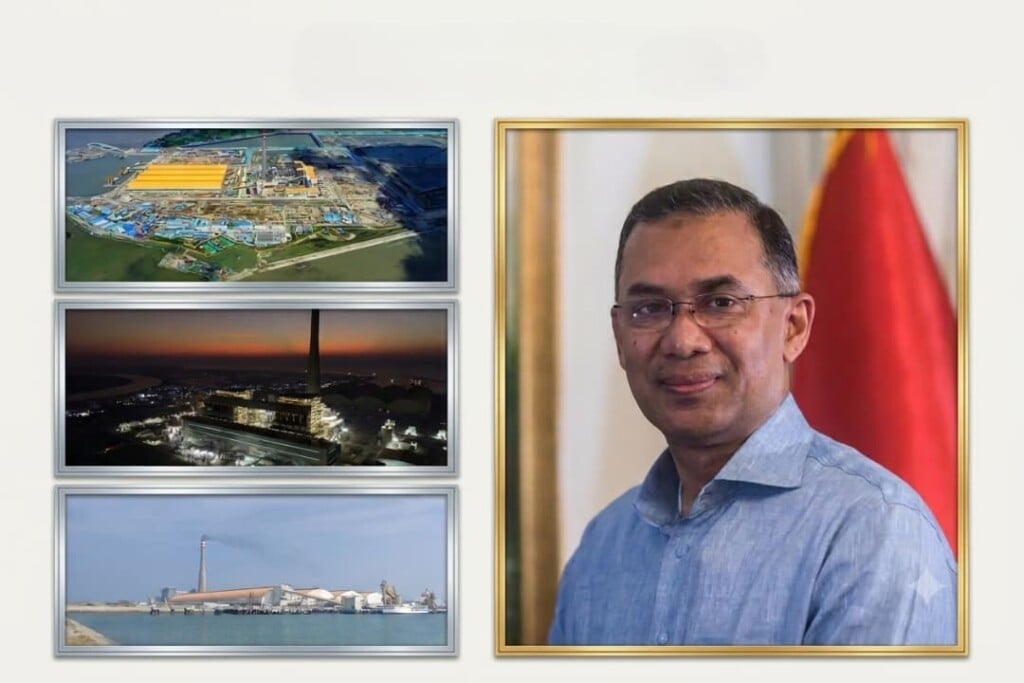
Prime Minister Tarique Rahman has instructed the authorities to increase electricity generation from coal-fired power plants so that more natural gas can be redirected to industries amid the country’s ongoing energy supply constraints.
He has also directed the Ministry of Power, Energy and Mineral Resources to ensure timely imports of liquefied natural gas (LNG), while avoiding the direct procurement method as far as possible. The government is seeking to improve gas and electricity supplies quickly in the short term and establish a more secure energy system over the longer term.
The instructions came during a meeting on Thursday with the ministry’s minister, secretary and senior officials. Officials presented an assessment of the country’s current electricity and energy supply situation, including a comparison with the conditions inherited when the BNP government took office. They also outlined medium-term plans up to 2029 and a longer-term strategy extending to 2035.
The meeting reviewed demand and supply for natural gas, fuel oil, coal and furnace oil, as well as electricity demand and the contribution of different fuels to power generation.
Economic Affairs Adviser Dr Rashed Al Mahmud Titumir told journalists on Thursday that the supply of gas to industries was expected to improve by the coming winter, while visible progress in both gas and electricity supplies was expected by the following summer.
The Prime Minister has asked for a detailed roadmap showing how the country’s energy supply position is expected to develop in stages up to 2029. The government wants the plan to give investors a clearer understanding of the availability of energy before they commit to new industrial projects.
Fuel oil reserves expected to reach 57 days
The government is working towards building a 90-day reserve of fuel oil. According to the energy authorities, if consignments covered by letters of credit opened for imports up to 30 August arrive on schedule, the country’s reserve would reach 57 days.
That would represent a significant improvement from the 14-day fuel oil stock inherited when the present government assumed office.
The immediate options for resolving the gas shortage, however, remain limited. The Prime Minister has therefore placed particular emphasis on making full use of the capacity of the country’s two existing floating storage and regasification units (FSRUs) and ensuring that LNG cargoes arrive on time.
The government has also been advised to avoid direct procurement for LNG imports wherever possible. Bangladesh recently failed to receive six LNG cargoes ordered through the direct procurement method. Foreign suppliers subsequently sold the cargoes to other countries at higher prices, according to officials familiar with the matter.
One official told The Business Standard that the Prime Minister had discouraged the use of direct procurement for LNG because it could create uncertainty over supplies as well as opportunities for irregularities. The government therefore wants to rely as far as possible on a procurement process that can provide greater certainty and transparency.
Coal-fired generation to ease pressure on gas
The government is seeking to reduce the amount of gas used for electricity generation in the short term by increasing output from coal-fired power plants. The approach could raise the cost of electricity generation and potentially increase the subsidy burden, but officials believe the additional expense could help release more gas for industrial consumers.
The energy division has also informed the Prime Minister that the first unit of the Rooppur Nuclear Power Plant is expected to be connected to the national grid around September or October. Once electricity from the unit becomes available, pressure on gas-fired power generation could ease, potentially improving overall electricity supply conditions.
The strategy reflects the government’s effort to manage a constrained gas supply by shifting part of the power generation burden towards alternative fuels. The energy division has also recommended increasing solar power generation as another way of reducing dependence on gas for electricity production.
Pipeline planned to bring Bhola gas into national grid
The government plans to connect gas discovered in Bhola to the national gas network by 2029. A feasibility study for the proposed pipeline has already been completed, with the project expected to cost around Tk500 crore.
The energy division argues that the investment could prove economically worthwhile because Bangladesh is currently paying high prices for imported LNG. Each LNG cargo costs around Tk730 crore to Tk750 crore, according to the information presented at the meeting.
Alongside the Bhola pipeline project, the government plans to intensify drilling and re-drilling activities at 150 gas wells. The energy division has presented a plan to increase domestic gas supplies by an additional 1,750 million cubic feet per day by 2029.
The Prime Minister has instructed the division to accelerate efforts to increase production from domestic sources. Greater reliance on locally produced gas is expected to reduce pressure on costly imports and provide a more stable supply for industries and other major consumers.
Government seeks LNG deals beyond Middle East
The government does not want to depend entirely on the Middle East for LNG supplies. Discussions are therefore under way with suppliers from other countries over long-term contracts. Talks are also reportedly taking place with one or two additional US companies regarding long-term LNG supply agreements.
According to the energy division, the country currently has authorised gas load requirements of 5,200 million cubic feet per day. If 3,200 million cubic feet can be supplied consistently, most sectors would be able to operate broadly normally. A supply level of 3,800 million cubic feet per day would eliminate the reported gas deficit, officials told the Prime Minister.
At present, Bangladesh can supply around 2,600 million to 2,750 million cubic feet of gas per day. Of that amount, around 1,585 million cubic feet is consumed by the power sector alone, accounting for roughly 62 per cent of total supply.
Power plants receive around 1,000 million cubic feet per day, while captive power generation at various industrial establishments consumes another 585 million cubic feet. The remaining 38 per cent is distributed among industries, commercial operations, transport and households.
The figures underline the central challenge facing policymakers: a large share of the country’s limited gas supply is being used to generate electricity, leaving less available for industrial production and other sectors.
Domestic gas production has fallen since 2018
Bangladesh began importing LNG in 2018. Before that, domestic gas production was sufficient to meet the country’s requirements. In 2018, gas fields were supplying around 2,000 million to 2,100 million cubic feet per day.
Domestic demand subsequently increased, while production from local gas wells failed to keep pace. Instead of rising, domestic output has declined over the years. Current production from the country’s gas fields is around 1,600 million cubic feet per day.
The decline in domestic production has increased Bangladesh’s reliance on imported LNG at a time when international energy prices can place considerable pressure on the country’s import bill. This has made exploration, well development and more efficient use of existing gas resources important components of the government’s longer-term energy strategy.
The energy division has consequently proposed increasing coal-based generation so that gas currently being consumed by power plants can be redirected to industrial users. Although coal-fired generation costs somewhat more than gas-fired generation, officials argue that the additional cost may be justified if it helps maintain gas supplies for industries.
The division estimates that one million cubic feet of gas can generate around five megawatts of electricity. Increasing generation from coal and renewable sources could therefore free up part of the gas now being used in the power sector.
Three more floating LNG terminals planned by 2029
To address the structural gas shortage, the government plans to establish three additional floating LNG terminals by 2029. The new facilities would expand the country’s capacity to receive and regasify imported LNG and provide an additional buffer when domestic production falls short of demand.
The broader strategy combines several measures rather than relying on a single source of energy. These include increasing coal-fired power generation in the short term, bringing nuclear generation into the national grid, expanding solar power, increasing domestic gas exploration and production, connecting Bhola’s gas to the national network, diversifying long-term LNG suppliers and adding new LNG terminal capacity.
The government’s stated objective is to improve the reliability and predictability of energy supplies by 2029, with a longer-term goal of strengthening energy security through 2035. For the industrial sector, the immediate priority is to secure a more dependable supply of gas by reducing the amount of gas diverted to electricity generation.
If the proposed measures are implemented as planned, the government expects a more diversified energy mix to ease pressure on the gas network while providing industries with greater certainty over future energy availability.