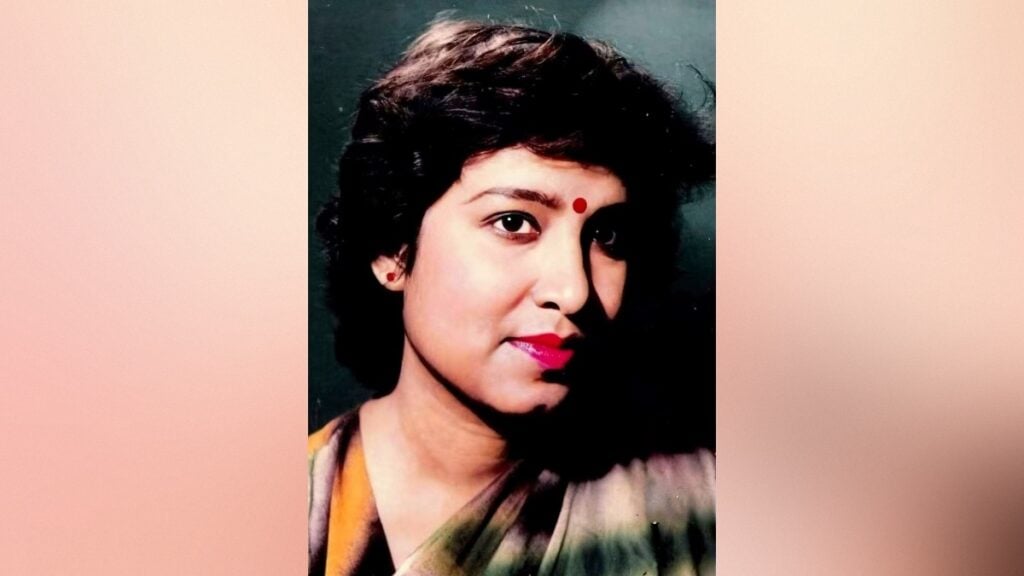
In Bengali literature, Taslima Nasrin stands out as one of the few writers who has carved out a distinct universe of her own through controversy, rebellion, love, anti-establishment views, and courageous expressions of free thought. She is not merely a poet, novelist, or essayist—she embodies a widely discussed and controversial chapter in Bengali literature. Her pen has simultaneously articulated women’s rights, individual liberty, critiques of religious bigotry, and a voice of protest against societal chains.
Today, 25 August, marks Taslima Nasrin’s birthday.
She was born on this day in 1962 in the city of Mymensingh. The third among two brothers and two sisters, her nickname was “Tona”—a name given by the poet of love and rebellion, Helal Hafiz. Her father, Rajab Ali, was a physician, and her mother, Idul Wara, was a homemaker. After passing her SSC from Mymensingh Residential School in 1976 and HSC from Ananda Mohan College in 1978, she enrolled in Mymensingh Medical College. She earned her MBBS degree in 1984. Subsequently, she served as a doctor in a government rural hospital, the gynaecology department of Mitford Hospital, and the anesthesiology department of Dhaka Medical College Hospital.
Yet beneath the physician’s white coat, another identity was flourishing—that of a poet.
Taslima began writing poetry at the age of thirteen. During her college years, from 1978 to 1983, she edited and published the literary magazine Sejuti. Her poems began appearing in various newspapers and periodicals. In 1986, her first poetry collection, Shikore Bipul Khudha (Tremendous Hunger in the Roots), was published. This was followed by Nirbasito Bahire On Tore (Exiled Outside and Within), Amar Kichhu Jai Ase Na (I Couldn’t Care Less), Atole Ontorin (Confined in the Depths), Balikar Gollachhut (The Girl’s Game), and Behula Eka Bhasiyechilo Vela (Behula Set Sail Alone on the Raft)—works that portrayed not only love but also the deprivations, loneliness, rage, and protest inherent in women’s lives.
During the 1990s, her writing assumed a more intense social and political dimension. Her columns and essays critiquing women’s rights, inequality, and religious fundamentalism caused a massive stir. In 1992, she received the prestigious Ananda Puraskar for her collection Nirbachito Kolam (Selected Columns).
Shortly after, her controversial novel Lajja (Shame) was published. Set against the backdrop of communal realities in Bangladesh, the novel’s release triggered intense uproar. Reports emerged of physical harassment against her, religious edicts (fatwas) were issued targeting her, and her personal safety was plunged into severe crisis.
For a writer, exile is far more psychological than geographical. In Taslima’s life, that exile became a prolonged reality. Yet even far from her language, society, and roots, she did not cease writing. Instead, she transformed the long journey of exile into another chapter of her creative output.
Her autobiographical works similarly address personal life, womanhood, society, religion, sexuality, and individual freedom in an uninhibited and uncompromising voice. Several of these writings faced bans in both Bangladesh and India. While controversy subjected her to fierce criticism, it also earned her international recognition.
Opinions surrounding Taslima Nasrin remain polarized—she faces harsh criticism alongside fervent support. Some view her as a courageous voice for women’s liberation and free thought, while others deeply disagree with her language and perspectives. Nevertheless, one truth remains hard to deny: her pen has stirred a profound wave in Bengali literature and social discourse.
She believes in the right to question, the freedom of self-expression, and equal status for women. Whether a reader agrees or disagrees with her writing is a matter of personal freedom; yet the debate, discussion, and introspection sparked by her works represent an undeniable force in the history of Bengali literature and culture.
Taslima Nasrin—a name, a controversy, a rebellious pen;
At times love poetry, at times the language of protest,
At times the prolonged sigh of a lonely exile.
On her birthday, warm wishes and best regards go out to this controversial yet widely celebrated writer.
May her pen return across the long years of exile with deeper humanity, purer creativity, and an abiding love for people.
Happy Birthday, Taslima Nasrin.
May courage remain awake in your rebellious pen,
And may the future shine bright in the light of creation.