Author: Jamil Akhtar
The history of Bangladesh’s energy security is not merely a record of building power plants, developing gas fields, or laying pipelines. It is the history of a long-term vision for a nation’s future, state control over national resources, and a political philosophy aimed at establishing indigenous energy self-reliance to drive development.
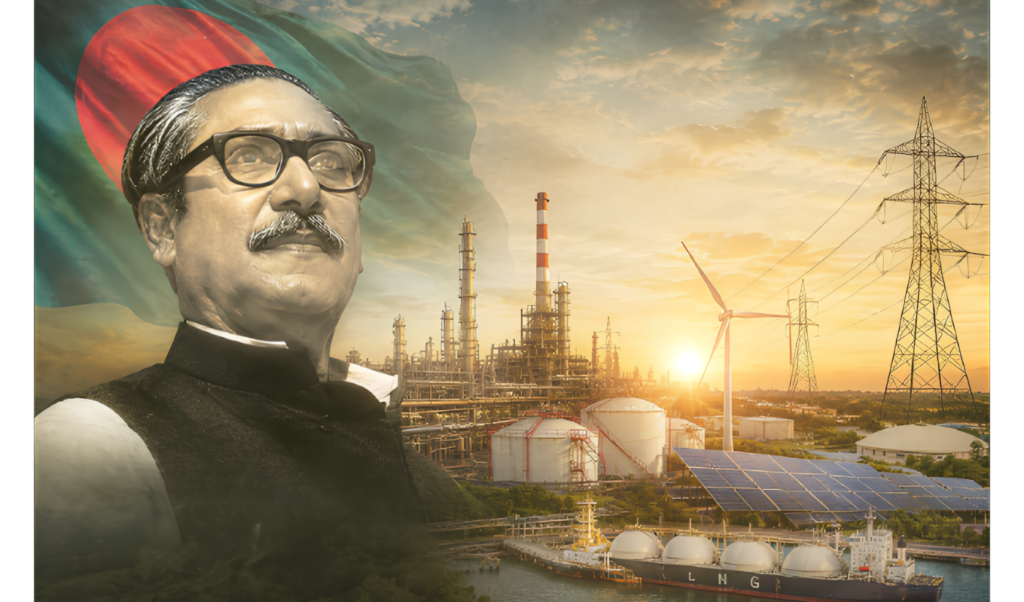
This legacy began under the leadership of Bangabandhu Sheikh Mujibur Rahman. Following independence, when a war-ravaged nation was starting its economic journey virtually from scratch, Bangabandhu foresaw that the future of Bangladesh’s industrialisation and economic progress would heavily depend on energy security.
On 9 August 1975, he demonstrated this visionary foresight through one of his most monumental decisions: purchasing five major gas fields—Titas, Bakhrabad, Habiganj, Rashidpur, and Kailashtila—from the multinational Shell Oil Company for just £4.5 million. This historic transaction established state ownership over the nation’s most vital natural gas reserves.
For a newly independent, war-torn country, this was an exceptionally bold move. At the time, national foreign exchange reserves were depleted, infrastructure lay destroyed, and industries were devastated. Amid widespread crisis, Bangabandhu recognized that alongside addressing immediate hardship, securing control over national energy resources was essential for the future of Bangladesh.
Bangabandhu’s energy vision extended beyond the acquisition of gas fields. Through a series of foundational measures—including the establishment of Petrobangla in 1972, asserting state ownership over national mineral resources, building structures for power generation and transmission, and enacting the Petroleum Act and the Territorial Waters and Maritime Zones Act in 1974—he laid the groundwork for a self-reliant energy framework.
For Bangabandhu, energy was not simply a commercial commodity; it was a cornerstone of the state’s economic sovereignty.
Tragically, Bangabandhu was granted only three and a half years to advance this vision. His assassination on 15 August 1975 cut short not only the life of a statesman, but also the continuity of a long-term national development philosophy.
Over the subsequent decades, Bangladesh’s energy sector suffered from shifting political priorities, mismanagement, and underinvestment. Between 1991 and 1996, severe constraints emerged in gas production and supply. Despite the existence of reserves in certain regions, the lack of adequate transmission infrastructure prevented distribution to other parts of the country. This shortfall crippled power generation, fertilizer production, and industrial output, making widespread load-shedding a daily reality.
When the Awami League government, led by Sheikh Hasina, took office in 1996, a new phase of planned initiatives in the energy and power sectors began. Crucially, the administration approached energy and power not as isolated domains, but as interconnected components of national infrastructure.
The construction of the Ashuganj-Bakhrabad gas transmission pipeline brought a major structural upgrade to the eastern gas grid, increasing supply to the Chittagong region and helping restore operations in power plants and fertilizer factories.
Simultaneously, initiatives were undertaken to extend gas transmission infrastructure to the western region, including laying a pipeline along the Bangabandhu Jamuna Multipurpose Bridge. Gas fields such as Salda, Meghna, Beanibazar, Sangu, and Jalalabad were integrated into the national grid, paving the way for further discoveries, including the Maulavibazar field. Later, the Bibiyana gas field emerged as one of the most vital assets in Bangladesh’s energy landscape.
The power sector underwent significant structural shifts during this period. The government opened power generation to the private sector, initiating major Independent Power Producer (IPP) projects at Meghnaghat and Haripur alongside barge-mounted power plants to rapidly expand generation capacity.
A fundamental insight emerged from this era: constructing power plants alone does not guarantee electricity. Power generation requires a reliable fuel supply, which demands pipelines, ongoing exploration, functional drilling rigs, and long-term investment.
The initiatives undertaken between 1996 and 2001 marked a critical turning point in the history of Bangladesh’s energy security.
However, after 2001, this momentum was not sustained. Long-term planning for exploration, capacity expansion, and infrastructure development faltered, leading to severe repercussions a few years later. By 2006–07, electricity and gas shortages had escalated to a crisis point, severely damaging industry, commerce, and daily life.
Consequently, when the Sheikh Hasina-led government returned to power in 2009, its primary challenge was rebuilding national energy capacity.
At that time, domestic gas production stood at approximately 1,744 million standard cubic feet per day (MMCFD), exploration had stalled, and active drilling rigs were scarce. Expanding power generation made increasing the gas supply an immediate imperative.
The administration adopted a multi-pronged strategy focused on domestic gas exploration, drilling new wells, conducting workovers on existing wells, discovering new fields, expanding transmission infrastructure, and introducing imported gas where necessary.
Between 2009 and July 2024, plans were set in motion to drill 155 wells. This effort led to the discovery of several new gas fields, including Sundalpur, Srikail, Rupganj, Bhola North, Zakiganj, and Ilisha, driving national gas production up to a peak of nearly 2,750 MMCFD.
Exploration capabilities were bolstered alongside drilling. Older rigs were refurbished, new ones were acquired, and extensive 2D and 3D seismic surveys were conducted across both onshore and offshore areas. Energy security was addressed not merely through current output, but by identifying future potential reserves.
Substantial investments were also directed into the gas transmission network, expanding pipeline mileage and improving inter-regional supply distribution.
Simultaneously, a new operational reality emerged: growing economic demands could no longer rely solely on domestic natural gas. To bridge the deficit, infrastructure for Liquefied Natural Gas (LNG) imports was developed, introducing imported gas into the national grid via Floating Storage and Regasification Units (FSRUs).
It is important to note that imported LNG was intended not to replace domestic gas, but to complement it and manage supply deficits. The government pursued domestic exploration and import infrastructure in tandem.
Infrastructure for petroleum products was similarly expanded during this period, increasing storage capacity and introducing pipeline transportation for liquid fuel, alongside rapid growth in the LPG sector.
Between 2009 and 2024, Bangladesh’s energy infrastructure expanded in scale and complexity beyond any previous period.
Yet this raises a critical question: despite substantial investments and extensive infrastructure, why do energy shortages persist today?
The answer lies in the nature of energy security: it is not a five-year project bound to a single administration, but a continuous state process. Drilling a well yields results only after several years, and discovering a gas field does not translate into immediate production. The entire supply chain—from exploration and extraction to processing, transmission, and final delivery to industrial units and power plants—must operate as an integrated system.
The current situation serves as a stark warning.
If projects stall, drilling operations cease, exploration declines, rigs remain idle, pipeline installations freeze, and investment decisions linger whenever there is a transition in governance, energy security rapidly erodes.
The most dangerous aspect of neglect in the energy sector is its delayed impact. Failing to drill a well today creates a supply deficit two or three years down the line. Halting exploration now will affect supply years later, at which point resolving the crisis demands far greater time and capital.
This is precisely why questions arise regarding the continuity of ongoing energy projects, exploration programmes, and long-term plans during periods when the Awami League is out of power. Disrupting scheduled drilling, workover operations, and deep-drilling plans designed to feed future gas into the national grid directly impacts current production and supply stability.
In such circumstances, simplistic political narratives often emerge, claiming that previous administrations failed to explore for gas. However, the realities of the energy sector are far more complex.
When documented data confirms that hundreds of wells were drilled, new gas fields were discovered, production was increased, new rigs were brought in, thousands of kilometres of seismic surveys were conducted, and transmission networks were expanded over a given period, public debate should center on those factual metrics rather than political rhetoric.
Similarly, current challenges cannot be attributed to a single factor. National energy security is shaped by a combination of domestic production limits, declining output from aging wells, the pace of new exploration, import reliance, FSRU handling capacities, foreign exchange pressures, and infrastructure bottlenecks.
Herein lies the enduring relevance of Bangabandhu’s 1975 decision.
He recognized that a nation cannot safeguard its economy indefinitely by relying on imported energy; it must retain sovereignty over its own resources. Sheikh Hasina adapted that philosophy to modern realities by integrating domestic exploration, production enhancement, transmission expansion, and managed imports.
This is not to claim that every decision made during their tenures was flawless. However, one fundamental truth remains undeniable: Bangabandhu identified the necessity of continuous investment and long-term planning for energy security immediately after independence, and Sheikh Hasina maintained that vision as a cornerstone of national development policy over an extended period.
Today’s challenges are therefore not merely a gas shortage; they represent a test of the resilience of the state’s long-term planning.
Political administrations will change, and governments will transition. However, gas fields, pipelines, power stations, and drilling rigs are national assets, not the property of any political party. Regardless of who holds office, Bangladesh must move past the practice of discarding previous projects simply to start anew.
When a well is shut down, the loss extends beyond its immediate output: industrial production drops, power plant capacity falls, employment is impacted, and overall economic costs rise. Ultimately, the burden falls on the citizens.
The core lesson of Bangabandhu’s purchase of the five gas fields in 1975, despite severe financial constraints, was straightforward: investing today is essential to secure the nation’s future.
That commitment to expanding exploration, production, transmission, and import capacity was carried forward under Sheikh Hasina.
If that continuity breaks, the consequences will be borne by the entire country in the years ahead.
Political debate over energy policy is natural, but it must be grounded in data and strategic planning. Beyond assessing how many wells were drilled, fields discovered, pipelines laid, or megawatts generated, the central question remains: where will Bangladesh derive its energy over the next decade?
Energy security cannot be established overnight; it requires decades of sustained effort. Yet, the foundations of that security can be damaged by a few short-sighted decisions.
Bangabandhu’s acquisition of those five gas fields on 9 August 1975 was more than a historic transaction—it serves as a reminder that a visionary leader makes decisions with future generations in mind.
What Bangladesh requires most today is the restoration of that long-term vision. Governments and political landscapes will evolve, but Bangladesh’s energy security strategy must remain steadfast. Energy security is not a partisan matter; it is fundamental to the nation’s existence and economic future.