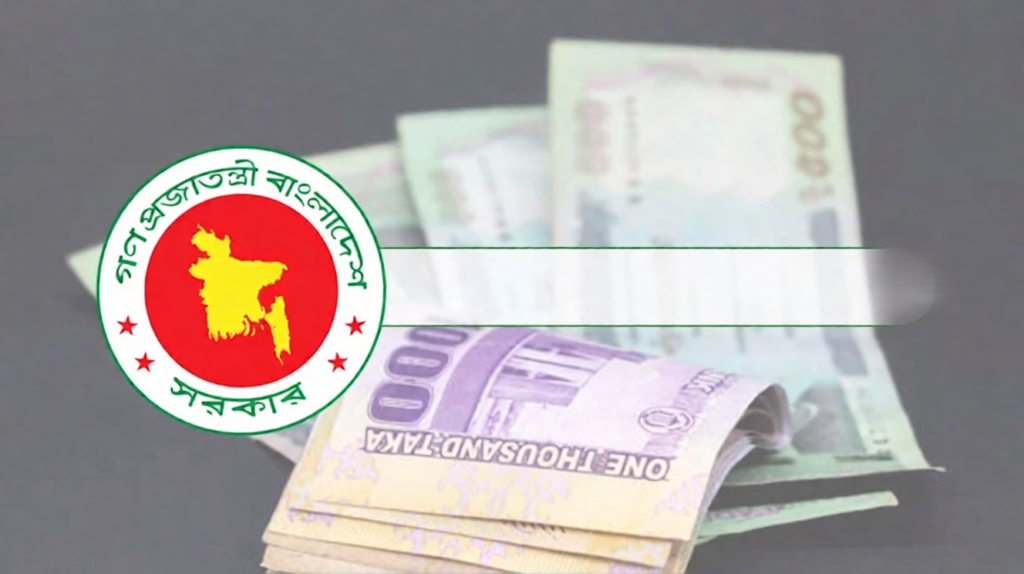
The Government of Bangladesh has formally issued the gazette notification for the National Pay Scale 2026, introducing substantial basic salary increases ranging between 100 and 142 percent across 20 distinct grades. Backdated to take effect from 1 July 2026, the updated framework overhauls the compensation scheme for hundreds of thousands of civil servants, state employees, and public sector workers nationwide. Under the newly promulgated structure, the entry-level basic pay for Grade 20 rises to BDT 20,000 per month, whilst Grade 1 basic remuneration reaches BDT 156,000.
Graduated Implementation and Salary Re-Fixation Rules
To mitigate immediate fiscal pressure on the national treasury, the administration has structured the payout across three distinct phases:
-
1 July 2026 – 31 December 2026: Officials in Grade 9 and above draw 40 percent of the net increase, whereas employees in Grades 10 to 20 receive 50 percent of the incremental difference.
-
1 January 2027 – 30 June 2027: Senior grades receive 70 percent of the hike, whilst junior grades receive 75 percent.
-
1 July 2027 onwards: Full 100 percent implementation applies across all 20 grades, with retrospective arrears adjusted accordingly.
Individual pay determination—termed “pay fixation”—does not automatically place every employee on a grade’s initial step. Compensation levels rely on two established procedures to account for accumulated annual increments.
For staff currently earning the minimum baseline within their existing scale, transition remains straightforward. An employee in Grade 16 previously earning the baseline figure of BDT 9,300 under the old pay band (BDT 9,300–22,490) directly moves to the new baseline of BDT 21,900 under the revised band (BDT 21,900–52,900).
For civil servants earning above the minimum threshold due to years of service, calculations require a step-by-step adjustment:
-
Determine the Base Surplus: Subtract the starting baseline of the former pay scale from the official’s actual basic salary as of 30 June.
-
Add to New Baseline: Combine this surplus figure with the revised scale’s starting baseline.
-
Identify final placement: Match the total to the nearest corresponding step within the new structure. If the calculated figure falls between designated steps, the salary automatically scales up to the next higher increment.
Mathematical Worked Example
Illustration: Consider an employee whose basic salary as of 30 June stood at BDT 13,790, against an old entry baseline of BDT 12,500.
Surplus Difference: $\text{BDT } 13,790 – \text{BDT } 12,500 = \text{BDT } 1,290$
Provisional Revised Total: Adding this difference to a hypothetical new scale starting at BDT 25,000 yields $\text{BDT } 25,000 + \text{BDT } 1,290 = \text{BDT } 26,290$.
Final Fixation: If BDT 26,290 does not exist as an explicit step in the gazette, the baseline scales up to the immediate higher increment, fixing the new basic salary at BDT 26,300.
Fixed Grade Exceptions and Career Progression Provisions
The multi-step fixation formula excludes designated top-tier public officials whose monthly baselines are fixed without variable increments:
-
Cabinet Secretary & Principal Secretary to the Prime Minister: BDT 172,000
-
Senior Secretary: BDT 164,000
-
Grade 1 Officials: BDT 156,000
The gazette also covers personnel on deputation, official leave, temporary suspension, or post-retirement leave (PRL). Deputed personnel will have their pay fixed on the basis of earnings they would have drawn within their parent cadres. However, civil servants whose PRL ended on or before 30 June remain ineligible for retrospective re-fixation under the 2026 scale. Furthermore, permanent employees remaining in the same post without promotion for eight consecutive years will automatically transition to the next higher pay scale in their ninth year, subject to satisfactory service records.