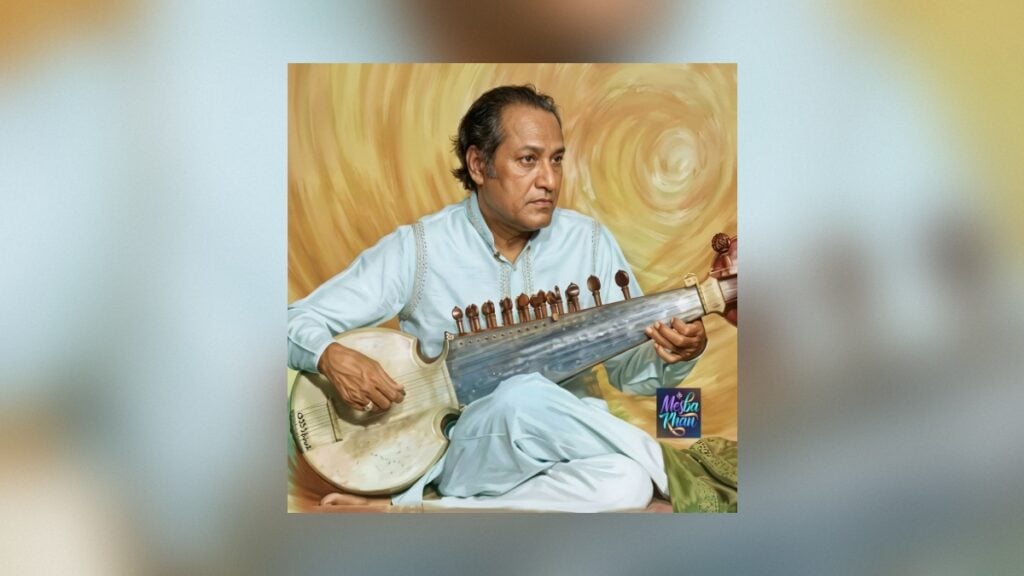
Some musicians become part of history not simply because of their performances, but because they carry a musical tradition into new artistic and cultural spaces. Ustad Bahadur Hussain Khan was one such figure. A distinguished sarod player, composer and music director, he made a lasting contribution to South Asian classical music while also extending his work into dance, cinema, documentary filmmaking and music education.
Bahadur Hussain Khan was born on 19 January 1931 in Shibpur village, in Nabinagar upazila of Brahmanbaria. He came from a prominent musical family whose influence extended across the classical music traditions of the Indian subcontinent. His father, Ustad Ayet Ali Khan, was a respected musician and sarod player, while his uncle was the legendary maestro Ustad Allauddin Khan.
Music was deeply rooted in the family. Several of Ayet Ali Khan’s children, including Abed Hussain Khan, Mobarak Hussain Khan, Sheikh Sadi Khan, Tansen Khan and Yasmin Khan, were associated with music and culture. Growing up in such an environment gave Bahadur Khan an early and intimate exposure to the discipline of classical music.
His first lessons on the sarod came from his father. His musical education later took a more demanding turn when he travelled to Maihar, where he received extended training from his uncle Allauddin Khan. The years he spent there played a decisive role in shaping his artistic identity.
The Maihar tradition placed great emphasis on rigorous practice, musical discipline, the structure of ragas, rhythmic precision and the expressive possibilities of instrumental music. These elements remained visible throughout Bahadur Khan’s later career. Yet he did not simply reproduce the tradition he had inherited. He found ways to carry its principles into different artistic forms.
His professional career began in 1949 as an artist with Bangladesh Betar. Two years later, in 1951, he moved to Bombay, now Mumbai, where he worked as music director for dancer Shanti Bardhan’s Little Ballet Troupe. This experience expanded his artistic horizons, bringing classical music into closer contact with dance, theatre and visual performance.
Bahadur Khan’s career, however, cannot be fully understood through his work as a sarodist alone. He was also a composer and music director whose work became closely associated with Bengali and Indian cinema.
One of the most significant chapters of his career was his musical association with filmmaker Ritwik Ghatak. His work was connected with several of Ghatak’s films, including Meghe Dhaka Tara, Subarnarekha, Komal Gandhar and Jukti Takko Aar Gappo. These films are recognised as important works in the history of Bengali cinema, and Bahadur Khan’s music formed part of their distinctive artistic landscape.
Subarnarekha was among his notable film-music assignments. His wider body of work included Natun Pata, Trisandhya, Jekhane Danriye, Shwet Mayur, Titas Ekti Nadir Naam, Garam Hawa and Jukti Takko Aar Gappo. His classical training gave his music a strong foundation, but he also understood that cinema required music to respond to images, characters, narrative and atmosphere.
His contribution extended to Bangladeshi cinema as well. He worked on films including Titas Ekti Nadir Naam and Nadi O Nari, leaving his mark through music and orchestration. His career therefore connected different parts of the Bengali-speaking cultural world at a time when classical music and cinema were increasingly interacting with one another.
Bahadur Khan’s musical activities also reached beyond feature films. He directed background music for documentaries associated with major cultural figures, including Rabindranath Tagore, Allauddin Khan and artist Jamini Roy. These projects demonstrated the breadth of his musical interests and his ability to adapt classical musical sensibilities to different forms of visual storytelling.
Teaching was another important part of his life. Alongside his work in Kolkata, he taught Indian classical music at the Ali Akbar College of Music in California in the United States. Among his students was sarod player Tejendra Narayan Majumdar, who later became recognised in his own right. Through teaching, Bahadur Khan’s influence extended beyond his own performances and compositions to another generation of musicians.
Some recordings of his sarod performances were released, although much of his work is not readily accessible today. The limited availability of recordings is significant because musical archives are essential to preserving the work of performers from earlier generations. When recordings, manuscripts and other documentation are not adequately preserved, important parts of a musician’s contribution can become difficult for later audiences and researchers to hear or study.
Perhaps the most distinctive feature of Bahadur Hussain Khan’s career was his ability to combine a deep respect for tradition with a willingness to work across artistic forms. The rigorous training he received in Maihar remained central to his musical identity, but he did not confine that knowledge to conventional classical performances.
He brought the language of classical music into cinema and dance, where melody and rhythm could serve a different purpose. A sarod phrase could carry the character of a raga, but it could also help establish the emotional atmosphere of a film scene. This ability to move between artistic settings gave his work a distinctive character.
His career also reflects a broader cultural exchange within South Asia. Born in Shibpur, trained in Maihar and active in both Bangladesh and India, Bahadur Khan’s professional journey crossed geographical and artistic boundaries. His work connected the rigorous world of classical instrumental music with the rapidly developing mediums of cinema, dance and documentary.
Bahadur Hussain Khan’s life was relatively short. He died in Kolkata on 3 October 1989 at the age of 58. Within those years, he established himself in several roles—as a sarod player, composer, music director and teacher.
His legacy is therefore larger than a list of performances or film credits. It represents a particular way of carrying a classical tradition forward: preserving its discipline while allowing it to interact with changing forms of artistic expression.
Today, remembering Bahadur Hussain Khan means remembering an artist whose journey began with the sarod and expanded into a much wider cultural landscape. His work brought together the musical inheritance of his family, the rigorous training of Maihar and the creative possibilities of cinema, dance and education.
The sound of his sarod may no longer be heard as frequently as it once was, and much of his recorded work remains difficult to access. Yet his contribution continues to form part of the musical history of Bengal and the wider Indian subcontinent.
Ustad Bahadur Hussain Khan’s instrument fell silent in 1989. The tradition, knowledge and artistic legacy he helped carry forward continue to resonate.