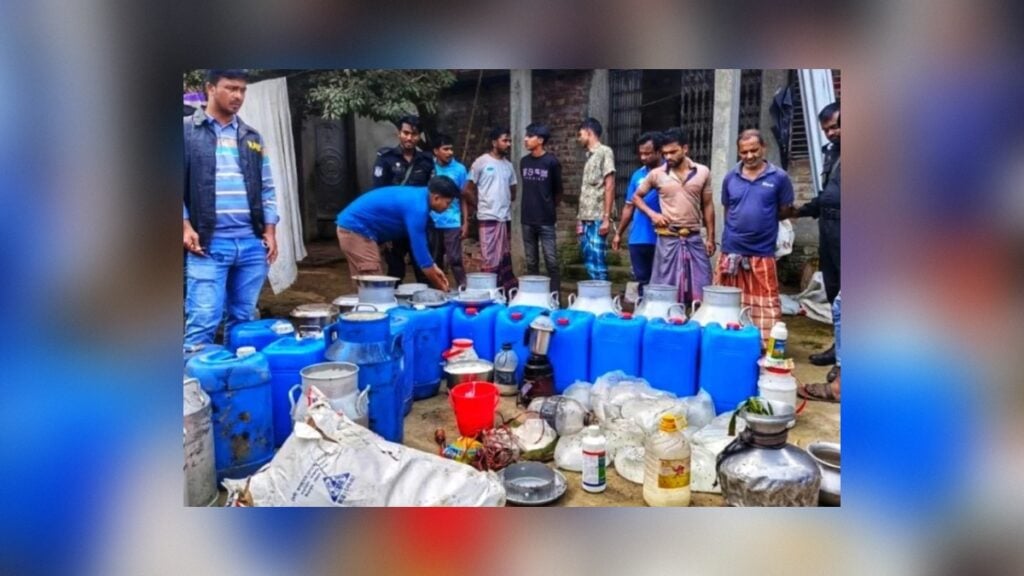
Pabna has emerged as a major centre of an alleged adulterated milk trade, with artificial milk reportedly being produced from soybean oil, glucose, saccharin, urea fertiliser, detergent powder, caustic soda and other chemicals.
The liquid, produced without any cows being involved, is allegedly being supplied to milk collection and chilling centres used by well-known companies. From there, milk and dairy products can eventually reach consumers, including children and patients.
More than 200 chilling centres have reportedly been established across Bhangura, Chatmohar and Faridpur upazilas of Pabna. These facilities serve as initial collection, quality-checking and storage points for milk. Of the centres identified in these three areas, 92 are reportedly associated with recognised companies, while the remainder are privately owned. Numerous other chilling centres are also operating in Santhia, Bera and Bhangabari.
People involved in the alleged trade, speaking on condition of anonymity, said a mixture of chemicals costing around Tk450 can be added to 40 litres of a white, non-creamy liquid to make it resemble high-fat milk. The resulting product can then be sold for about Tk2,200, giving traders an alleged profit of roughly Tk1,750 per 40 litres.
According to the accounts provided, production on a large scale can generate substantial monthly earnings. Those involved also claimed that penalties imposed when the operation is detected are often insufficient to deter repeat offences.
Chemicals reportedly delivered through courier services
Those involved in producing the artificial milk were reluctant to discuss the process openly. However, some said the chemicals could be ordered from traders in Dhaka, Chattogram and other parts of the country through telephone calls or online orders.
The chemicals are reportedly delivered to production sites through courier or transport operators. The finished liquid is then taken to collection points.
One allegation made by people familiar with the trade is that some operators gain access to chilling centres by paying bribes. They claimed that a payment of around Tk500 could sometimes be enough to facilitate the delivery of the artificial product.
Such allegations, however, are not representative of all chilling centres or milk-processing companies. Several major dairy companies say they have strict procedures in place to reject milk that fails quality checks.
Administrative action has resulted in fines
Authorities have taken action against several individuals and businesses accused of involvement in adulterated milk production.
On 28 September, Uttam Ghosh and his wife, Poly Ghosh, from the Pechakola Ghat area of Bera were fined Tk100,000 by the administration. According to the report, this was their first such penalty.
Earlier, on 6 September, the owner of Jui Dairy Farm in the Nagdemra area of Santhia was fined Tk200,000 over various violations.
Other businesses and individuals who have faced action include Keya Dairy, Amina Dairy and Premium Food in Faridpur, Joydeb Ghosh of Bera and Ashraful Ali of Singari village in Bhangura.
Joydeb Ghosh was fined Tk200,000 after being accused of producing adulterated milk for around 12 years in the Nakalia and Pechakola markets of Bera.
Despite such enforcement drives, allegations of continued production indicate that fines alone may not be enough to eliminate the trade.
Genuine dairy farmers facing mounting pressure
The alleged adulterated milk business is also affecting farmers who produce genuine milk.
Farmers say the cost of producing genuine milk is comparatively high, while some collection centres prefer cheaper supplies. They also allege that middlemen involved in collecting milk from farmers exert pressure on producers who are unwilling or unable to provide commissions.
Ashraful Islam, a dairy farmer from Baowikhola village, said dishonest traders were selling artificial milk at lower prices, damaging the market for genuine producers.
Farmers selling milk at Tk50-Tk55 a litre are sometimes unable to recover their production costs, he said. Without stronger enforcement, he warned, the region’s dairy industry could face severe difficulties.
Abdul Latif, president of a local dairy producers’ co-operative association in Santhia, said genuine farmers did not normally adulterate milk. According to him, the problem was linked mainly to some dishonest intermediaries seeking higher profits.
He also pointed to weaknesses in quality control at some collection centres as a factor allowing adulterated milk to enter the supply chain.
Daily milk shortfall creates a lucrative gap
Information from livestock officials and small-scale dairy farmers suggests that Pabna and Sirajganj together require around 450,000 litres of milk a day, while production is estimated at approximately 350,000 litres.
That leaves a daily shortfall of around 55,000 to 60,000 litres.
A significant proportion of locally produced milk is absorbed by large dairy processors, wholesalers, sweet shops and household consumers. The reported shortage creates a substantial gap in the supply chain, which, according to local sources, is being exploited by traders producing artificial milk.
| Supply and distribution category | Approximate daily volume |
|---|---|
| Total demand in Pabna and Sirajganj | 450,000 litres |
| Total milk production | 350,000 litres |
| Estimated daily shortfall | 55,000–60,000 litres |
| Milk supplied to Milk Vita | 120,000–150,000 litres |
| Milk supplied to Aftab, Akij, PRAN, BRAC and other processors | About 175,000 litres |
| Milk supplied to wholesalers | 50,000–55,000 litres |
| Milk supplied to more than 200 sweet shops | About 15,000 litres |
| Milk bought by local consumers in markets | About 10,000 litres |
| Chilling centres in Bhangura, Chatmohar and Faridpur | More than 200 |
| Chilling centres associated with recognised companies | 92 |
Dairy companies say quality checks are in place
PRAN Dairy’s administration manager, Saikat Sheikh, said the company collects milk using digital software and an LS machine, following a strict standard operating procedure involving 13 to 14 stages of testing.
Milk that fails to meet the required standards, or in which even a small amount of adulteration is detected, is rejected, he said.
Sheikh also claimed that four or five chilling-centre employees had been injured over the past year after refusing to accept milk following the detection of adulteration.
He argued that stricter controls were also needed outside individual companies, particularly over the sale and transportation of chemicals used to produce artificial milk. He called for a common, mandatory standard operating procedure for all organisations involved in milk collection.
Dr Saiful Islam, additional general manager of Milk Vita, said samples collected at the company’s chilling centres are tested for fat, solids-not-fat (SNF) and harmful chemicals using modern laboratory technology.
If adulteration or harmful chemicals are detected, the milk is immediately rejected and destroyed, he said.
He also said the reputation of the region’s dairy sector was being harmed by the activities of some dishonest intermediaries.
Experts warn that basic tests may not detect every adulterant
Dr AKM Humayun Kabir, a professor at Chattogram Veterinary and Animal Sciences University, said natural milk contains a balanced combination of components that cannot simply be reproduced by adding chemicals.
Artificially increasing the apparent fat content may make a liquid resemble milk, but it does not recreate the original structure or nutritional value of genuine milk, he said.
He also warned that some forms of adulteration may be difficult to identify through basic testing. Specific laboratory examinations may be required to detect substances such as urea, alkalis or formaldehyde.
According to him, stronger quality-control measures are necessary to prevent the problem from becoming a serious public-health concern.
Pabna Civil Surgeon Dr Abul Kalam Azad also raised concerns about the potential health consequences. He said liquids containing edible oil, detergent and caustic soda could pose serious risks to human health, particularly when consumed by children or people who are already ill.
The reported use of industrial or chemical substances in products intended to be consumed as milk is therefore not simply a question of food quality. It raises concerns about consumer safety and the integrity of the wider dairy supply chain.
Lack of a permanent laboratory remains a major obstacle
Pabna District Commissioner Aminul Islam said the administration was conducting regular drives against adulterated milk. However, he identified the absence of a modern laboratory in the district as a significant limitation.
Testing for specific chemicals requires appropriate laboratory facilities, while a mobile laboratory from Rajshahi reportedly visits the district only once a month.
Authorities are working towards establishing a permanent laboratory in Pabna, according to the district administration.
A permanent testing facility would allow suspected milk samples to be examined more frequently and could strengthen enforcement against adulteration. At the same time, effective monitoring of chemical sales and transportation, tighter quality controls at chilling centres, consistent testing procedures across milk collectors and meaningful action against repeat offenders would be needed to address the problem across the supply chain.
For genuine dairy farmers, the issue is equally pressing. Unless the market rewards properly produced milk and collection systems operate transparently, farmers say they will continue to face pressure from cheaper adulterated alternatives.