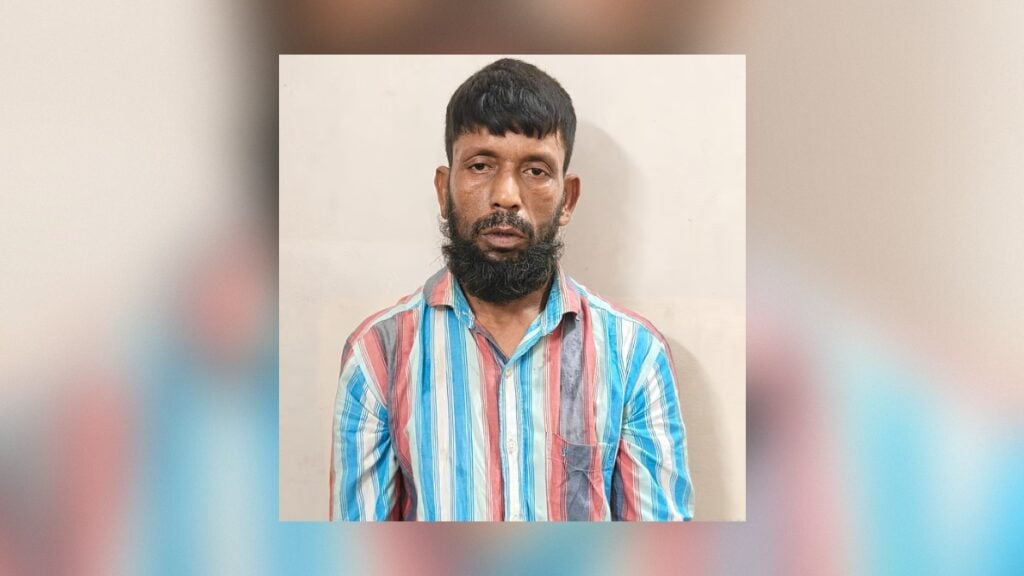
A 12-year-old history of serious criminal allegations surrounding Moniruzzaman Matubbar, also known as Hridoy, has come under fresh scrutiny following his arrest in connection with the deaths of a pregnant woman and her husband in Ashulia, on the outskirts of Dhaka.
Moniruzzaman was first accused of killing his wife in 2014 in Nagarkanda, Faridpur. He was later arrested and spent four years in prison in connection with the case before securing bail in 2018. After returning home for a brief period, he allegedly went into hiding again. Investigators say he subsequently became involved in further serious offences, including a case involving the alleged gang rape and killing of a woman.
His name has now emerged in the investigation into the deaths of Nazma Begum, 39, who was pregnant, and her husband, Alamgir Kabir, 45, in Ashulia. Following his arrest, Moniruzzaman reportedly admitted responsibility for the killings in court.
Police said he is currently being held at Dhaka Central Jail.
First case: alleged killing of his wife
Moniruzzaman, also known as Monir Hossain and Hridoy Matubbar, is 44 and comes from Damdardi village in Nagarkanda upazila of Faridpur. He is the third among six siblings.
According to police and family sources, he had a history of conflicts with people in his community. His family had hoped that marriage would encourage him to settle into a more stable life, but that did not happen.
Police said allegations were brought against him in 2014 over the killing of his wife, Rahela Begum, in Nagarkanda. He allegedly fled after the incident, prompting the filing of a murder case at Nagarkanda police station.
Abdul Quddus, a former sub-inspector who investigated the case, said Moniruzzaman was arrested in Dhaka after going into hiding. According to the investigation, he allegedly strangled his sleeping wife before fleeing the area.
A charge sheet was subsequently submitted against him in the case. After spending four years in custody, he was released on bail in 2018. He stayed at home for some time before disappearing again. As he remained wanted in the wife-killing case, a court issued an arrest warrant against him.
A new life in hiding in Ashulia
After securing bail, Moniruzzaman moved to Ashulia in Savar and began living there away from his home district. It was in the area that investigators later linked him to further criminal allegations.
The latest case centres on the deaths of Nazma Begum and her husband, Alamgir Kabir.
On the night of 5 September, police recovered the couple’s bodies from a flat in a residential building in Jamgora, central Ashulia. The flat had been locked, and the door was broken open before the bodies were found.
Nazma’s body was lying on a bed. The body of her unborn child was also found at the scene following the injuries she had suffered. Alamgir’s body was found in the same room, with a rope around his neck and his body hanging from a ceiling fan.
Nazma worked at a garment factory. Alamgir had previously worked in the garment sector but was unemployed at the time of the incident. Both were originally from Nawabganj upazila in Dinajpur.
Nazma’s elder sister, Shapla Begum, subsequently filed a murder case with Ashulia police station against unidentified suspects. The Dhaka district unit of the Police Bureau of Investigation (PBI) later took over the investigation.
Investigation identifies a suspect
According to PBI officials, investigators initially had little information about who was responsible for the killings. Intelligence work eventually led them to identify Moniruzzaman as a suspect.
He was detained on 8 September from the Narshingpur area of Ashulia. During questioning, investigators said, he admitted to killing Alamgir and Nazma and provided details of the incident.
Based on information allegedly provided by him, PBI recovered Nazma’s purse, mobile phone, SIM card and identity documents.
Moniruzzaman later gave a confessional statement before a court in connection with the case.
Dispute over relationship preceded killings
According to the investigation, Moniruzzaman had become acquainted with Alamgir after settling in Ashulia. The two lived close to each other. At the time, Alamgir was unemployed, while Moniruzzaman was involved in vegetable trading.
Investigators said Moniruzzaman had developed a relationship with Nazma some time earlier after allegedly giving her the prospect of marriage. When Alamgir became aware of the relationship, tensions developed between the two men.
On 2 September, Alamgir and Nazma invited Moniruzzaman to their home. According to the PBI account, a confrontation began after Alamgir raised the issue of Moniruzzaman’s relationship with his wife.
The argument reportedly escalated into a physical struggle. Investigators said Nazma struck Moniruzzaman with a broom, after which he kicked her in the abdomen. She fell on the bed and suffered severe injuries. Her unborn child also died.
Alamgir then allegedly attacked Moniruzzaman with a cooking utensil and a metal pipe. During the confrontation, Moniruzzaman is accused of wrapping a towel around Alamgir’s neck and strangling him.
Investigators said he subsequently hung Alamgir’s body from the ceiling fan in an apparent attempt to conceal the circumstances of the death. He then allegedly took Nazma’s Android phone, SIM card, identity documents and purse to his own residence.
A long criminal history under investigation
The Ashulia killings have brought renewed attention to Moniruzzaman’s earlier case and the subsequent allegations against him. His criminal history, according to police, stretches back to the 2014 case involving the alleged killing of his wife.
Police have also linked his name to a separate case involving the alleged gang rape and killing of a woman. Details of that case and the legal proceedings surrounding it remain subject to investigation.
The latest Ashulia case is now being examined through the evidence recovered from the scene, the items allegedly recovered at Moniruzzaman’s instance, witness accounts and his statement before the court. His alleged confession will also be considered alongside other evidence as the legal process continues.
For investigators, the challenge now is to establish the full sequence of events surrounding the Ashulia killings and determine the extent of Moniruzzaman’s involvement through corroborating evidence. Meanwhile, his earlier murder case and the subsequent allegations against him have added another layer to an investigation involving a suspect who had remained out of the authorities’ reach for years.