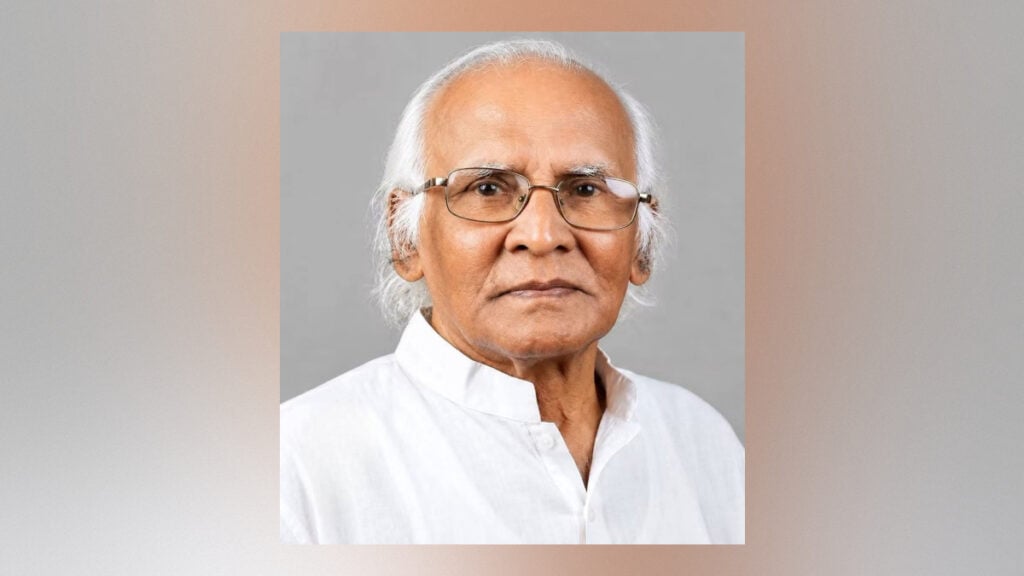
There was a time when his voice carried the fire of a turbulent nation. During the Liberation War of 1971, his songs gave courage to freedom fighters and stirred a deep sense of patriotism among a people fighting for independence. Yet, as the years passed, the man behind those powerful words gradually withdrew from public life, leaving behind a remarkable body of work that deserves to be remembered.
He was Nayeem Gohar, a freedom fighter, lyricist, poet, novelist, singer, actor, playwright, BBC Bengali broadcaster and newsreader. His life brought together literature, music, broadcasting, theatre and the struggle for Bangladesh’s independence. Despite the breadth of his talents, he lived much of his life without the self-promotion often associated with public figures.
Born on 15 August 1936 into a distinguished family in the Bikrampur region, Gohar showed considerable academic promise from an early age. He went on to study at the University of Dhaka, where he secured the first position in his graduation examination.
His literary career began while he was still young. He initially wrote poetry in English, and his work appeared in the Observer, then one of the country’s leading English-language newspapers. He later published poetry collections including Shob O Swagatokti and Nishiddho Bichhana, while his story collection Rahugras also established his credentials as a serious writer. Numerous poems and short stories by him appeared in newspapers and literary publications over the years.
Yet Gohar was not particularly careful about preserving his own creative work. Much of his writing remained scattered across newspapers, magazines and personal collections. As a result, a significant part of his literary legacy has become difficult to trace, leaving behind the paradox of a prolific creator whose own archive was never properly preserved.
For most people, however, Nayeem Gohar’s most enduring identity was that of a lyricist.
During the bloody months of 1971, his patriotic songs became part of the emotional landscape of the Liberation War. Songs such as ‘Nongor Tolo Tolo, Shomoy Je Holo Holo’, ‘Sagor Parite Jhor Jage Jodi Jagte Dao’, ‘Pub-er Oi Akashe Surjo Uthchhe Aloke Alokomoy’, ‘Joy Joy Joy Joy Bangla’ and ‘Jonmo Amar Dhonno Holo Mago’ expressed the aspirations, courage and determination of a nation seeking freedom.
For many who lived through that period, such songs were more than musical compositions. They became expressions of patriotism and resistance, carrying the hopes of a people facing an uncertain and violent future.
Gohar’s contribution to the Liberation War was not confined to his creative work. On the night of 25 March 1971, when the Pakistani military launched its brutal crackdown in what became known as the genocide of the night of 25 March, he took a considerable personal risk to deliver an urgent message from Bangabandhu Sheikh Mujibur Rahman to M. R. Siddiqui in Chattogram. His role in that critical period later received formal recognition from the state.
In 2012, many years after independence, Nayeem Gohar was awarded the Independence Award, the country’s highest civilian honour, in recognition of his contribution.
His songwriting extended well beyond patriotic music. He wrote extensively for modern and classical music, covering themes of love, nature, humanity and the emotional experiences of ordinary people. He is credited with writing nearly 200 songs, demonstrating the range of his lyrical imagination.
He also made his mark in television. His first play after independence, Pakhi Amar Jayanta, was broadcast on Bangladesh Television. The character Jayanta was named after his own son.
Together with Fazle Lohani, Gohar was also associated with the television programme Jodi Kichhu Mone Na Koren, which introduced a distinctive style of presentation and social commentary. One of the lines he wrote for the programme became widely recognised:
‘Ichchhe Korei Jara Bhul Koren,
Jeneo Na Janar Bhan Koren,
Tader Kichhu Bhul Bujhiye Deb.’
His talents also extended to acting. Acclaimed film director Ehtesham repeatedly encouraged him to take on a leading role in films. At the time, the film magazine Rupchhaya published his photograph and described him as a promising new face whose future identity audiences would come to know.
Gohar, however, did not pursue a conventional career as a film hero. His legacy ultimately became far broader. He emerged as a witness to a defining period in Bangladesh’s history and as one of the creative voices that helped give emotional expression to the country’s struggle for independence.
After independence, his life gradually took a quieter turn. Despite his achievements, he increasingly withdrew from public attention and eventually moved away from the creative world that had once occupied so much of his life. The reasons for that retreat remain largely unknown.
Perhaps there was disappointment. Perhaps there were unfulfilled dreams. Or perhaps, after witnessing the immense sacrifices of 1971, he found the realities of independent Bangladesh difficult to reconcile with the aspirations that had inspired the struggle.
There are no easy answers.
What remains certain is the scale of his contribution. Nayeem Gohar died on 7 October 2015, bringing to an end the life of a remarkable creative figure whose voice had once resonated through one of the most decisive chapters in Bangladesh’s history.
His artistic legacy has also continued through his two daughters. Singer Tajreen Gohar and noted theatre and film actress Elora Gohar have carried forward aspects of the creative heritage they inherited from their father.
A decade after his death, Nayeem Gohar’s name may not receive the attention it deserves, but his work remains woven into Bangladesh’s cultural and historical memory. His songs still recall the passion of 1971, while his literary and artistic contributions reveal a man whose talents reached far beyond a single field.
‘Nongor Tolo Tolo,
Shomoy Je Holo Holo’—
The words once sounded like a call to action. Today, they also carry the poignancy of remembrance.
Some people leave behind monuments. Others leave behind words and melodies that continue to speak long after they are gone. Nayeem Gohar belongs to the latter group: a gifted creator, a participant in the Liberation War and a powerful voice of his generation whose remarkable contribution deserves to be remembered with respect.